Tag: Financial Wellness

  • Build A Budget

    Financial Health

    Make a plan to live within your means.

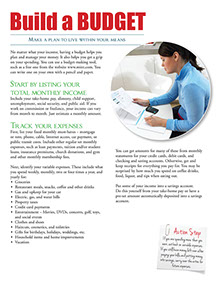
    No matter what your income, having a budget helps you plan and manage your money. It also helps you get a grip on your spending. You can use a budget-making tool, such as a free one from the websitewww.mint.com. You can write one on your own with a pencil and paper.

    Track your expenses:

    First, list your fixed monthly must-haves − mortgage or rent, phone, cable, Internet access, car payment, or public transit costs. Include other regular set monthly expenses, such as loan payments, tuition and/or student loans, insurance premiums, church donations, and gym and other monthly membership fees. Next, identify your variable expenses. These include what you spend weekly, monthly, two or four times a year, and yearly for:

    *  Groceries

    *  Restaurant meals, snacks, coffee and other drinks

    *  Gas and upkeep for your car

    *  Electric, gas, and water bills

    *  Property taxes

    *  Credit card payments

    *  Entertainment – Movies, DVDs, concerts, golf, toys, and social events

    *  Clothes and shoes

    *  Haircuts, cosmetics, and toiletries

    *  Gifts for birthdays, holidays, weddings, etc.

    *  Household items and home improvements

    *  Vacation

    You can get amounts for many of these from monthly statements for your credit cards, debit cards, and checking and saving accounts. Otherwise, get and keep receipts for everything you pay for. You may be surprised by how much you spend on coffee drinks, food, liquor, and tips when eating out.

    Put some of your income into a savings account. Do this yourself from your take-home pay or have a pre-set amount automatically deposited into a savings account.

    Start by listing your total monthly income:

    Include your take-home pay, alimony, child support, unemployment, social security, and public aid. If you work on commission or freelance, your income can vary from month to month. Just estimate a monthly amount.

    Action Step

    If you are spending more than you earn, cut back on variable expenses. If you still have money left over after paying your bills and putting money into savings, carry over the extra for future expenses.
    Ways to Well-Being book by the American Institute for Preventive Medicine. www.HealthyLife.com. All rights reserved.

    © American Institute for Preventive Medicine

  • Conquer Job Stress

    SUCCESS OVER STRESS

    Happy man with arms up while setting at work desk.

    Burnout: When stress goes too far

    When stress goes on for too long, a person may feel “burned out.” This usually means they become exhausted and unable to do their job well anymore. They may also become negative or feel angry toward others at work.

    Burnout can seriously affect your health. It can lead to depression and possibly other problems, like heart disease and stroke.

    Stop the cycle

    It’s not too late to manage your work stress. Even if you feel your stress is high, there are ways to make things better. Here’s how:

    *Take breaks – even short ones.Just 10 minutes of downtime during the day can make a big difference in your stress levels. Don’t work through lunch and break times.

    *Practice the art of waiting and walking away.If you feel angry or stressed about something, don’t respond right away. Say something like, “let me think about that and get back to you.” Avoid sending angry emails when you feel stressed.

    *Go easy on yourself.Are you expecting perfection from yourself? No one is perfect. Learn from mistakes and move on.

    *Discuss your concerns.If you’re having trouble with something at work, talk to your supervisor about solutions. Don’t keep it bottled inside and assume it will work itself out.

    Source: American Psychological Association

    © American Institute for Preventive Medicine

  • Save Now For Holiday Gift-Giving

    FINANCIAL HEALTH

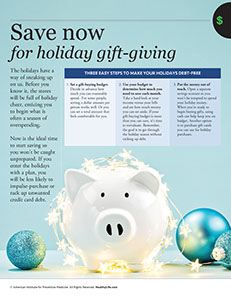
    Piggy bank with holiday lights and ornments.

    The holidays have a way of sneaking up on us. Before you know it, the stores will be full of holiday cheer, enticing you to begin what is often a season of overspending.

    Now is the ideal time to start saving so you won’t be caught unprepared. If you enter the holidays with a plan, you will be less likely to impulse-purchase or rack up unwanted credit card debt.

    Three easy steps to make your holidays debt-free

    1.Set a gift-buying budget.Decide in advance how much you can reasonably spend.  For some people, setting a dollar amount per person works well. Or you can set a total amount that feels comfortable for you.

    2.Use your budget to determine how much you need to save each month.Take a hard look at your income versus your bills and see how much money you can set aside. If your gift-buying budget is more than you can save, it’s time to reevaluate. Remember, the goal is to get through the holiday season without racking up debt.

    3.Put the money out of reach.Open a separate savings account so you won’t be tempted to spend your holiday money. When you’re ready to begin buying gifts, using cash can help keep you on budget. Another option is to purchase gift cards you can use for holiday purchases.

    © American Institute for Preventive Medicine

  • Deal With Debt

    Financial Health

    Get out of debt on your own or with help.

    Whether it’s from living above your means, expensive medical bills, a job loss, or supporting your parents, you can eliminate debt. The first step is to avoid getting deeper in debt. Limit spending to essentials and follow a plan to pay down the debt.

    On your own:

    *  Cut up credit cards or put them away until they are paid off.

    *  Rank order what needs to be paid off – student and other loans, credit cards, etc.

    *  Contact your creditors right away to work out payment plans that you can manage. Do this before debt collectors get involved. If you can’t work out a plan with your mortgage company, contact the local office of the Department of Housing and Urban Development or the housing authority in your state, city, or county for help in finding a legitimate housing counseling agency near you.

    *  Bring in more income from a part time job and selling household items you no longer need at a garage sale or online site, such as Ebay. Consider selling some of your gold and silver jewelry for cash.

    Get professional help from:

    *  A professional financial planner through work

    *  The Financial Planning Association (FPA) at 800.647.6340 orwww.fpanet.org

    *  The National Foundation for Credit Counseling at 800.388.2227 orwww.nfcc.org/FirstStep/firststep_03.cfm.

    Beware of any debt relief service that*:

    *  Charges any fees before it settles your debts

    *  Pressures you to make “voluntary contributions,” another name for fees

    *  Touts a “new government program” to bail out personal credit card debt

    *  Guarantees it can make your debt go away

    *  Tells you it can stop all debt collection calls and lawsuits

    *  Guarantees that your credit card and any other debt not tied to an asset, such as your house, can be paid off for just pennies on the dollar

    *  Offers to enroll you in a debt management program (DMP) without teaching you skills to budget and manage your money

    *  Adapted fromwww.ftc.gov/bcp/edu/pubs/consumer/credit/cre19.shtm

    Action Step

    Pay off the credit card or other debt with the lowest balance first. After this is paid in full, pay down the next debt with the lowest balance.

    Ways to Well-Being book by the American Institute for Preventive Medicine. www.HealthyLife.com. All rights reserved.

    © American Institute for Preventive Medicine
  • Dealing With Difficult Personalities

    WORK LIFE

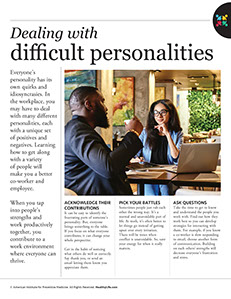
    Two coworkers sitting with laptop, talking and drinking coffee.

    Everyone’s personality has its own quirks and idiosyncrasies. In the workplace, you may have to deal with many different personalities, each with a unique set of positives and negatives. Learning how to get along with a variety of people will make you a better co-worker and employee.

    When you tap into people’s strengths and work productively together, you contribute to a work environment where everyone can thrive.

    Acknowledge their contributions

    It can be easy to identify the frustrating parts of someone’s personality. But, everyone brings something to the table. If you focus on what everyone contributes, it can change your whole perspective.

    Get in the habit of noticing what others do well or correctly. Say thank you, or send an email letting them know you appreciate them.

    Pick your battles

    Sometimes people just rub each other the wrong way. It’s a normal and unavoidable part of life. At work, it’s often better to let things go instead of getting upset over every irritation. There will be times when conflict is unavoidable. So, save your energy for when it really matters.

    Ask questions

    Take the time to get to know and understand the people you work with. Find out how they work best so you can develop strategies for interacting with them. For example, if you know a co-worker is slow responding to email, choose another form of communication. Building on each others’ strengths will decrease everyone’s frustration and stress.

    © American Institute for Preventive Medicine
  • Should You Join A Mlm?

    FINANCIAL HEALTH

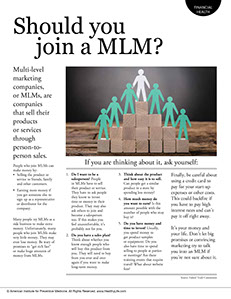
    Tier made of blocks with paper cut out of people.

    Multi-level marketing companies, or MLMs, are companies that sell their products or services through person-to-person sales.

    People who join MLMs can make money by:

    *  Selling the product or service to friends, family and other customers.

    *  Earning more money if you get someone else to sign up as a representative or distributor for the company.

    Many people try MLMs as a side business to make extra money. Unfortunately, many people who join MLMs make very little money. They may even lose money. Be wary of promises to “get rich fast” or make huge amounts of money from MLMs.

    If you are thinking about it, ask yourself:

    1.  Do I want to be a salesperson? People in MLMs have to sell their product or service. They have to ask people they know to invest time or money in their product. They may also ask others to join and become a salesperson too. If this makes you feel uncomfortable, it’s probably not for you.

    2.  Do you have a sales plan? Think about whether you know enough people who will buy this product from you. They will need to buy from you over and over again if you want to make long-term money.

    3.  Think about the product and how easy it is to sell. Can people get a similar product in a store by spending less money?

    4.  How much money do you want to earn? Is this amount possible with the number of people who may buy it?

    5.  Do you have money and time to invest? Usually, you spend money to get product samples or equipment. Do you also have time to spend selling to people at parties or meetings? Are there training events that require travel? What about website fees?

    Finally, be careful about using a credit card to pay for your start-up expenses or other costs. This could backfire if you have to pay high interest rates and can’t pay it off right away.

    It’s your money and your life. Don’t let big promises or convincing marketing try to talk you into an MLM if you’re not sure about it.

    Source: Federal Trade Commission

    © American Institute for Preventive Medicine

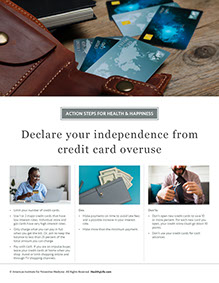
  • Declare Your Independence From Credit Card Overuse

    Financial Health

    Credit cards fanned out on table.

    *  Limit your number of credit cards.

    *  Use 1 or 2 major credit cards that have low interest rates. Individual store and gas cards have very high interest rates.

    *  Only charge what you can pay in full when you get the bill. Or, aim to keep the balance to less than 25 percent of the total amount you can charge.

    *  Pay with cash. If you are an impulse buyer, leave your credit cards at home when you shop. Avoid or limit shopping online and through TV shopping channels.

    Dos

    *  Make payments on time to avoid late fees and a possible increase in your interest rate.

    *  Make more than the minimum payment.

    Don’ts

    *  Don’t open new credit cards to save 10 or more percent. For each new card you open, your credit score could go down 10 points.

    *  Don’t use your credit cards for cash advances.

    ays to Well-Being book by the American Institute for Preventive Medicine. www.HealthyLife.com. All rights reserved.

    © American Institute for Preventive Medicine
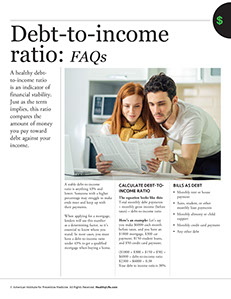
  • Debt-To-Income Ratio: Faqs

    FINANCIAL HEALTH

    Young couple looking over bills together.

    A healthy debt-to-income ratio is an indicator of financial stability. Just as the term implies, this ratio compares the amount of money you pay toward debt against your income.

    A stable debt-to-income ratio is anything 43% and lower. Someone with a higher percentage may struggle to make ends meet and keep up with their payments.

    When applying for a mortgage, lenders will use this number as a determining factor, so it’s essential to know where you stand. In most cases, you must have a debt-to-income ratio under 43% to get a qualified mortgage when buying a home.

    Calculate debt-to-income ratio

    The equation looks like this: Total monthly debt payments ÷ monthly gross income (before taxes) = debt-to-income ratio

    Here’s an example: Let’s say you make $6000 each month before taxes, and you have an $1800 mortgage, $300 car payment, $150 student loans, and $50 credit card payment.

    ($1800 + $300 + $150 + $50) ÷ $6000 = debt-to-income ratio

    $2300 ÷ $6000 = 0.38

    Your debt to income ratio is 38%.

    Bills as debt

    *  Monthly rent or house payment

    *  Auto, student, or other monthly loan payments

    *  Monthly alimony or child support

    *  Monthly credit card payment

    *  Any other debt

    © American Institute for Preventive Medicine

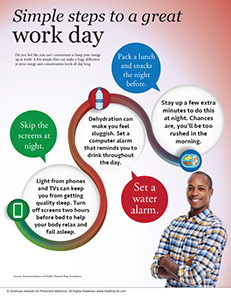
  • Simple Steps To A Great Work Day

    WORK LIFE

    Smiling man with arms crossed.

    Do you feel like you can’t concentrate or keep your energy up at work? A few simple fixes can make a huge difference in your energy and concentration levels all day long.

    Pack a lunch and snacks the night before.Stay up a few extra minutes to do this at night. Chances are, you’ll be too rushed in the morning.

    Set a water alarm.Dehydration can make you feel sluggish. Set a computer alarm that reminds you to drink throughout the day.

    Skip the screens at night.Light from phones and TVs can keep you from getting quality sleep. Turn off screens two hours before bed to help your body relax and fall asleep.

    Sources: National Institutes of Health, National Sleep Foundation

    © American Institute for Preventive Medicine
  • Financial Wellness

    Financial Health

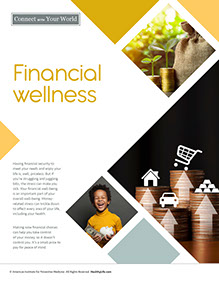
    Stacked coins with illustration arrows pointing up with icons of a house, card, credit card, etc...

    Having financial security to meet your needs and enjoy your life is, well, priceless. But if you’re struggling and juggling bills, the stress can make you sick. Your financial well-being is an important part of your overall well-being. Money-related stress can trickle down to affect every area of your life, including your health.

    Making wise financial choices can help you take control of your money, so it doesn’t control you. It’s a small price to pay for peace of mind.

    ays to Well-Being book by the American Institute for Preventive Medicine. www.HealthyLife.com. All rights reserved.

    © American Institute for Preventive Medicine