Tag: Financial Wellness

  • Ergonomics For The Home Office

    WORK LIFE

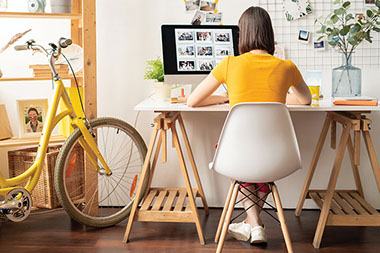
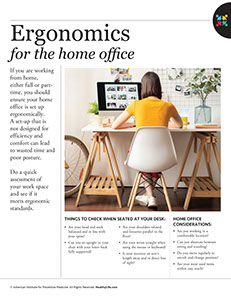
    Women sitting at desk working on computer.

    If you are working from home, either full or part-time, you should ensure your home office is set up ergonomically. A set-up that is not designed for efficiency and comfort can lead to wasted time and poor posture.

    Do a quick assessment of your work space and see if it meets ergonomic standards.

    Things to check when seated at your desk:

    *  Are your head and neck balanced and in line with your spine?

    *  Can you sit upright in your chair with your lower back fully supported?

    *  Are your shoulders relaxed and forearms parallel to the floor?

    *  Are your wrists straight when using the mouse or keyboard?

    *  Is your monitor an arm’s length away and in direct line of sight?

    Home office considerations:

    *  Are you working in a comfortable location?

    *  Can you alternate between sitting and standing?

    *  Do you move regularly to stretch and change position?

    *  Are your most used items within easy reach?

    © American Institute for Preventive Medicine

  • Slouching Harms Your Health

    WORK LIFE

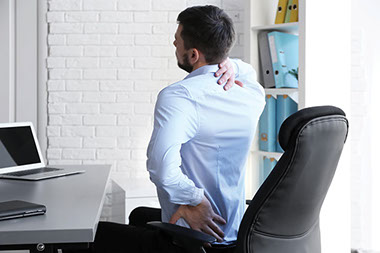
    Man sitting on chair at desk stretching his back.

    Many people sit at a desk for hours each day. And the way you sit can affect your health.

    Muscles & bones

    Your musculoskeletal system includes your bones, joints and muscles. These parts of the body work together to provide support and stability. They allow you to move around.

    The musculoskeletal system has to change and adapt to your life. The type of shoes you wear, how you walk and even how you use devices can affect your musculoskeletal system.

    The way you sit at your desk affects this system too. Slouching can cause wear and tear on the spine. This makes it more likely that you will hurt your back. It can also lead to neck or shoulder pain.

    Having bad posture at your desk can lower your flexibility. It can make it harder for your joints to move, too.

    Un-learning bad posture

    Many people slouch without thinking about it. It becomes a habit. But there are ways to fix it and prevent more injury to your back.

    Researchers think that yoga could have positive benefits for posture and health. Some evidence suggests that it could help with hyperkyphosis in older people. Hyperkyphosis is a condition that causes the spine to curve forward, giving a “hunched” appearance.

    To be safe, people should talk with their doctor before doing yoga or any exercise program.

    Other ways to improve posture include:

    *  Be aware of your posture. Set alarms or reminders that tell you to sit up straight.

    *  Think about your posture when you stand and walk. This can carry over to better sitting posture.

    *  Make sure your keyboard and computer are working for you. You shouldn’t be slouching to reach the keyboard or see the screen.

    *  Change positions often. Don’t sit all day with one leg crossed or your feet tucked under your chair.

    *  Get up for breaks. Don’t spend breaks at your desk. Take a walk or gently stretch. Don’t eat at your desk.

    *  Work toward a healthy weight. Extra weight around the belly can weaken abdominal muscles. This can lead to back pain.

    Talk to your doctor if you have back, shoulder or neck pain. Ask them about the best exercise options for you or a possible referral to physical therapy. Exercise can help you support your body and boost your overall health, whether you’re sitting or not.

    Source: National Institutes of Health
    © American Institute for Preventive Medicine

  • Make Thrifty Count

    Financial Health

    Money sign standing on top of coins.

    Building personal wealth starts with making wise financial decisions. Be strategic about where you save money, so it is sustainable. Make it fun and economical, such as cooking a gourmet meal at home with your family and then turning off the lights to have a “candlelit” dinner. Or, get an annual state or national park pass and plan outdoor weekend adventures with your family, saving money while also making memories!

    Be More Earth-Friendly

    Many products we use regularly consume more energy than is needed. Choose energy-efficient products, such as ENERGY STAR certified LED light bulbs, which use up to 90% less energy than standard bulbs and last 15 times longer.

    ays to Well-Being book by the American Institute for Preventive Medicine. www.HealthyLife.com. All rights reserved.

    © American Institute for Preventive Medicine

  • Filing For A Tax Extension

    FINANCIAL HEALTH

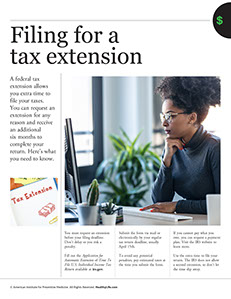
    Women on computer.

    A federal tax extension allows you extra time to file your taxes. You can request an extension for any reason and receive an additional six months to complete your return. Here’s what you need to know.

    *  You must request an extension before your filing deadline. Don’t delay or you risk a penalty.

    *  Submit the form via mail or electronically by your regular tax return deadline, usually April 15th.

    *  To avoid any potential penalties, pay estimated taxes at the time you submit the form.

    *  If you cannot pay what you owe, you can request a payment plan. Visit the IRS website to learn more.

    *  Use the extra time to file your return. The IRS does not allow a second extension, so don’t let the time slip away.

    *  Fill out the Application for Automatic Extension of Time To File U.S. Individual Income Tax Return available atirs.gov.

    © American Institute for Preventive Medicine

  • Stay Healthy At Work

    WORK LIFE

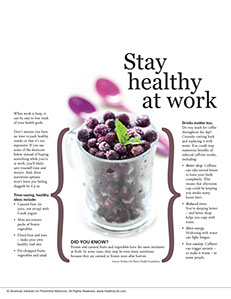
    Image of frozen berries in a glass.

    When work is busy, it can be easy to lose track of your health goals.

    Don’t assume you have no time to pack healthy snacks or that it’s too expensive. If you use some of the shortcuts below instead of buying something while you’re at work, you’ll likely save yourself time and money. And, these nutritious options won’t leave you feeling sluggish by 4 p.m.

    Time-saving, healthy ideas include:

    *  Canned fruit (in juice, not syrup) with Greek yogurt

    *  Mini microwave packs of frozen vegetables

    *  Dried fruit and nuts – make your own healthy trail mix

    *  Pre-chopped fruits, vegetables and salad

    Did you know?

    Frozen and canned fruits and vegetables have the same nutrients as fresh. In some cases, they may be even more nutritious because they are canned or frozen soon after harvest.

    Source: Produce for Better Health Foundation

    Drinks matter too.

    Do you reach for coffee throughout the day? Consider cutting back and replacing it with water. You could reap numerous benefits of reduced caffeine intake, including:

    *  Better sleep. Caffeine can take several hours to leave your body completely. This means that afternoon cup could be keeping you awake many hours later.

    *  Reduced stress. You’re sleeping better – and better sleep helps you cope with stress.

    *  More energy. Hydrating with water can fight fatigue.

    *  Less anxiety. Caffeine can trigger anxiety – or make it worse – in some people.

    © American Institute for Preventive Medicine

  • Manage Job Stress

    Work Life

    Job stress causes a worker to feel overly taxed both mentally and physically. It affects both workers and employers.

    What Causes Job Stress?

    *  Too much work to do. Conflicting expectations.

    *  Lack of support from co-workers and bosses.

    *  Crowded, noisy, unsafe work conditions. Infrequent rest breaks.

    *  Rapid changes for which workers are not prepared. Job insecurity.

    If not dealt with, job stress can lead to health problems.

    Signs & Symptoms of Job Stress

    *  Hard time concentrating. Headache.

    *  Sleep problems. Stomach problems.

    *  Short temper.

    *  Job dissatisfaction. Low morale.

    *  Increase in being late for work or not going to work.

    Ways to Manage Job Stress

    *  Schedule your time and tasks to be done. Use a calendar, planner, “TO DO” lists, etc. Rank order tasks. Break tasks down into steps. Check off items that are done.

    *  Organize your work space to make it easier to find things. Get rid of items and e-mails that you don’t need.

    *  Ask for help from your boss and co-workers, as needed. Ask your boss for the order in which your job tasks need to be done.

    *  Take breaks. Get enough sleep.

    *  Leave work at work. Try not to take work home. If this is not possible, take as little work home as you need to.

    *  Plan for and take vacations that give you a rest from work.

    *  Relax as much as you can.

    Resources

    National Institute for Occupational Safety and Health (NIOSH)

    800.CDC.INFO (232.4636)

    www.cdc.gov/niosh

    Occupational Safety and Health Administration (OSHA)

    800.321.OSHA (321.6742)

    www.osha.gov

    Healthier at Home book by the American Institute for Preventive Medicine. www.HealthyLife.com. All rights reserved.

    © American Institute for Preventive Medicine

  • Get Up & Move After Work

    WORK LIFE

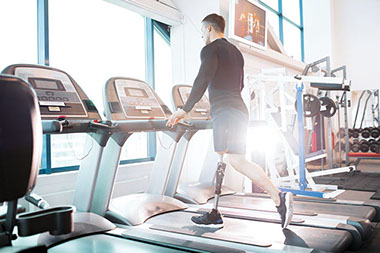
    Man with amputee leg using the treadmill.

    If you’re like many people, you may already be sitting for several hours each day at work. And this could be harming your health. Sitting for long periods is linked to health problems and even a shorter life.

    We can’t always control how much we sit at work. But we can take steps toward better health outside of those hours. Here’s what you can do to get moving in your time away from your job.

    Your prime time

    Been sitting at a desk all day? After work can be a great time to get in some activity. Some people enjoy an exercise class or going to the gym before dinner.

    But if you can’t manage one of these things, don’t give up. Even a short walk is helpful. Go after dinner if you don’t have time before then. Some exercise is always better than not doing any exercise.

    Try using your usual TV or screen time each night to go for a walk or work out to an exercise video.

    Don’t forget lunch

    Want to squeeze in more activity? You can also use your lunch break to break up your sitting time. Try taking a walk throughout your building or head outside.

    You don’t have to do all your exercise at once. Breaking up your exercise into 10-minute chunks offers health benefits. Even 10 minutes a day of activity can add two years to your life expectancy. Thirty minutes of activity a day adds four years or more.

    Try the same thing with any work break. Even a 15-minute break is long enough to get your body moving.

    What if I’m just too tired?

    If you find that you are tired every night after work, it may be time to look at your sleep habits. Are you getting seven to eight hours? If not, try to find ways to make sleep a priority.

    If you’re getting enough sleep but still feel tired, talk with your doctor. Sleep disorders and certain health issues can cause fatigue. Getting your energy back is an important step toward becoming more physically active.

    Source: National Institutes of Health
    © American Institute for Preventive Medicine

  • Stay Healthy With Shift Work

    WORK LIFE

    Doctor on phone working the night shift.

    For many people, shift work is a great way to get in hours around family commitments. For some people, shift work is simply part of their profession. Nurses, doctors, first responders and many others work shifts because it’s necessary.

    When you don’t work a 9 to 5 shift, it can be harder to find time to eat well and exercise. In the middle of the night, most restaurants and stores are closed. You may also feel tired and less motivated to exercise and eat well. But there are some ways to get around these obstacles.

    Try these healthy tips if you work a shift schedule:

    1.  Stock up on healthy food. When you’re tired, it’s easy to simply reach for convenience foods. Instead, keep your favorite fresh foods on hand at home or work and make them convenient. Washed and cut fruits and vegetables are a great snack anytime. You may also try nuts or seeds, oatmeal and hummus.

    2.  Make meals before your shift. Many times, the only choice during shift work is a vending machine. Try cooking large meals in a crock pot and freezing individual portions.

    3.  Avoid large portions. Many people feel tired and sluggish after a large meal. Pack portions that will fill you up without making you feel stuffed. Between meals, choose pre-packed, healthy snacks.

    4.  Take a break to eat. Sit down at a table, if possible. Enjoy your food and eat slowly. This can help you avoid overeating or mindless snacking.

    5.  Watch the caffeine.  Many people need at least six hours or more to process caffeine so they can sleep. If you’re feeling sluggish, try drinking plenty of water instead of coffee or tea.

    6.  Move your body when you can. Walk up and down stairs or hallways on breaks. Try stretching at your desk. You can even do some jumping jacks if you don’t have time for anything else. Any kind of physical activity can give you more energy and lift your mood.

    7.  Remember that sleep is important. Even if you don’t have a typical work schedule, you can still make sleep a priority. Aim for seven to nine hours per 24-hour period. If you can’t get that much at once, see if you can still get that much by using naps.

    Source: National Sleep Foundation

    © American Institute for Preventive Medicine

  • Mend Your Spending

    Financial Health

    Use your money wisely.

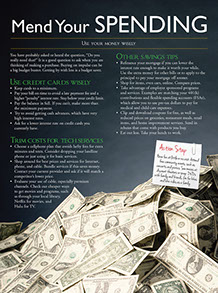
    You have probably asked or heard the question, “Do you really need that?” It is a good question to ask when you are thinking of making a purchase. Buying on impulse can be a big budget buster. Getting by with less is a budget saver.

    Use credit cards wisely:

    *  Keep cards to a minimum.

    *  Pay your bill on time to avoid a late payment fee and a higher “penalty” interest rate. Stay below your credit limit.

    *  Pay the balance in full. If you can’t, make more than the minimum payment.

    *  Try to avoid getting cash advances, which have very high interest rates.

    *  Ask for a lower interest rate on credit cards you currently have.

    Trim costs for tech services:

    *  Choose a cellphone plan that avoids hefty fees for extra minutes and texts. Consider dropping your landline phone or just using it for basic services.

    *  Shop around for best prices and services for Internet, phone, and cable. Bundle services if this saves money. Contact your current provider and ask if it will match a competitor’s lower price.

    *  Evaluate your use of cable, especially premium channels. Check out cheaper ways to get movies and programs, such as through your local library, Netflix for movies, and Hulu for TV.

    Other savings tips:

    *  Refinance your mortgage if you can lower the interest rate enough to make it worth your while. Use the extra money for other bills or to apply to the principal to pay your mortgage off sooner.

    *  Shop for items, even cars, online. Compare prices.

    *  Take advantage of employer sponsored programs and services. Examples are matching your 401(k) contributions and flexible spending accounts (FSAs), which allow you to use pre-tax dollars to pay for medical and child care expenses.

    *  Clip and download coupons for free, as well as reduced prices on groceries, restaurant meals, retail items, and home improvement services. Send in rebates that come with products you buy.

    *  Eat out less. Take your lunch to work.

    Action Step

    Have fun at little or no cost. Attend free community events, such as concerts and picnics. See movies at discount theaters or swap DVDs with family and friends. Go for hikes and bike rides as a family.

    Ways to Well-Being book by the American Institute for Preventive Medicine. www.HealthyLife.com. All rights reserved.

    © American Institute for Preventive Medicine

  • Host Productive Meetings

    WORK LIFE

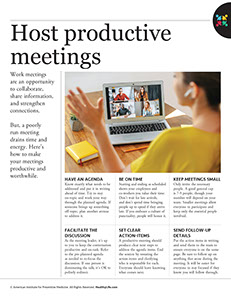
    Video conferencing.

    Work meetings are an opportunity to collaborate, share information, and strengthen connections. But, a poorly run meeting drains time and energy. Here’s how to make your meetings productive and worthwhile.

    Have an agenda

    Know exactly what needs to be addressed and put it in writing ahead of time. Try to stay on-topic and work your way through the planned agenda. If someone brings up something off-topic, plan another avenue to address it.

    Be on time

    Starting and ending as scheduled shows your employees and co-workers you value their time. Don’t wait for late arrivals, and don’t spend time bringing people up to speed if they arrive late. If you embrace a culture of punctuality, people will honor it.

    Keep meetings small

    Only invite the necessary people. A good general cap is 7-9 people, though your number will depend on your team. Smaller meetings allow everyone to participate and keep only the essential people involved.

    Facilitate the discussion

    As the meeting leader, it’s up to you to keep the conversation productive and on-task. Refer to the pre-planned agenda as needed to re-focus the discussion. If one person is dominating the talk, it’s OK to politely redirect.

    Set clear action-items

    A productive meeting should produce clear next steps to address the agenda items. End the session by restating the action items and clarifying who is responsible for each. Everyone should leave knowing what comes next.

    Send follow-up details

    Put the action items in writing and send them to the team to ensure everyone is on the same page. Be sure to follow up on anything that arose during the meeting. It will be easier for everyone to stay focused if they know you will follow through.

    © American Institute for Preventive Medicine