Tag: Healthcare

  • How To Avoid Hospital Germs

    Medical Care

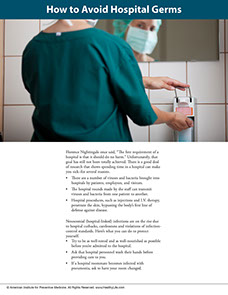
    Image of nurse using antibacterial dispenser.

    Florence Nightingale once said, “The first requirement of a hospital is that it should do no harm.”

    Unfortunately, that goal has still not been totally achieved. There is a good deal of research that shows spending time in a hospital can make you sick-for several reasons.

    *  There are a number of viruses and bacteria brought into hospitals by patients, employees, and visitors.

    *  The hospital rounds made by the staff can transmit viruses and bacteria from one patient to another.

    *  Hospital procedures, such as injections and I.V. therapy, penetrate the skin, bypassing the body’s first line of defense against disease.

    Nosocomial (hospital-linked) infections are on the rise due to hospital cutbacks, carelessness and violations of infection-control standards. Here’s what you can do to protect yourself.

    *  Try to be as well-rested and as well-nourished as possible before you’re admitted to the hospital.

    *  Ask that hospital personnel wash their hands before providing care to you.

    *  If a hospital roommate becomes infected with pneumonia, ask to have your room changed.
    Page from A Year of Health Hints book by the American Institute for Preventive Medicine. www.HealthyLife.com. All rights reserved.

    © American Institute for Preventive Medicine

  • The Ins And Outs Of Ambulatory Surgery

    Medical Care

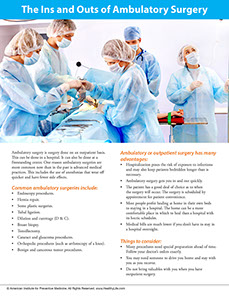
    Ambulatory surgery is surgery done on an outpatient basis. This can be done in a hospital. It can also be done at a freestanding center. One reason ambulatory surgeries are more common now than in the past is advanced medical practices. This includes the use of anesthesias that wear off quicker and have fewer side effects. Common ambulatory surgeries include:

    *  Endoscopy procedures.

    *  Hernia repair.

    *  Some plastic surgeries.

    *  Tubal ligation.

    *  Dilation and curettage (D & C).

    *  Breast biopsy.

    *  Tonsillectomy.

    *  Cataract and glaucoma procedures.

    *  Orthopedic procedures (such as arthroscopy of a knee).

    *  Benign and cancerous tumor procedures.

    Ambulatory or outpatient surgery has many advantages:

    *  Hospitalization poses the risk of exposure to infections and may also keep patients bedridden longer than is necessary.

    *  Ambulatory surgery gets you in and out quickly.

    *  The patient has a good deal of choice as to when the surgery will occur. The surgery is scheduled by appointment for patient convenience.

    *  Most people prefer healing at home in their own beds to staying in a hospital. The home can be a more comfortable place in which to heal than a hospital with its hectic schedules.

    *  Medical bills are much lower if you don’t have to stay in a hospital overnight.

    Things to consider:

    *  Many procedures need special preparation ahead of time. Follow your doctor’s orders exactly.

    *  You may need someone to drive you home and stay with you as you recover.

    *  Do not bring valuables with you when you have outpatient surgery.

    Page from A Year of Health Hints book by the American Institute for Preventive Medicine. www.HealthyLife.com. All rights reserved.

    © American Institute for Preventive Medicine
  • Planning For Health Care Coverage

    Medical Care

    Image of couple talking to a health care agent.

    Medical costs are expensive. Whether you are in your 50s, 60s, 70s, or older, now is the time to review how you cover them. Now is the time, too, to plan for how they will be paid for in the future. Without health insurance, some persons could lose all their assets if they had to pay for medical expenses.

    Like life insurance, health insurance can be hard to understand. Don’t let it baffle you, though. Find out what you need to know to protect yourself and your assets. Don’t find out you have too little coverage when it’s too late. Use the “Health Insurance Checklist” to keep track of your health care coverage.

    If you are a Veteran, find out about Veterans health care from

    Page from the Health at Home Lifetime book by the American Institute for Preventive Medicine. www.HealthyLife.com. All rights reserved.

    © American Institute for Preventive Medicine
  • Save On Medications

    Medical Care

    Image of mother and daughter at the pharmacy.

    Ask for freebies.

    If you are prescribed a new medicine, ask your doctor if you can have free samples or a prescription for fewer tablets. This allows you to try the medicine before you pay for a full month’s supply.

    No frills pills.

    Instead of brand name drugs, ask for generic ones. These usually cost less. Co-pays for generics cost less, too. Even if your doctor gives you free samples to try, ask if a generic form of the medicine can be prescribed. If the sample medicine does not have a generic form, ask if you can get another generic medicine that has the same effects. Find out more about generic drugs from 888.INFO.FDA (463.6332) orwww.fda.gov/cder/ogd.

    Split the pill, split the cost?

    When your doctor prescribes medicines, ask if it would save money to prescribe pills that could be split in half. This means you would get two months of medicine for the cost of one. Use a pill splitter from a drug store to help keep the halves an equal size. Split one pill at a time so you take the halves in back-to-back doses.

    Mail order your medicine.

    Use a mail order pharmacy for prescribed medicines you take on a regular basis. You usually get a 3-month supply for the same cost you would pay for one month at a drug store. Your doctor needs to write a prescription for 3 months.

    Shop around.

    Medicine prices can vary a lot. Call large chains first. They can pass along the savings of buying in bulk. Even so, your local pharmacy may have a lower price on some drugs. Make sure the pharmacy takes your insurance. Some pharmacies offer 24-hour emergency and delivery services. Some keep track of all the drugs you buy. They can check for harmful mixtures of drugs. Think about helpful service and convenience, as well as cost.

    Deal or no deal.

    Costs for medicines from foreign Internet sites may or may not be cheaper. A study by the FDA showed that generic drugs sold in the U.S. are often cheaper than both Canadian brand-name and generic drugs. Factor in shipping and handling costs, too. {Note: Get safety information on imported drugs fromwww.fda.gov/importeddrugs. Before you buy prescriptions on the Internet, make sure the pharmacy has the VIPPS seal. This stands for Verified Internet Pharmacy Practice Sites. Also, check with the National Association of Boards of Pharmacy atwww.nabp.netor call 847.391.4406 to find out if a Web site is a licensed pharmacy in good standing.}

    Medicare Part D may be free.

    If you are eligible for Medicare, you may benefit from Medicare Part D Prescription Drug Savings Program. To find out, contact: Medicare Choices Helpline at 800.MEDICARE (633.4227) orwww.medicare.gov. Before you call, have a list of all the medicines you take, their dosages, and your zip code.

    Take all of it.

    If your doctor or pharmacist says to take a drug until it is gone, do it. Don’t stop taking the medicine even if you start to feel better. This also applies to medicines you take for high blood pressure, diabetes, and heart disease. You can also avoid the cost of getting sick again. If you stop taking medicines because you can’t pay for them, talk to your doctor.

    Store OTC medicines in a good place.

    The bathroom medicine chest is not a good place. Bathroom heat and humidity can make drugs lose their power faster. This means they would have to be replaced sooner. A kitchen cupboard or linen closet is better, especially if it has a lock.

    The best medicine may be no medicine.

    Don’t pressure your doctor to prescribe medicine if he or she doesn’t think you need it. For example, antibiotics treat bacterial infections, not viral ones, such as colds and flu.

    Find out about prescription savings programs.

    *  The Partnership for Prescription Assistance at 888.4PPANOW (477.2669) orwww.pparx.org. This program offers a single point of access to more than 475 public and private patient assistance programs. This includes over 150 drug company programs.

    *  NeedyMeds at 215.625.9609 orwww.needymeds.com. This Web site gives information to help you find programs to help you with the cost of medicines and other health care expenses.

    *  PAP Advocates for Patient Assistance Programs at 870.873.4629 orwww.prescriptionmedicationhelp.com. This helps you enroll in programs to be able to get prescribed medicines for free.

    *  RxAssist at 401.729.3284 orwww.rxassist.org. With this, pharmaceutical companies provide free medicines to people who cannot afford to buy their medicine.

    *  Together Rx Access atwww.togetherrxaccess.com. This is a prescription savings program for people with no prescription coverage. Persons enrolled get a Together Rx Access Card to present at drug stores to save money on certain prescriptions.

    *  FRxEE Medicine™ Foundation.com atwww.freemedicinefoundation.com.

    *  NORDs Medication Assistance Program atwww.rarediseases.org/programs/medication.

    Save money on store brands.

    When you do buy OTC medicines, buy store brands instead of name brands. Like prescribed generic medicines, these have the same active ingredients, but cost less.

    Keep it simple.

    When you buy over-the-counter medicines, don’t buy combination ones, such as cold pills that have a decongestant and an antihistamine. There will be times when you need only one of these ingredients.

    Read OTC labels.

    Don’t waste your money on over-the-counter (OTC) medicines that you don’t need. Read the label to make sure it’s the right product to treat your symptoms. If you have questions about how useful a product is, ask the pharmacist and/or your doctor.

    Simplify your home Rxs.

    Keep some OTC medicines handy for common problems like fever or heartburn. Only buy OTC medicines you use often because they lose their effects over time. Most are good for three years or less. (Check the labels for the expiration dates.)

    Cover image to the Healthy Savings book by the American Institute for Preventive Medicine. www.HealthyLife.com. All rights reserved.

    © American Institute for Preventive Medicine

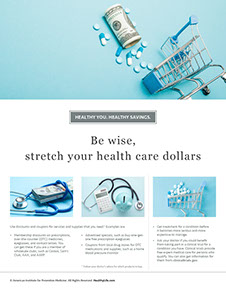
  • Be Wise, Stretch Your Health Care Dollars

    Medical Care

    Small shopping cart with pills and money.

    Use discounts and coupons for services and supplies that you need.* Examples are:

    *  Membership discounts on prescriptions, over-the-counter (OTC) medicines, eyeglasses, and contact lenses. You can get these if you are a member of wholesale clubs, such as Costco, Sam’s Club, AAA, and AARP.

    *  Advertised specials, such as buy-one-get-one free prescription eyeglasses

    *  Coupons from local drug stores for OTC medications and supplies, such as a home blood pressure monitor

    *  Get treatment for a condition before it becomes more serious and more expensive to manage.

    *  Ask your doctor if you could benefit from taking part in a clinical trial for a condition you have. Clinical trials provide free expert medical care for persons who qualify. You can also get information for them fromclinicaltrials.gov.

    *  Follow your doctor’s advice for which products to buy.

    A Year of Health Hints book by the American Institute for Preventive Medicine. www.HealthyLife.com. All rights reserved.

    © American Institute for Preventive Medicine
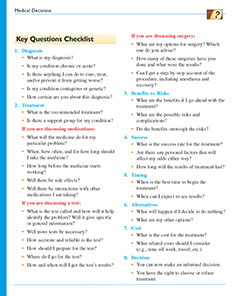
  • Key Questions Checklist

    Medical Care

    Diagnosis

    *  What is my diagnosis?

    *  Is my condition chronic or acute?

    *  Is there anything I can do to cure, treat, and/or prevent it from getting worse?

    *  Is my condition contagious or genetic?

    *  How certain are you about this diagnosis?

    Treatment

    *  What is the recommended treatment?

    *  Is there a support group for my condition?

    If you are discussing medications:

    *  What will the medicine do for my particular problem?

    *  When, how often, and for how long should I take the medicine?

    *  How long before the medicine starts working?

    *  Will there be side effects?

    *  Will there be interactions with other medications I am taking?

    If you are discussing a test:

    *  What is the test called and how will it help identify the problem? Will it give specific or general information?

    *  Will more tests be necessary?

    *  How accurate and reliable is the test?

    *  How should I prepare for the test?

    *  Where do I go for the test?

    *  How and when will I get the test’s results?

    If you are discussing surgery:

    *  What are my options for surgery? Which one do you advise?

    *  How many of these surgeries have you done and what were the results?

    *  Can I get a step-by-step account of the procedure, including anesthesia and recovery?

    Benefits vs. Risks

    *  What are the benefits if I go ahead with the treatment?

    *  What are the possible risks and complications?

    *  Do the benefits outweigh the risks?

    Success

    *  What is the success rate for the treatment?

    *  Are there any personal factors that will affect my odds either way?

    *  How long will the results of treatment last?

    Timing

    *  When is the best time to begin the treatment?

    *  When can I expect to see results?

    Alternatives

    *  What will happen if I decide to do nothing?

    *  What are my other options?

    Cost

    *  What is the cost for the treatment?

    *  What related costs should I consider (e.g., time off work, travel, etc.).

    Decision

    *  You can now make an informed decision.

    *  You have the right to choose or refuse treatment.

    Page from the Healthier at Home book by the American Institute for Preventive Medicine. www.HealthyLife.com. All rights reserved.

    © American Institute for Preventive Medicine

  • Rate Your Doctor

    Medical Care

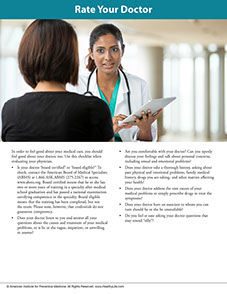
    In order to feel good about your medical care, you should feel good about your doctor, too. Use this checklist when evaluating your physician.

    *  Is your doctor ‘board certified” or ‘board eligible?” To check, contact the American Board of Medical Specialists (ABMS) at 1.866.ASK.ABMS (275.2267) or accesswww.abms.org. Board certified means that he or she has two or more years of training in a specialty after medical school graduation and has passed a national examination certifying competence in the specialty. Board eligible means that the training has been completed, but not the exam. Please note, however, that credentials do not guarantee competency.

    *  Does your doctor listen to you and answer all your questions about the causes and treatment of your medical problems, or is he or she vague, impatient, or unwilling to answer?

    *  Are you comfortable with your doctor? Can you openly discuss your feelings and talk about personal concerns, including sexual and emotional problems?

    *  Does your doctor take a thorough history, asking about past physical and emotional problems, family medical history, drugs you are taking, and other matters affecting your health?

    *  Does your doctor address the root causes of your medical problems or simply prescribe drugs to treat the symptoms?

    *  Does your doctor have an associate to whom you can turn should he or she be unavailable?

    *  Do you feel at ease asking your doctor questions that may sound

    Page from A Year of Health Hints book by the American Institute for Preventive Medicine. www.HealthyLife.com. All rights reserved.

    © American Institute for Preventive Medicine
  • The Healing Touch

    Alternative Medicine

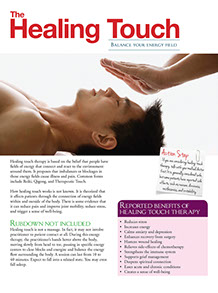
    Image of person having healing touch therapy.

    Balance your energy field

    Healing touch therapy is based on the belief that people have fields of energy that connect and react to the environment around them. It proposes that imbalances or blockages in those energy fields cause illness and pain. Common forms include Reiki, Qigong, and Therapeutic Touch.

    How healing touch works is not known. It is theorized that it affects patients through the connection of energy fields within and outside of the body. There is some evidence that it can reduce pain and improve joint mobility, reduce stress, and trigger a sense of well-being.

    Rubdown not included

    Healing touch is not a massage. In fact, it may not involve practitioner to patient contact at all. During this energy therapy, the practitioner’s hands hover above the body, moving slowly from head to toe, pausing in specific energy centers to clear blocks and energize and balance the energy flow surrounding the body. A session can last from 10 to 40 minutes. Expect to fall into a relaxed state. You may even fall asleep.

    Reported benefits of healing touch therapy

    *  Reduces stress

    *  Increases energy

    *  Calms anxiety and depression

    *  Enhances recovery from surgery

    * Hastens wound healing

    *  Relieves side-effects of chemotherapy

    *  Strengthens the immune system

    *  Supports grief management

    *  Deepens spiritual connection

    *  Eases acute and chronic conditions

    *  Creates a sense of well-being

    Action Step

    If you are considering healing touch therapy, talk with your medical doctor first. It is generally considered safe, but some patients have reported side effects, such as nausea, dizziness, restlessness, and irritability.

    Page from Ways to Well-Being book by the American Institute for Preventive Medicine. www.HealthyLife.com. All rights reserved.

    © American Institute for Preventive Medicine
  • Choose Benefit Options With Both Cost And Care In Mind

    Medical Care

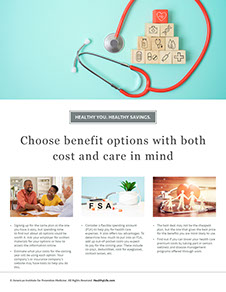
    Wooden blocks with medical icons.

    *  Signing up for the same plan as the one you have is easy, but spending time to find out about all options could be worth it. Ask your employer for written materials for your options or how to access the information online.

    *  Estimate what your costs for the coming year will be using each option. Your company’s or insurance company’s website may have tools to help you do this.

    *  Consider a flexible spending account (FSA) to help pay for health care expenses. It also offers tax advantages. To determine how much to put into an FSA, add up out-of-pocket costs you expect to pay for the coming year. These include co-pays, deductibles, cost for eyeglasses, contact lenses, etc.

    *  The best deal may not be the cheapest plan, but the one that gives the best price for the benefits you are most likely to use.

    *  Find out if you can lower your health care premium costs by taking part in certain wellness and disease management programs offered through work.

    A Year of Health Hints book by the American Institute for Preventive Medicine. www.HealthyLife.com. All rights reserved.

    © American Institute for Preventive Medicine

  • Long-Term Care Insurance

    Medical Care

    Image of couple talking to an insurance agent.

    Long-term care insurance is meant to cover the cost of nursing home care and long-term  home health care. Medicare and private health insurances do not cover these costs. This kind of insurance is not government regulated. You may want to purchase this for yourself. Your children may want to purchase it for you to protect themselves from having to pay for your long-term care or to protect their future inheritance.

    Find out more about long-term care insurance from:

    *  LongTermCare.gov athttp://longtermcare.gov. Learn the basics of long-term care and ways to pay for it. Use the LTC PathFinder tool to get information on long-term care insurance that is most relevant and useful to you now.

    *  National Advisory Center for Long-Term Care Insurance atwww.longtermcareinsurance.org. Get help from an unbiased long-term care insurance advisor. Ask for multi-company comparative quotes  for long-term care insurance.

    *  Consider a policy that starts paying on the 90th day instead of day 1. The difference in price can be 30%. Do this only if you can afford the long-term care center’s cost for the first 3 months on your own.

    *  Check Moody’s and Standard & Poors at your local library. Look for insurers rated “A” or better.

    *  Read the complete policy coverage. Consult an attorney or knowledgeable person to review it with you.

    *  Pay premiums, by check, directly to the insurance company. Never pay in cash.

    *  Fill out the policy application yourself or with a friend or relative. Don’t allow someone to do it for you.

    *  Be cautious of companies advertised by celebrities.

    *  Insist on coverage that does not require a hospital stay before going to a nursing home.

    *  Resist high pressure insurance agents or claims that their long-term care insurance is endorsed by the government.

    Be cautious before you purchase a policy. Ask the following questions:

    *  Will the policy cover home health care? Does this include “aides” or housekeeping coverage or just “skilled” care?

    *  Does the policy cover Alzheimer’s disease, specifically?

    *  Must you be medically ill to receive benefits? What about custodial care?

    *  Does the coverage include nursing home custodial care, adult day care, or other community-based services?

    *  Does the policy require a prior hospital stay before entering a nursing home?

    *  Are there exclusions for “pre-existing” illnesses? Are there waiting periods?

    *  How long is a stay in a nursing home covered? (The average stay is just under 4 years.)

    *  How much will the nursing home be paid on a daily basis from this policy? What is the daily charge of the nursing home? You will have to pay the difference between the insurance coverage and what the nursing home charges.

    *  If premiums are being paid, is there a guarantee that the policy can be renewed?

    *  Is the policy one that can’t be canceled?

    *  Will your coverage keep up with inflation?

    *  Are premiums waived while getting benefits?

    Page from the Health at Home Lifetime book by the American Institute for Preventive Medicine. www.HealthyLife.com. All rights reserved.

    © American Institute for Preventive Medicine