Tag: Healthy Travel

  • Footwear And Foot Care For Travelers

    Healthy Travel

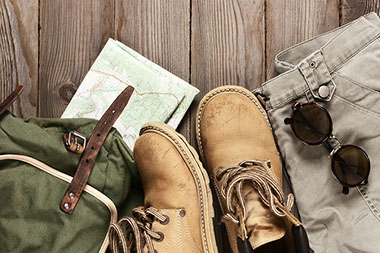
    Image of hiking boots, backpack and map.

    Hours of shopping and sightseeing can leave your feet tired, aching, and sore. Here’s what to do to save yourself the agony of sore feet, blisters, and other foot problems.

    To prepare your feet for the rigors of travel, do each of these exercises several times a day.

    *  Take off your shoes and socks, and pick up a pencil with your toes as you sit.

    *  Rotate your feet in a circular motion in one direction, then in the other.

    *  Point your toes to the ceiling, then to the floor.

    *  Stand, and roll up on your toes and hold for a count of 25.

    *  If you have foot problems and plan to travel, see your podiatrist. He or she may be able to remove corns, for example, or take care of other problems that might cause discomfort if you’re going to be on your feet a lot.

    *  Pack comfortable shoes that you’ve already worn several times. Walking or jogging shoes are best. Avoid high heels, dress oxfords, or other fashion footwear that don’t adequately support your feet.

    *  Take along two pairs of walking shoes, and alternate footwear every other day.

    *  Wear cotton socks, not nylon. (And don’t go sockless.)

    *  If your ankles and feet tend to swell, wear support stockings. Support hose are available for both men and women.

    If these suggestions fail to prevent achy feet or blisters, try these remedies.

    *  Soak your feet in a tub of cool water to which you’ve added one cup of Epsom salts for every gallon of water.

    *  Wash and thoroughly dry your feet every day. Then apply a powder to help absorb perspiration.

    *  Gently massage your feet with a moisturizing lotion. Begin at your toes and work up to your ankles. Massaging the feet can also help to relieve foot cramps.

    *  Don’t pop blisters. Instead, cushion them with a corn pad or bunion pad.
    Page image from A Year of Health Hints book by the American Institute for Preventive Medicine. www.HealthyLife.com. All rights reserved.

    © American Institute for Preventive Medicine

  • How To Locate A Physician Away From Home

    Healthy Travel

    Image of doctor with medical icons.

    The best made travel plans can’t guarantee against illness or injuries. Although travelers don’t like thinking about the possibility of a medical emergency, a little forethought can save you a lot of misery or aggravation. Knowing what to do and who to contact should you need medical help, especially when traveling abroad, reduces anxiety and avoids wasting time when minutes count.

    Specialized travel medical clinics exist in some areas. Consult the following for names of physicians you can contact, if need be, in the area you plan to visit.

    International Association for Medical Assistance to Traveler (IAMAT)

    1623 Military Rd. #279

    Niagra Falls, NY 14304-1745

    716.754.4883

    www.iamat.org

    Overseas Citizens Services (OCS), Bureau of Consular Affairs

    1.888.407.4747

    http://travel.state.gov/about/contact/contact_4745.html

    The American Embassy or American, British, or Canadian consul or consulate in the country you’re visiting.

    Page image from A Year of Health Hints book by the American Institute for Preventive Medicine. www.HealthyLife.com. All rights reserved.

    © American Institute for Preventive Medicine
  • How To Prevent Jet Lag

    Healthy Travel

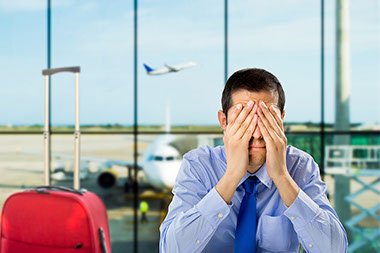
    Image of man covering his face while at the airport.

    Jet travel makes it possible to reach the far corners of the world in a matter of hours. Yet crossing several time zones disrupts your body’s natural rhythm of eating and sleeping. The result is a combination of fatigue, disorientation, indigestion, headaches, and insomnia, collectively called jet lag. Traveling from east to west is more of a problem than traveling west to east. Traveling north or south, if you don’t change time zones, doesn’t cause jet lag. It may take as long as one day per time zone for your body to adjust to changes.

    Ways to prevent jet lag include the following:

    *  Three nights before you leave, change your bedtime. If you’re traveling east, go to bed 1 hour earlier for each time zone you will cross. For example, if you usually go to bed at 10:30 p.m.; two nights before the trip, go to bed at 9:30 p.m. and the night before you leave, go to bed at 8:30 p.m. If you’re traveling west, go to bed one hour later for each time zone you will cross.

    *  Once you are on the plane, change your watch to match the time it is where you are going. Act according to that time. For example, if it is time to sleep in the country you are going to, try to sleep on the plane. If it is daytime, do activities that keep you awake.

    *  When you travel east on a long flight (over many time zones), try to take an overnight flight or one that arrives at nighttime so you can sleep on the plane or when you arrive.

    *  Ask your doctor about using melatonin, an over-the-counter product that may help “reset” your natural awake/sleep cycle. Ask, too, about taking vitamin B12 and vitamin C supplements certain days before your flight and after you return home.

    *  During the flight, avoid sleeping pills, alcohol, and caffeine. Drink plenty of water or juices to avoid dehydration. The air in the aircraft is very dry.

    *  If you arrive at your destination during the day, plan to spend some time outdoors. Try to expose yourself to as many hours of daylight as the number of time zones you crossed.

    *  Don’t go to bed until evening.

    Page image from A Year of Health Hints book by the American Institute for Preventive Medicine. www.HealthyLife.com. All rights reserved.

    © American Institute for Preventive Medicine
  • How To Prevent Motion Sickness

    Healthy Travel

    Motion sickness is like a hangover you don’t deserve. Symptoms include fatigue, dizziness, nausea, vomiting, pallor, and sweating. Experts think this misery results because your eyes and inner ear receive conflicting messages when you travel by car, boat, or plane. The inner ear, which is responsible for your sense of balance, tells your body it’s moving in one direction, while your eyes tell you you’re moving in another. So closing your eyes can reduce the conflict. The following steps can also help prevent motion sickness.

    Aboard ship:

    *  Spend as much time as you can on deck in the fresh air.

    *  If you’re going to be spending the night (or nights) on a boat, try to get a cabin near the middle of the craft, close to the waterline, where there’s less pitching and rolling.

    On a plane:

    *  Request a seat over the wings. Avoid sitting in the tail section; it’s the bumpiest.

    *  Open the overhead vents and direct air at your face.

    On land transportation:

    *  Fix your gaze on the scenery straight ahead, not to the side.

    *  Sit near an open window, for fresh air, unless you’re traveling through a heavily polluted area.

    *  If you’re traveling by car, offer to drive. The person at the wheel never gets motion sickness.

    In addition, the following steps are helpful no matter what your means of transportation.

    *  Get plenty of rest before setting out. Fatigue makes you more vulnerable to motion sickness.

    *  Avoid drinking alcohol before or during travel, and don’t overindulge the night before.

    *  Take an over-the-counter motion sickness medication (such as Dramamine) approximately 30 minutes before travel begins. Read the package for cautions and other important information.

    *  If over-the-counter medications don’t bring relief, ask your doctor about a prescription medication containing scopolamine, available as a patch that’s usually worn behind your ear.

    *  Don’t read while traveling and don’t try to focus on any other stationary object. Aboard a ship, lie down on your back and close your eyes.

    *  If any of your traveling companions get sick, move as far away from them as possible; otherwise, you may get sick, too.

    Some people report that taking tablets of powdered gingerroot relieves their motion sickness. Others find relief by pressing on an acupressure point about midway on the inside of the wrist, where the hand and forearm meet.

    If preventive measures fail and you feel sick anyway, you can try the following:

    *  Breathe slowly and deeply.

    *  Remove yourself from smoke and food odors, and get some fresh air.

    *  To reduce tension and anxiety, concentrate on relaxing all your muscles, as though you’re a limp rag doll, and visualize a peaceful scene.

    *  To settle a queasy stomach, eat dry crackers.

    Page image from A Year of Health Hints book by the American Institute for Preventive Medicine. www.HealthyLife.com. All rights reserved.

    © American Institute for Preventive Medicine
  • Immunizations: Your Best Shot Against Infectious Diseases

    Healthy Travel

    Image of mother comforting young daughter as she gets a shot.

    Polio, yellow fever, cholera, malaria, and typhoid are not typical problems in the United States and most developed countries. But outbreaks are common in certain rural or undeveloped parts of the world.

    Here’s what to do if you plan to travel outside the United States.

    *  Be sure you’ve been immunized against diphtheria, pertussis (whooping cough), tetanus, polio, measles, rubella, and mumps. Most people are routinely immunized against these diseases in childhood. You should have a booster shot for tetanus every ten years, however.

    *  Ask your doctor if he or she recommends medicine to prevent malaria or immunizations against influenza, pneumonia, or hepatitis.

    *  Contact your doctor or local health department to determine if you need to receive additional immunizations for your trip. Vaccination requirements for specific countries are also listed in the booklet, Health Information for International Travel-The Yellow Book, available from the Centers for Disease Control and Prevention (CDC).

    For information, call the CDC Travelers’ Information Line at 1.800.CDC.INFO (232.4636). Or accesswww.cdc.gov/travelon the Internet and select “Travelers’ Health.” You can find out what immunizations are advised for the places you are planning to go to. You can also find out about specific notices and outbreak advisories.

    Most immunizations are not required, but are recommended to protect the health of the traveler. Under the International Health Regulations adapted by the World Health Organization (WHO), a country may, under certain conditions, require an International Certificate of Vaccination against yellow fever from international travelers. A copy of the International Certificate of Vaccination, CDC 731 (formerly PHS-731), may be purchased from the U.S. Government Printing Office, Washington, DC 20402,http://bookstore.gpo.gov, 1.866.512.1800.

    Page image from A Year of Health Hints book by the American Institute for Preventive Medicine. www.HealthyLife.com. All rights reserved.

    © American Institute for Preventive Medicine
  • Beating Jet Lag

    SELF-CARE CORNER

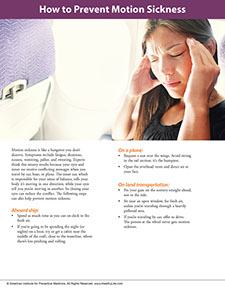
    Man sleeping on plane.

    Summer travel plans may take you to places across the globe. While this can be exciting, switching to a different time zone can take a toll on the body.

    The body has its own internal clock that tells you when to be awake and when to sleep. This is your circadian rhythm.

    If you travel to a different time zone, the clock gets disrupted:

    You may be awake when it’s nighttime or want to sleep during the day. This can make you exhausted. Jet lag can also cause:

    *  Headaches

    *  Feeling irritable

    *  Trouble concentrating

    *  Loss of appetite

    *  Upset stomach

    *  Diarrhea

    There are some ways to fight jet lag so you can enjoy your trip:

    *  Stay hydrated. Drink plenty of water before, during, and after your arrival.

    *  Avoid alcohol. Some people think a nightcap will help them sleep. But alcohol actually disrupts sleep and makes you more tired.

    *  Use your travel time wisely. If you’ll be on a plane during the “new” night time, try to rest. Use a sleep mask and ear plugs. Avoid staring at TV screens or other devices.

    *  Be careful with caffeine. If you must have caffeine, drink it in the new time zone’s morning hours. Avoid it after lunch.

    *  Get out in the sun. When you get to your destination, go outside if it’s daytime. This will help to tell your body when to be awake.

    *  Skip naps if possible. Napping could make it harder for you to fall asleep at the correct time. If you take a nap at 6 p.m., you could be awake most of the night.

    *  Consider melatonin. Melatonin is a hormone that your body makes to tell you that it’s time for sleep. Taking melatonin at your new bedtime can help you sleep better. It is available over-the-counter, but ask your doctor before trying it.

    Source: National Sleep Foundation

    © American Institute for Preventive Medicine

  • Plane Travel For Those With Special Health Problems

    Healthy Travel

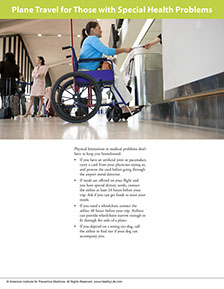
    Women in wheelchair at airport check-in counter.

    Physical limitations or medical problems don’t have to keep you homebound.

    *  If you have an artificial joint or pacemaker, carry a card from your physician saying so, and present the card before going through the airport metal detector.

    *  If meals are offered on your flight and you have special dietary needs, contact the airline at least 24 hours before your trip. Ask if you can get foods to meet your needs.

    *  If you need a wheelchair, contact the airline 48 hours before your trip. Airlines can provide wheelchairs narrow enough to fit through the aisle of a plane.

    *  If you depend on a seeing-eye dog, call the airline to find out if your dog can accompany you.

    Page image from A Year of Health Hints book by the American Institute for Preventive Medicine. www.HealthyLife.com. All rights reserved.

    © American Institute for Preventive Medicine

  • Campfire Safety

    WELL-BEING

    Group of people sitting around a campfire and tent.

    Whether roasting marshmallows or sitting up late to tell ghost stories, a campfire is a comforting and enjoyable way to spend time together. However, a fire should always be handled with caution. It’s essential to be smart when dealing with open flames. Here are three ways to stay safe around the campfire:

    1.Choose the campfire spot wisely.If possible, always use a fire pit designed for proper fire containment. Campfires should be located at least 15 feet away from any buildings, tents, or shrubs.

    2.Keep the area clear.There should be 10 feet of cleared space around the campfire, so remove any branches or debris. Keep all clutter clear of the site. And, of course, watch the kids closely. It’s never too early to teach them how to be safe around a fire.

    3.Douse the fire correctly at the end of the evening.Pour water over the fire until all coals are extinguished. Once the fire is completely out, stir the ash and test by carefully holding your hand above the area to be sure there is no residual heat. Repeat the process if needed.

    Source: Recreation.gov

    © American Institute for Preventive Medicine
  • Prevent In-Flight Ear Pops

    Healthy Travel

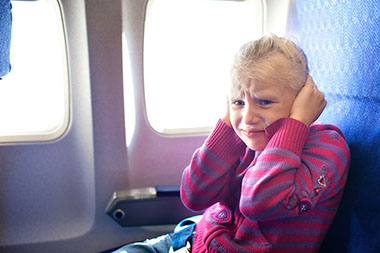
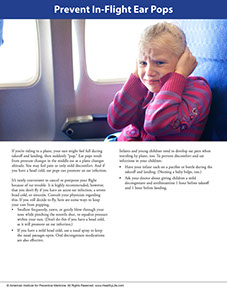
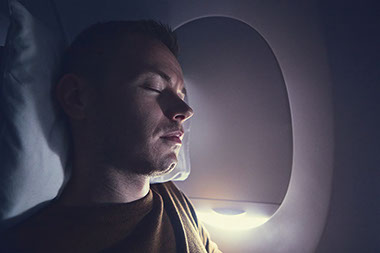
    Image of young girl on plane covering her ears.

    If you’re riding in a plane, your ears might feel full during takeoff and landing, then suddenly “pop.” Ear pops result from pressure changes in the middle ear as a plane changes altitude. You may feel pain or only mild discomfort. And if you have a head cold, ear pops can promote an ear infection.

    It’s rarely convenient to cancel or postpone your flight because of ear trouble. It is highly recommended, however, that you don’t fly if you have an acute ear infection, a severe head cold, or sinusitis. Consult your physician regarding this. If you still decide to fly, here are some ways to keep your ears from popping.

    *  Swallow frequently, yawn, or gently blow through your nose while pinching the nostrils shut, to equalize pressure within your ears. (Don’t do this if you have a head cold, as it will promote an ear infection.)

    *  If you have a mild head cold, use a nasal spray to keep the nasal passages open. Oral decongestant medications are also effective.

    Infants and young children tend to develop ear pain when traveling by plane, too. To prevent discomfort and ear infections in your children:

    *  Have your infant suck on a pacifier or bottle during the takeoff and landing. (Nursing a baby helps, too.)

    *  Ask your doctor about giving children a mild decongestant and antihistamine 1 hour before takeoff and 1 hour before landing.

    Page image from A Year of Health Hints book by the American Institute for Preventive Medicine. www.HealthyLife.com. All rights reserved.

    © American Institute for Preventive Medicine
  • Safe Travels

    WELL-BEING

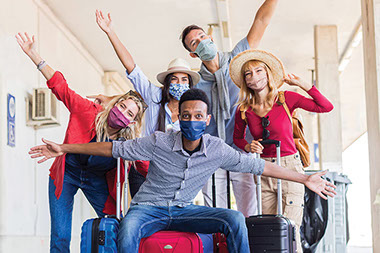
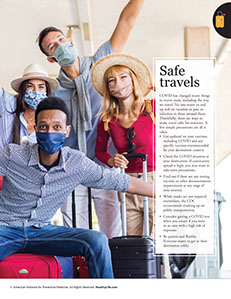
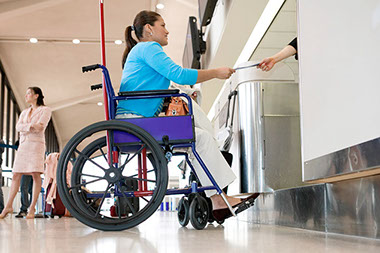
    Group of friends with luggage, wearing face masks, ready to travel.

    COVID has changed many things in recent years, including the way we travel. No one wants to end up sick on vacation or pass an infection to those around them. Thankfully, there are ways to make travel safer for everyone. A few simple precautions are all it takes.

    *  Get updated on your vaccines, including COVID and any specific vaccines recommended by your destination country.

    *  Check the COVID situation at your destination. If community spread is high, you may want to take extra precautions.

    *  Find out if there are any testing, vaccine, or other documentation requirements at any stage of your journey.

    *  While masks are not required everywhere, the CDC recommends masking up on public transportation.

    *  Consider getting a COVID test when you return if you were in an area with a high risk of exposure.

    *  Be patient and flexible. Everyone wants to get to their destination safely.

    © American Institute for Preventive Medicine