Tag: identity

  • Create A Family Mission Statement

    FAMILY LIFE

    Family sitting together talking.

    A family mission statement defines your core values & priorities. It’s a useful tool to bind your family together for a common purpose.

    Gather as a family to talk about what you value most. Brainstorm words that best describe your family dynamics and priorities.

    Ask good questions

    *  What is our family’s purpose?

    *  What do we love to do together?

    *  What makes our family unique?

    *  What legacy do we hope to leave?

    Create a draft

    Identify themes from your conversations together and write a mission statement. The statement can be a paragraph, bullet points, or phrases that capture your family.

    Reflect & refine

    Take time to reflect on your first draft and see if it fits your family. Talk about what you’ve put together and get feedback. Adjust and refine as needed.

    Finalize & display

    Your mission statement doesn’t have to be perfect, but it should accurately reflect your family’s core values and goals. Display it somewhere visible.

    Update

    As your family grows and changes, your mission statement should change, too. Your values and goals will naturally evolve over time.

    © American Institute for Preventive Medicine

  • Explore Your Family History

    FAMILY LIFE

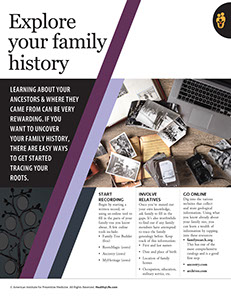
    Old black and white photos on table next to camera, laptop, old photo album.

    Learning about your ancestors & where they came from can be very rewarding. If you want to uncover your family history, there are easy ways to get started tracing your roots.

    Start recording

    Begin by starting a written record, or using an online tool to fill in the parts of your family tree you know about. A few online tools include:

    *  Family Tree Builder (free)

    *  RootsMagic (costs)

    *  Ancestry (costs)

    *  MyHeritage (costs)

    Involve relatives

    Once you’ve maxed out your own knowledge, ask family to fill in the gaps. It’s also worthwhile to find out if any family members have attempted to trace the family genealogy before. Keep track of this information:

    *  First and last names

    *  Date and place of birth

    *  Location of family homes

    *  Occupation, education, military service, etc.

    Go online

    Dig into the various websites that collect and store geological information. Using what you know already about your family tree, you can learn a wealth of information by tapping into these resources:

    *familysearch.org– This has one of the most comprehensive catalogs and is a good first step.

    *ancestry.com

    *archives.com

    © American Institute for Preventive Medicine

  • Find Your Fitness Personality

    Fitness

    Body type isn’t the only trait that determines which activities are best for you, though. You’ve probably already given some thought to what you’d like, based on whether you prefer to do activities alone or in a group; competitive or noncompetitive activities, or outdoor or indoor activities.

    Finding a fitness activity that suits your personality is also a big factor in how much you’ll enjoy exercise and stick with it long enough to reap the benefits. Do any of the following descriptions of fitness personalities sound like you? If so, read the “hint for success” that pertains to each one.

    The Weekend Warrior

    The weekend warrior is sedentary throughout the work week and binges on exercise or sports over the weekend. Hint: Add minimal activity (even as little as 15 minutes twice per week) during the week to help condition your heart and lungs, sustain muscular endurance, and prevent strains or injuries on the weekend.

    The Fanatic

    The fanatic thinks that if a moderate exercise is good, then a lot is better. He or she always tries to work out a little more, a lot harder, or more intensely than others, and feels anxious and irritable if he or she misses a workout. Hint: Fitness should be a pleasure, not an addiction or ball and chain.

    The Social Butterfly

    The social butterfly has difficulty sticking with a solo fitness program, and loves to chat and mingle with other participants in a group. Hint: Don’t always depend on group activities or other people to enable you to meet your fitness goals. Be willing to go it alone if you must.

    The Cannonball

    The cannonball jumps into a fitness program with a burst of energy and determination but loses enthusiasm a few weeks later. Hint: Don’t try to do too much, too soon, or you’ll probably burn out after 2 or 3 weeks. It takes 10 to 12 weeks to start to see the results of your efforts.

    The Flipper

    The flipper dabbles in one activity, then quickly abandons it for another, and is related to the cannonball. Sometimes he or she may remain inactive for long intervals between flurries of activity. Hint: Real fitness results from consistent efforts, over the long term.

    The Analyst

    The analyst loves exercise gadgets and equipment. He or she reads lots of fitness books and magazines and likes to talk about the benefits of exercise. Hint: This is not a problem if you actually pursue the activities you’re learning about. But remember, the important thing is to get out and move.


    Page image from A Year of Health Hints book by the American Institute for Preventive Medicine. www.HealthyLife.com. All rights reserved.

    © American Institute for Preventive Medicine

  • Protect Your Personal Information

    FINANCIAL HEALTH

    Image of laptop with shield and lock key.

    Identity theft is a serious crime. It happens when someone steals your personal information such as your social security number or credit card numbers and uses it without your permission. You may see mistakes or mystery charges on your bank, credit card, or other account statements. You may receive bills for products or services you never received. Protect your personal information, urges the Federal Trade Commission. Get detailed information online atwww.ftc.gov/idtheft.

    *Keep your important papers secure.Limit what you carry in your wallet or purse. Pick up new checks at the bank instead of having them mailed to your home. Take outgoing mail to a collection box or the post office. Don’t leave it in your mailbox. Shred sensitive documents, receipts, credit card offers, insurance forms, checks, bank statements, and similar documents.

    *Secure your social security number.Only give it out when necessary (and ask if you can use a different kind of identification).

    *Protect your computer and mobile devices.Use anti-virus software. Don’t open files or click on links sent by strangers. Remove the memory cards from mobile devices before recycling them.

    *Protect your data online.Keep your passwords private. Don’t over share on social networking sites. If you post too much information about yourself, an identity thief can use that information to answer challenging questions on your accounts (birthdays, mother’s name, pet names, high school).

    © American Institute for Preventive Medicine

  • Stop! Thief

    FINANCIAL HEALTH

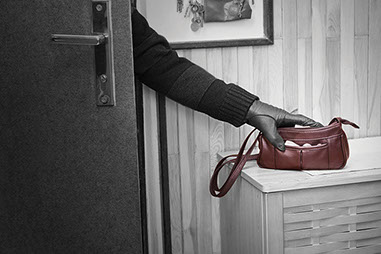
    Image of arm sneaking in from a door grabbing a purse on the counter.

    When your purse or wallet is lost or stolen, do you know the 8 steps you need to take right away because the thief is already cashing in on your loss? Act fast, advises the Federal Trade Commission:

    1. File a report with the police immediately. Get a copy in case your bank, credit card company, or insurance  company needs proof of the crime.

    2. Report the loss to your bank. Cancel checking and savings accounts. Open new ones, and stop payments on outstanding checks. Cancel each credit and charge card. Get new cards with new account numbers. Get a new ATM card, account number, and PIN or password.

    3. Call your utility companies. Tell them that someone may try  to get new service using your identification.

    4. Report your missing driver’s license to the department of  motor vehicles.

    5. Report missing cards to the major credit reporting agencies and place a fraud alert on your accounts: Equifax: 1-800-525-6285, Experian: 1-888-397-3742, TransUnion: 1-800-680-7289.

    6. Change the locks on your home and car if the keys were taken.

    7. Contact the Social Security Administration.    Call: 1-800-772-1213.

    8. Contact your insurance companies. Make sure no one tries to add someone to your policies.

    © American Institute for Preventive Medicine