Category: Family Life

  • Anxious Kids, Anxious Parents

    FAMILY LIFE

    Image of young child.

    How do you manage a child who gets stomachaches every school morning? Or one who refuses to go to after-school activities? Or who is trapped in the bathroom with frequent hand washing?

    One in every 5 kids suffers from a diagnosable anxiety disorder. Experts Reid Wilson, professor of psychiatry at the University of North Carolina School of Medicine, and Lynn Lyons, a social worker and psychotherapist, say anxiety disorders are the number one reason why parents bring a child to a mental health professional.

    “When kids grow and step into new experiences, they should have questions and uncertainties. Worry becomes a problem when a child is consistently avoiding activities or experiences that are a normal part of development,” according to these experts.

    How do you know if your child may have anxiety? Wilson and Lyons, authors of Anxious Kids, Anxious Parents: 7 Ways to Stop the Worry Cycle and Raise Courageous & Independent Children, say to look for the following behaviors and see a mental health professional with your concerns (worry, they say, may run in families):

    *  They cling to you.

    *  They refuse to try new activities.

    *  They continually ask you for reassurance of their “what if” questions.

    *  They feel sick and complain of aches, pains, and nausea.

    *  They avoid school or cry or throw tantrums if you force them to go.

    *  They act shy and don’t talk in class or around others.

    *  They worry about future or past events (“I will look stupid reading this book report” or “Did I make my best friend mad?” or “Something bad is going to happen to my family”).

    Children can learn to manage their uncertainty, but sometimes it takes a professional to help.

    © American Institute for Preventive Medicine

  • Create Family Ties

    FAMILY LIFE

    Image of three generational family.

    Families who spend time together as a cohesive unit are more likely to survive a crisis, such as an illness or job loss than those with poor coping skills.

    According to the CDC, good communication between parents and children is important for developing positive relationships.

    *  Teach active listening skills. Pay attention to what others say. Ask questions if you don’t understand what your spouse or children are trying to tell you.

    *  Hold regular family meetings to present complaints and set mutual goals and plans.

    *  Celebrate birthdays, holidays and other special occasions together.

    *  Learn the value of compromise.

    *  Be flexible. This is especially important if one parent returns to work or if one wage earner loses his or her job.

    *  Allow for individual strengths and interests. Don’t compare brothers and sisters. Allow family members to have “their own space.”

    © American Institute for Preventive Medicine

  • Just Baby & You

    FAMILY LIFE

    Image of mother and baby.

    Get outside and walk with your baby. But exercise caution and good judgment, advises the American Chiropractic Association.

    *  A backpack-style or front-side carrier decreases a parent’s stability when walking or hiking. It is critical that a parent get into shape before attempting to use one of these products.

    *  If using a backpack-style or front-side baby carrier, make sure to select one with wide straps for your shoulders and waist. This will help distribute the carrier’s weight evenly. The shoulder straps should fit comfortably over the center of your collarbone.

    *  Don’t forget about your own health and comfort. Bring yourself as close to the baby as possible before lifting. You don’t want to lift with your arms outstretched. Bend from the knees and hips and keep your back straight. Use a two-stage lift that consists of pulling the child up to your chest and then lifting straight up with your leg muscles.

    *  Once you place the child in the carrier, check to make sure there is no bunching of material against the child’s body, particularly on the back, buttocks, and spine. Isolated, uneven pressure like this can produce pain.

    If you wish to use a baby sling, keep in mind that it is intended only for infants, and be sure to follow these tips:

    *  A baby can become very hot inside the sling, so be mindful of the temperature around you. Also, make certain the baby’s breathing is clear and unobstructed by the sling’s material.

    *  Switch sides when wearing the sling to balance the positional stress on you and your baby.

    *  Never run or jog while carrying a baby in any backpack-style carrier, front-side carrier, or baby sling. A baby’s body is not adjusted to the cyclic pattern that is a part of running and jogging. This motion can do damage to the baby’s neck, spine, and brain. It is better to use a jogging stroller.

    © American Institute for Preventive Medicine

  • Solve The Homework Hassle

    FAMILY LIFE

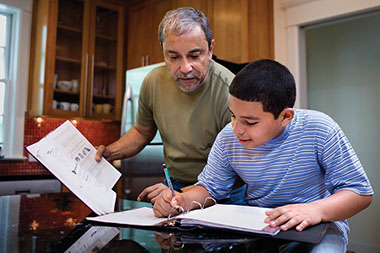
    Image of father helping son with homework.

    Do you dread those long nights of homework hassle-for parents and students? Homework does not have to be a time of great stress for families, according to Paula Kramer, chair and professor of occupational therapy at University of the Sciences. Dr. Kramer suggests the following ways to help avoid arguments over turning off the TV and hitting the books:

    *  Come to an understanding with your child that homework is a necessity-and must be done every day.

    *  Communicate (in person and by email) with the teachers and find out how much time the student is expected to devote to homework each night. Setting expectations and time limits will make the child more productive.

    *  Allow for active playtime before homework. If the child does not have an after-school activity such as a sport or dance class, provide 45 minutes to an hour for the child to engage in active behavior prior to homework. The physical activity will help the child burn off energy, settle the nervous system, and refocus mentally for homework.

    *  Create a designated area for homework and studying-desk in a bedroom or the kitchen table. Just keep the homework spot the same, quiet, and free from distractions.

    *  Create charts to track homework progress. The chart will not only set a schedule that visibly shows that homework needs to be done every night, but will also allow the child to track progress. Rewards can be given for homework completed successfully a few nights in a row.

    *  Use positive praise to encourage good homework and study habits.

    *  Be a role model for the child. School cannot teach everything. Responsibility for successful behavior also lies at home. Parents need to take an active role in their child’s education and should check in on the child during homework to make sure it is completed properly.

    © American Institute for Preventive Medicine

  • Tvs Can Injure Kids

    FAMILY LIFE

    Image of boy watching TV.

    How about that shocking headline? Although most parents do not consider furniture and TVs to be dangerous, children are often injured when these items tip over.

    A study conducted by the Center for Injury Research and Policy of The Research Institute at Nationwide Children’s Hospital found that nearly 15,000 children younger than age 18 go to ERs annually for injuries received from furniture tip-overs.

    According to the study, published in Clinical Pediatrics, most furniture tip-over-related injuries occurred among children younger than age 7 and resulted from TVs tipping over. More than one quarter of the injuries occurred when children pulled over or climbed on furniture.

    Older children were more likely to suffer injuries from desks, cabinets, or bookshelves tipping over. Head and neck injuries were most common among younger children, while children older than age 9 were more likely to suffer injuries to the lower body.

    Despite warnings from the U.S. Consumer Product Safety Commission, the number of tip-over injuries has increased since the early 1990s.

    Parents can reduce risks to children by placing TVs low to the ground and near the back of their stands and strapping televisions and furniture to the wall with safety straps or L-brackets. Purchase furniture with wide legs or with solid bases. Install drawer stops on chests of drawers, and place heavy items close to the floor on shelves.

    Also, parents can reduce a child’s desire to climb furniture by not placing attractive items, such as toys or the remote control, high on top of furniture or the TV.

    © American Institute for Preventive Medicine

  • Advocate Against Domestic Violence

    FAMILY LIFE

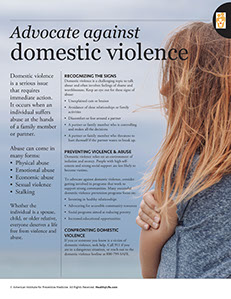
    Back of women, wind blowing her hair as she hugs herself.

    Domestic violence is a serious issue that requires immediate action. It occurs when an individual suffers abuse at the hands of a family member or partner.

    Abuse can come in many forms:

    *  Physical abuse

    *  Emotional abuse

    *  Economic abuse

    *  Sexual violence

    *  Stalking

    Whether the individual is a spouse, child, or older relative, everyone deserves a life free from violence and abuse.

    Recognizing the signs

    Domestic violence is a challenging topic to talk about and often involves feelings of shame and worthlessness. Keep an eye out for these signs of abuse:

    *  Unexplained cuts or bruises

    *  Avoidance of close relationships or family activities

    *  Discomfort or fear around a partner

    *  A partner or family member who is controlling and makes all the decisions

    *  A partner or family member who threatens to hurt themself if the partner wants to break up.

    Preventing violence & abuse

    Domestic violence relies on an environment of isolation and secrecy. People with high self-esteem and strong social support are less likely to become victims.

    To advocate against domestic violence, consider getting involved in programs that work to support strong communities. Many successful domestic violence prevention programs focus on:

    *  Investing in healthy relationships

    *  Advocating for accessible community resources

    *  Social programs aimed at reducing poverty

    *  Increased educational opportunities

    Confronting domestic violence

    If you or someone you know is a victim of domestic violence, seek help. Call 911 if you are in a dangerous situation, or reach out to the domestic violence hotline at 800-799-SAFE.

    © American Institute for Preventive Medicine
  • Baby Teeth

    FAMILY LIFE

    Image of baby at the doctor's office.

    The ideal time for a child to visit the dentist is 6 months after the child’s first teeth appear. During this initial visit, a dentist will be able to examine the development of the child’s mouth.

    Babies may have dental problems, such as teething irritations, gum disease, and prolonged thumb or pacifier sucking.

    The sooner the child visits a dentist, the better, says the Academy of General Dentistry in offering these other tips:

    *  Clean your infant’s gums with a clean, damp cloth twice a day.

    *  Ask your dentist when you may begin to rub a tiny dab of toothpaste on your child’s gums. Doing so will help your child become accustomed to the flavor of toothpaste.

    *  As soon as the first teeth come in, begin brushing them with a small, soft-bristled toothbrush and a pea-sized dab of fluoride toothpaste.

    *  Help a young child brush at night. This is the most important time to brush, due to lower salivary flow during sleep and higher risk for cavities and plaque.

    *  By about age 5, your child can learn to brush his or her teeth with proper help from an adult.

    © American Institute for Preventive Medicine

  • Does Your Family Calendar Need A “Time Out”?

    FAMILY LIFE

    Image of smiling family.

    Today’s families are busier than ever. Sports, music, and other extracurricular activities may take up most – if not all – of your child’s free time outside of school. Is this helping or hurting our kids?

    The American Academy of Pediatrics says free play time is an important aspect of a child’s development. All children need some time to be creative, interactive, and to problem-solve. This can be quiet time alone with toys, pretend play with friends, or even just daydreaming. The time should not be spent with electronics such as watching TV or playing video games.

    Also consider sleep. If your schedule is so packed that you or your children are exhausted all the time, it’s time to take another look. Children need adequate sleep for mental and physical development. Adults need enough sleep for optimal health and stress relief.

    If your household is running ragged with commitments, consider some “time out” for your whole family. It may be one of the best things you do for your child’s well-being – and your own sanity.

    © American Institute for Preventive Medicine

  • Kids And Social Media:How To Keep Tabs

    FAMILY LIFE

    Image of mother and daughter sitting on the couch, while mother checks tablet.

    Today’s kids and teens are using the Internet, for better or worse. Although it can be a fun and useful tool, parents need to be aware of their kids’ online activities, especially social media like Facebook, Twitter, and Snapchat.

    Potential threats like cyber bullying and Internet predators are realities for kids today. And, with smartphones and other portable devices, kids can be targeted anywhere, at anytime. The American Academy of Pediatrics recommends the following tips to keep kids safe:

    Be connected with them.

    Talk with your kids about which social media outlets they use, and make sure you check these outlets too. Tell them the rule is that you will be “friends” with them on any sites they use. Talk with other parents about their kids’ social media sites and stay up to date on the latest ones.

    Have regular checks.

    If your child has a smartphone or tablet, check it once a week or more often to ensure they’re being safe and appropriate. Rather than keeping it a secret, be honest with them about these checks. It will be less like “spying” and more like regular, open monitoring. You want to keep good communication and trust with your child.

    Tell them about consequences.

    Any photo or message posted online can be shared with the world. If they wouldn’t announce it on national TV, they shouldn’t share it online either.

    Set time limits.

    Don’t let kids have their phones or devices in their rooms at night. Not only will it interfere with needed sleep, but it could be an opportunity for inappropriate social media usage. Consider capping their usage at two hours a day for total screen time.

    © American Institute for Preventive Medicine

  • Start A Conversation About Domestic Violence

    FAMILY LIFE

    Image of female looking downwards.

    Everyone knows a victim of domestic violence, but most people don’t know what to do to help.

    “If someone comes to you and tells you they’re a victim of domestic violence, the most important thing you can do is offer your support without judgment,” said Vicky Dinges, vice president of corporate responsibility at Allstate. “There are 1,300 deaths and two million injuries related to domestic violence each year. Odds are we all know someone who’s in an abusive relationship. Knowing how to help might just save a life.”

    Here are some easy ways to start a conversation:

    *Offer support without judgment or criticism.There are a lot of reasons why victims may stay in an abusive relationship, and many reasons why they may also leave and return to the relationship multiple times. Let them know it’s not their fault and that they are not alone.

    *Don’t be afraid to tell them that you’re concerned for their safety.Help your friend or family member recognize the abuse while acknowledging that they are in a very difficult and dangerous situation.

    *Avoid confrontations.There are many reasons why people experiencing abuse don’t reach out to family and friends. It’s important to recognize when they are ready to talk about their experiences while still offering support.

    *Encourage them to get help.Suggest ways they can get additional support. Help them look into available resources, such as the National Domestic Violence Hotline number – 800-799-SAFE (7233) or website atwww.thehotline.org. This resource also finds local support groups and provides information on staying safe.

    © American Institute for Preventive Medicine