Category: Healthy Travel

  • How To Prevent Jet Lag

    Healthy Travel

    Image of man covering his face while at the airport.

    Jet travel makes it possible to reach the far corners of the world in a matter of hours. Yet crossing several time zones disrupts your body’s natural rhythm of eating and sleeping. The result is a combination of fatigue, disorientation, indigestion, headaches, and insomnia, collectively called jet lag. Traveling from east to west is more of a problem than traveling west to east. Traveling north or south, if you don’t change time zones, doesn’t cause jet lag. It may take as long as one day per time zone for your body to adjust to changes.

    Ways to prevent jet lag include the following:

    *  Three nights before you leave, change your bedtime. If you’re traveling east, go to bed 1 hour earlier for each time zone you will cross. For example, if you usually go to bed at 10:30 p.m.; two nights before the trip, go to bed at 9:30 p.m. and the night before you leave, go to bed at 8:30 p.m. If you’re traveling west, go to bed one hour later for each time zone you will cross.

    *  Once you are on the plane, change your watch to match the time it is where you are going. Act according to that time. For example, if it is time to sleep in the country you are going to, try to sleep on the plane. If it is daytime, do activities that keep you awake.

    *  When you travel east on a long flight (over many time zones), try to take an overnight flight or one that arrives at nighttime so you can sleep on the plane or when you arrive.

    *  Ask your doctor about using melatonin, an over-the-counter product that may help “reset” your natural awake/sleep cycle. Ask, too, about taking vitamin B12 and vitamin C supplements certain days before your flight and after you return home.

    *  During the flight, avoid sleeping pills, alcohol, and caffeine. Drink plenty of water or juices to avoid dehydration. The air in the aircraft is very dry.

    *  If you arrive at your destination during the day, plan to spend some time outdoors. Try to expose yourself to as many hours of daylight as the number of time zones you crossed.

    *  Don’t go to bed until evening.

    Page image from A Year of Health Hints book by the American Institute for Preventive Medicine. www.HealthyLife.com. All rights reserved.

    © American Institute for Preventive Medicine

  • How To Prevent Motion Sickness

    Healthy Travel

    Motion sickness is like a hangover you don’t deserve. Symptoms include fatigue, dizziness, nausea, vomiting, pallor, and sweating. Experts think this misery results because your eyes and inner ear receive conflicting messages when you travel by car, boat, or plane. The inner ear, which is responsible for your sense of balance, tells your body it’s moving in one direction, while your eyes tell you you’re moving in another. So closing your eyes can reduce the conflict. The following steps can also help prevent motion sickness.

    Aboard ship:

    *  Spend as much time as you can on deck in the fresh air.

    *  If you’re going to be spending the night (or nights) on a boat, try to get a cabin near the middle of the craft, close to the waterline, where there’s less pitching and rolling.

    On a plane:

    *  Request a seat over the wings. Avoid sitting in the tail section; it’s the bumpiest.

    *  Open the overhead vents and direct air at your face.

    On land transportation:

    *  Fix your gaze on the scenery straight ahead, not to the side.

    *  Sit near an open window, for fresh air, unless you’re traveling through a heavily polluted area.

    *  If you’re traveling by car, offer to drive. The person at the wheel never gets motion sickness.

    In addition, the following steps are helpful no matter what your means of transportation.

    *  Get plenty of rest before setting out. Fatigue makes you more vulnerable to motion sickness.

    *  Avoid drinking alcohol before or during travel, and don’t overindulge the night before.

    *  Take an over-the-counter motion sickness medication (such as Dramamine) approximately 30 minutes before travel begins. Read the package for cautions and other important information.

    *  If over-the-counter medications don’t bring relief, ask your doctor about a prescription medication containing scopolamine, available as a patch that’s usually worn behind your ear.

    *  Don’t read while traveling and don’t try to focus on any other stationary object. Aboard a ship, lie down on your back and close your eyes.

    *  If any of your traveling companions get sick, move as far away from them as possible; otherwise, you may get sick, too.

    Some people report that taking tablets of powdered gingerroot relieves their motion sickness. Others find relief by pressing on an acupressure point about midway on the inside of the wrist, where the hand and forearm meet.

    If preventive measures fail and you feel sick anyway, you can try the following:

    *  Breathe slowly and deeply.

    *  Remove yourself from smoke and food odors, and get some fresh air.

    *  To reduce tension and anxiety, concentrate on relaxing all your muscles, as though you’re a limp rag doll, and visualize a peaceful scene.

    *  To settle a queasy stomach, eat dry crackers.
    Page image from A Year of Health Hints book by the American Institute for Preventive Medicine. www.HealthyLife.com. All rights reserved.

    © American Institute for Preventive Medicine

  • Immunizations: Your Best Shot Against Infectious Diseases

    Healthy Travel

    Image of mother comforting young daughter as she gets a shot.

    Polio, yellow fever, cholera, malaria, and typhoid are not typical problems in the United States and most developed countries. But outbreaks are common in certain rural or undeveloped parts of the world.

    Here’s what to do if you plan to travel outside the United States.

    *  Be sure you’ve been immunized against diphtheria, pertussis (whooping cough), tetanus, polio, measles, rubella, and mumps. Most people are routinely immunized against these diseases in childhood. You should have a booster shot for tetanus every ten years, however.

    *  Ask your doctor if he or she recommends medicine to prevent malaria or immunizations against influenza, pneumonia, or hepatitis.

    *  Contact your doctor or local health department to determine if you need to receive additional immunizations for your trip. Vaccination requirements for specific countries are also listed in the booklet, Health Information for International Travel-The Yellow Book, available from the Centers for Disease Control and Prevention (CDC).

    For information, call the CDC Travelers’ Information Line at 1.800.CDC.INFO (232.4636). Or accesswww.cdc.gov/travelon the Internet and select “Travelers’ Health.” You can find out what immunizations are advised for the places you are planning to go to. You can also find out about specific notices and outbreak advisories.

    Most immunizations are not required, but are recommended to protect the health of the traveler. Under the International Health Regulations adapted by the World Health Organization (WHO), a country may, under certain conditions, require an International Certificate of Vaccination against yellow fever from international travelers. A copy of the International Certificate of Vaccination, CDC 731 (formerly PHS-731), may be purchased from the U.S. Government Printing Office, Washington, DC 20402,http://bookstore.gpo.gov, 1.866.512.1800.

    Page image from A Year of Health Hints book by the American Institute for Preventive Medicine. www.HealthyLife.com. All rights reserved.

    © American Institute for Preventive Medicine
  • Pack A Traveler’S First-Aid Kit

    Healthy Travel

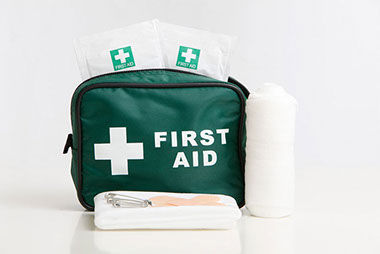
    Image of first aid kit.

    You can handle many minor medical emergencies that crop up as you travel if you have the right supplies at hand. Use the following list as a guideline for packing your own first-aid kit.

    *  Rubbing alcohol or alcohol wipes.

    *  Antibacterial cream or spray.

    *  Adhesive strips, gauze pads, and cotton swabs.

    *  Elastic bandages.

    *  Mild pain relievers, such as aspirin, acetaminophen, or ibuprofen.

    *  Antacids.

    *  Cough and cold remedies.

    *  Diarrhea medication.

    *  Broad-spectrum antibiotic (requires a doctor’s prescription).

    To conserve space in your baggage, purchase supplies in trial-size containers. If you’re going to travel by airplane, avoid aerosol products. They can explode if subjected to drastic changes in air pressure.

    You should also carry your medical insurance card and the name, address, and phone number of your doctor.

    Page image from A Year of Health Hints book by the American Institute for Preventive Medicine. www.HealthyLife.com. All rights reserved.

    © American Institute for Preventive Medicine
  • Plane Travel For Those With Special Health Problems

    Healthy Travel

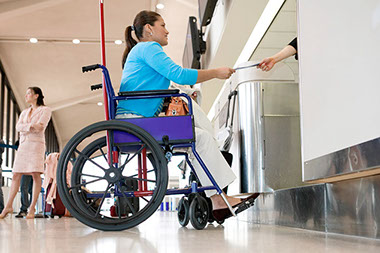
    Women in wheelchair at airport check-in counter.

    Physical limitations or medical problems don’t have to keep you homebound.

    *  If you have an artificial joint or pacemaker, carry a card from your physician saying so, and present the card before going through the airport metal detector.

    *  If meals are offered on your flight and you have special dietary needs, contact the airline at least 24 hours before your trip. Ask if you can get foods to meet your needs.

    *  If you need a wheelchair, contact the airline 48 hours before your trip. Airlines can provide wheelchairs narrow enough to fit through the aisle of a plane.

    *  If you depend on a seeing-eye dog, call the airline to find out if your dog can accompany you.

    Page image from A Year of Health Hints book by the American Institute for Preventive Medicine. www.HealthyLife.com. All rights reserved.

    © American Institute for Preventive Medicine
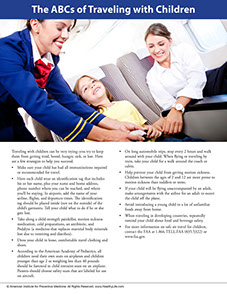
  • The Abcs Of Traveling With Children

    Healthy Travel

    Image of kids hanging around a camp site.

    Traveling with children can be very trying-you try to keep them from getting tired, bored, hungry, sick, or lost. Here are a few strategies to help you succeed.

    *  Make sure your child has had all immunizations required or recommended for travel.

    *  Have each child wear an identification tag that includes his or her name, plus your name and home address, phone number where you can be reached, and where you’ll be staying. In airports, add the name of your airline, flights, and departure times. The identification tag should be placed inside (not on the outside) of the child’s garments. Tell your child what to do if he or she gets lost.

    *  Take along a child-strength painkiller, motion sickness medication, cold preparations, an antibiotic, and Pedalyte (a medicine that replaces essential body minerals lost due to vomiting and diarrhea).

    *  Dress your child in loose, comfortable travel clothing and shoes.

    *  According to the American Academy of Pediatrics, all children need their own seats on airplanes and children younger than age 2 or weighing less than 40 pounds should be fastened in child restraint seats on an airplane. Parents should choose safety seats that are labeled for use on aircraft.

    *  On long automobile trips, stop every 2 hours and walk around with your child. When flying or traveling by train, take your child for a walk around the coach or cabin.

    *  Help prevent your child from getting motion sickness. Children between the ages of 2 and 12 are more prone to motion sickness than toddlers or teens.

    *  If your child will be flying unaccompanied by an adult, make arrangements with the airline for an adult to escort the child off the plane.

    *  Avoid introducing a young child to a lot of unfamiliar foods away from home.

    *  When traveling in developing countries, repeatedly remind your child about food and beverage safety.

    *  For more information on safe air travel for children, contact the FAA at 1.866.TELL.FAA (835.5322) orwww.faa.gov.

    Page image from A Year of Health Hints book by the American Institute for Preventive Medicine. www.HealthyLife.com. All rights reserved.

    © American Institute for Preventive Medicine
  • Prevent In-Flight Ear Pops

    Healthy Travel

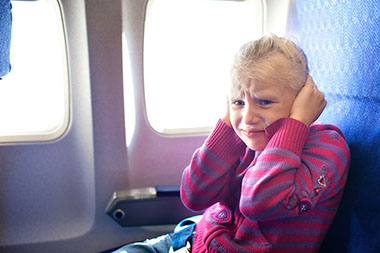
    Image of young girl on plane covering her ears.

    If you’re riding in a plane, your ears might feel full during takeoff and landing, then suddenly “pop.” Ear pops result from pressure changes in the middle ear as a plane changes altitude. You may feel pain or only mild discomfort. And if you have a head cold, ear pops can promote an ear infection.

    It’s rarely convenient to cancel or postpone your flight because of ear trouble. It is highly recommended, however, that you don’t fly if you have an acute ear infection, a severe head cold, or sinusitis. Consult your physician regarding this. If you still decide to fly, here are some ways to keep your ears from popping.

    *  Swallow frequently, yawn, or gently blow through your nose while pinching the nostrils shut, to equalize pressure within your ears. (Don’t do this if you have a head cold, as it will promote an ear infection.)

    *  If you have a mild head cold, use a nasal spray to keep the nasal passages open. Oral decongestant medications are also effective.

    Infants and young children tend to develop ear pain when traveling by plane, too. To prevent discomfort and ear infections in your children:

    *  Have your infant suck on a pacifier or bottle during the takeoff and landing. (Nursing a baby helps, too.)

    *  Ask your doctor about giving children a mild decongestant and antihistamine 1 hour before takeoff and 1 hour before landing.

    Page image from A Year of Health Hints book by the American Institute for Preventive Medicine. www.HealthyLife.com. All rights reserved.

    © American Institute for Preventive Medicine
  • Check Your Health Insurance Coverage

    Healthy Travel

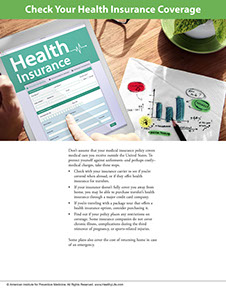
    Image of Health Insurance form on tablet.

    Don’t assume that your medical insurance policy covers medical care you receive outside the United States. To protect yourself against unforeseen-and perhaps costly-medical charges, take these steps.

    *  Check with your insurance carrier to see if you’re covered when abroad, or if they offer health insurance for travelers.

    *  If your insurance doesn’t fully cover you away from home, you may be able to purchase traveler’s health insurance through a major credit card company.

    *  If you’re traveling with a package tour that offers a health insurance option, consider purchasing it.

    *  Find out if your policy places any restrictions on coverage. Some insurance companies do not cover chronic illness, complications during the third trimester of pregnancy, or sports-related injuries.

    Some plans also cover the cost of returning home in case of an emergency.

    Page image from A Year of Health Hints book by the American Institute for Preventive Medicine. www.HealthyLife.com. All rights reserved.

    © American Institute for Preventive Medicine
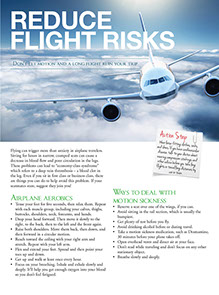
  • Reduce Flight Risks

    Healthy Travel

    Don’t let motion and a long flight ruin your trip.

    Flying can trigger more than anxiety in airplane travelers. Sitting for hours in narrow, cramped seats can cause a decrease in blood flow and poor circulation in the legs. These problems can lead to “economy-class syndrome” which refers to a deep vein thrombosis – a blood clot in the leg. Even if you sit in first class or business class, there are things you can do to help avoid this problem. If your seatmates stare, suggest they join you!

    Image of flying airplane.

    Airplane aerobics:

    *  Tense your feet for five seconds, then relax them. Repeat with each muscle group, including your calves, thighs, buttocks, shoulders, neck, forearms, and hands.

    *  Drop your head forward. Then move it slowly to the right, to the back, then to the left and the front again.

    *  Raise both shoulders. Move them back, then down, and then forward in a circular motion.

    *  Reach toward the ceiling with your right arm and stretch. Repeat with your left arm.

    *  Flex and extend your feet. Spread and then point your toes up and down.

    *  Get up and walk at least once every hour.

    *  Focus on your breathing. Inhale and exhale slowly and deeply. It’ll help you get enough oxygen into your blood so you don’t feel fatigued.

    To deal with motion sickness:

    *  Reserve a seat over one of the wings, if you can.

    *  Avoid sitting in the tail section, which is usually the bumpiest.

    *  Get plenty of rest before you fly.

    *  Avoid drinking alcohol before or during travel.

    *  Take a motion sickness medication, such as Dramamine, 30 minutes before your plane takes off.

    *  Open overhead vents and direct air at your face.

    *  Don’t read while traveling and don’t focus on any other stationary object.

    *  Breathe slowly and deeply.

    Action Step

    Wear loose-fitting clothes, socks, and shoes. If you have cardiovascular disease, talk to your doctor about wearing compression stockings and other advice before you take long flights or travel long distances by car or train.

    Page image from Ways to Well-Being book by the American Institute for Preventive Medicine. www.HealthyLife.com. All rights reserved.

    © American Institute for Preventive Medicine
  • Destination: Healthy Vacation

    Healthy Travel

    Image of father and child playing in the pool.

    Plan ahead to have a safe and fun trip!

    You deserve a break. In fact, doctors recommend it. Vacations are good for your health and happiness. Planning ahead, packing smart, and knowing about your destination will help you relax and enjoy.

    Do your homework.

    Learn about the places you plan to go to. Check out their weather conditions, construction areas, crime rates, and health concerns. Find out what your health insurance plan does and does not cover and if you need extra insurance. No matter where you travel, following these steps could make the difference between a great and a dreadful vacation.

    Dos

    *  Pack a basic first-aid kit.

    *  Pack all prescriptions and other valuables, such as jewelry in your carry-on luggage.

    *  Stretch your arms and legs at least every hour during travel.

    *  Stay hydrated. If the drinking water could be unsafe, choose bottled water.

    *  Wash your hands often. Take travel-size hand sanitizer gels and cloths.

    *  Talk to your family about safety concerns. Set rules for the kids.

    *  Tell a trusted friend or relative your trip schedule so you can be contacted for emergencies.

    *  Stop deliveries of papers and mail. Or, arrange to have someone pick them up.

    *  Ask your cell phone provider if you will have coverage. If not, consider renting a cell phone that does.

    Don’ts

    *  Don’t carry large amounts of cash or wear expensive jewelry.

    *  Don’t let kids wander or swim unsupervised.

    *  Don’t announce your vacation on Facebook, Twitter, or any other social network.

    *  Don’t hide the house key under the doormat.

    *  Don’t leave your pets home alone.

    Traveling abroad?

    Find out if you need certain vaccines. Contact the CDC Travelers’ Information Line at 800.CDC.INFO (232.4636) orwww.cdc.gov/travel. Ask your doctor, too. Discuss what medications you need to take to prevent and treat illnesses for you and your family.

    Action Step

    Make a To-Do list. Ask others traveling with you to contribute. Nothing is too obvious to write down. Check off tasks as you complete them.

    Page image from Ways to Well-Being book by the American Institute for Preventive Medicine. www.HealthyLife.com. All rights reserved.

    © American Institute for Preventive Medicine