Category: Uncategorized

  • Be Safe − Drive Safely Checklist

    Personal Safety

    *  Focus on the road when you are driving.

    *  Don’t talk on a cell phone or text message while driving.

    *  Always wear your seatbelt when you drive or ride in cars and trucks.

    *  Wear a helmet when riding on a motorcycle or a bicycle.

    *  Drive sober or with a driver who is.

    *  Discuss, with your care team, if any medication or supplement you take can make it unsafe for you to drive.

    *  Avoid driving at night if you have limited night vision.

    *  Keep emergency supplies in your car or truck. These include:

    – A cell phone

    – A flashlight and flares

    – Blankets

    – Bottled water

    Find out more about safe driving fromwww.safedriving.va.gov/resources/driving.asp

    Other Safety Tips

    *  Wear a medical alert tag to identify health concerns you have. Get one from a drug store or from: MedicAlert Foundation International at 1-888-633-4298 orwww.medicalert.org.

    *  Keep medicines and vitamins in “child-safe” containers and where children cannot reach them.

    *  Never be out of reach of a child in or near the water. Make sure children wear approved flotation devices. Adults should wear these, too.

    *  Lock guns in one place and bullets in another. Make sure children cannot get the keys.

    Resources

    VA National Center for Patient Safety

    www.patientsafety.gov

    National Safety Council

    www.nsc.org

    Health at Home Lifetime book by the American Institute for Preventive Medicine. www.HealthyLife.com. All rights reserved.

    © American Institute for Preventive Medicine

  • Relationship / Marital Problems

    Mental Health

    Signs & Causes

    Few, if any, relationships are perfect. Problems are bound to occur. The problems most often linked with marriage and other relationships include:

    *  Failures in communicating

    *  Misunderstandings

    *  Negative feelings, such as being hurt, put down, ignored, abused and/or lonely

    *  Power struggles

    *  Acting out to get attention. Ways to do this include pouting, whining, nagging and complaining

    *  Addictive behaviors

    Other problems arise when partners have different needs in a relationship. Common differences include:

    *  Money

    *  Sex

    *  Work

    *  Child-rearing

    *  “In-law” or other family problems

    *  Time and how it is spent (i.e., studying, partying, golfing, watching TV)

    Most of the time, these problems can be worked out by the persons involved. Professional help should be sought, though, if any of the following apply:

    *  The problems are severe

    *  The problems keep you from doing your daily tasks

    *  You cannot resolve the problems on your own

    *  You want to strengthen your relationship(s)

    Questions to Ask

    Self-Help

    Ways to Improve Communication

    *  Avoid blaming the other person. This puts him or her on the defensive and prevents communication. When blaming starts, listening stops.

    *  Take 51% of the responsibility for listening to what is being said. Ask questions to clear up what you don’t understand.

    *  Be sincere, honest, and show concern in your conversation. Don’t be sarcastic or make fun of the other person.

    *  Try to let go. Before getting into an argument, ask yourself if the issue can simply be “let go.” Ask the other person, too. If you both say yes, drop it and don’t let it re-surface at a later time.

    *  It’s alright to discuss problem issues, but be certain that you focus on how to solve the problem, not placing blame for it.

    *  Put yourself in the other person’s shoes. Try to see his or her point of view.

    *  Remind each other of the many positive strengths of the relationship. Build on these strong points. Don’t dwell on the negative ones.

    *  Don’t bring up old issues, disputes or grudges. When past problems enter in, the  conversation can get out of hand.

    *  Timing is critical. Ask yourself if it is the right time to bring up an issue. If the other person is undergoing problems with work, school, kids, health and/or family, adding yet another problem to their burden is not likely to solve the issue. It may serve to cause them more anguish. If possible, wait until the other person’s burden has lightened to bring up yet another problem.

    *  Don’t approach an issue with the idea of changing the other person’s mind or convey an attitude that you’re right and he or she is wrong.

    *  Share the issue. The problem belongs to both you and the other person. Work to understand your partner’s position first, then to have him or her understand your position.

    *  Omit distractions. Don’t attempt to discuss an issue while driving a car, taking care of children, doing a household chore or doing anything that will take your attention away from the issue and the other person.

    *  Make sure you know your own position and   be ready to state it clearly to the other person.

    *  Communicate in an assertive way.

    – State your position in terms of what your feelings about the issue are.

    – Don’t make demands of the other person or put them down.

    – Use “I” rather than “you” messages. For example, if you are upset by the fact that the other person has begun to neglect their appearance, instead of saying “You look like a slob,” it would be better to state “I like it better when your appearance is neat.”

    *  Listen with your heart. Hear what the other person is saying regardless of how they say it. Allow him or her to be comfortable while they are stating their position. Don’t take an “attack” position and wait tensely for your turn to talk. Don’t interrupt them while they are speaking.

    *  Make a plan. This should consist of what you can do to solve the issue and what you are willing to do. Knowing these things in advance can speed the solution and reconciliation process.

    *  Go in peace. Let the discussion of a problem run its course and end in peace with both of you at ease. Don’t continue to “stew” over who said what, the decisions that came out of the argument and whether the other person gained more than you did in the bargaining session. If you still feel uncomfortable with the solutions, re-state your position and try again. Be aware, however, that some issues may not be able to be changed. For example, in the case of differing sexual desires/needs, forcing or asking that your partner engage in sexual activity beyond their desire for it will not benefit you or your partner and will only cause more tension.

    Jealousy

    *  If you experience abnormal jealousy in relation to situations or persons in your life, the following suggestions may be helpful:

    *  Admit your jealousy. Pretending there is no problem or that it is not a serious problem only compounds the issue.

    *  Look for the cause of the jealousy. Some of the causes may be:

    – Your present or a past partner cheated on you which has caused you to feel insecure. Your partner seems to pay more attention to others, work or social friendships. Members of the opposite sex find your partner attractive and pay a lot of attention to him or her. You fear your partner may one day lose interest in you and seek another partner.

    *  Express your fears and concerns to your partner.

    *  Learn about jealousy. Read books on the subject, talk to people who live with jealous persons to get an idea of what it’s like to experience a partner’s jealous responses. Or, talk to other people who experience extreme jealous feelings themselves.

    *  Communicate. Talk to your spouse/partner about your feelings. Perhaps they are doing something they are not aware of that is causing you distress.

    *  Talk to a counselor if you cannot curb your jealous responses on your own.

    *  If you are the victim of someone’s abnormal jealousy or if you know someone who is abnormally jealous, the following suggestions may help you deal with them:

    – Be supportive. Recognize that your partner has a problem and encourage them to work on their behavior. Give them positive feedback as they progress.

    – Hold your ground. If your partner questions you, state your explanation clearly and without anger.

    – Be objective. Try to see the situation from your jealous partner’s point of view when possible. Avoid doing things that may be causing their jealousy and spend quality time together as a couple.

    – Don’t provoke jealousy. If you know your partner is prone to certain jealous reactions, don’t flirt with people in their presence, don’t ridicule, antagonize or tease your spouse/partner about their jealousy. Don’t leave “fake clues” to an alleged infidelity.

    – Don’t isolate yourself. Do not withdraw or avoid other social relationships. This can be the consequence of dealing with a violent or  otherwise abusive jealous person.

    *  Seek professional help. If you and your partner cannot work out your jealousy problems through communication, companionship and trying to create an otherwise satisfying relationship, consult a counselor.

    Sex

    *  Discuss your sexual needs with your partner.

    *  Ask your partner about his or her sexual needs.

    *  Develop areas where both you and your partner have compatible needs/desires.

    Money Matters

    *  Set financial goals. Decide together what you want to accomplish within a certain time (example: 6 months, 5 years, throughout life). Continue to review and modify your plans, if necessary.

    *  Organize financial records. Keep track of statements, check stubs and receipts. These can help monitor spending.

    *  Establish a credit history in both partners’ names.

    *  Limit the number of credit cards you have, how much you charge on them or get rid of them entirely. Opt for credit cards with the lowest interest rates, if you use them.

    *  Get professional help from an accountant, financial planner or other specialist if you need help managing your money.

    *  Develop a realistic budget. You can do this in one of two ways:

    – Single Fund – Both partners have a joint account and agree that “what’s mine is yours.” This works if both of you can agree on a budget and spending practices.

    – Separate Finances – This works well if both partners work. Each person is responsible for an agreed-on portion of the household costs. They are then free to do whatever  they wish with the rest of their money with no resentments from the other partner.

    Minding Your Mental Health Book. Published by the American Institute for Preventive Medicine. www.HealthyLife.com. All rights reserved.

    © American Institute for Preventive Medicine

  • Plan For Emergencies

    Medication

    Close up of hands filling a medication pill holder.

    Do you have a plan for what to do about your medicines during an emergency?

    One-week supply:Have a 7-day supply of medications and other medical supplies. Check expiration dates every six months.

    Storage tips:Store medications in labeled, child-proof containers in a dry, cool place. For refrigerated medicines, plan for some temporary storage.

    An important list:Include a medication list (prescription and non-prescription) and phone numbers for your doctors and pharmacies. Include copies of current prescriptions.

    ID cards:Always keep health insurance and prescription drug cards with you to replace damaged or lost medication, if needed.

    A Year of Health Hints book by the American Institute for Preventive Medicine. www.HealthyLife.com. All rights reserved.

    © American Institute for Preventive Medicine

  • Help For Restless Legs

    SELF-CARE CORNER

    Close up feet laying in bed.

    Do you feel a twitchy, jumpy feeling in your legs when you sit or lie down? Do you have an urge to move your legs when you go to bed at night? If so, you may have restless legs syndrome (RLS).

    What is RLS?

    RLS is known as a sleep disorder, although it can happen when you’re awake or asleep. It occurs when you’re resting or lying still, and is more common at night. Because it can interfere with sleep, RLS is linked to:

    *  Daytime sleepiness

    *  Memory problems or trouble concentrating

    *  Mood changes

    *  Job performance issues

    *  Problems with personal relationships

    RLS affects people of any age, but tends to cause more problems in older adults.

    What causes it?

    RLS can run in families, especially if your symptoms began before age 40. Experts believe RLS may be related to a problem in the part of the brain that controls movement. It may be linked to certain health problems, including:

    *  Low iron in your blood (iron deficiency anemia)

    *  End-stage renal (kidney) disease

    *  Neuropathy (nerve damage)

    Most of the time, though, there’s no clear cause of RLS.

    Self-care tips for restless legs

    You may be able to manage mild RLS at home. Try these tips:

    *  Avoid caffeine. Drinks like coffee, tea, energy drinks and cola usually contain caffeine.

    *  Don’t smoke. Ask your doctor if you need help quitting.

    *  Avoid alcohol.

    *  Get moderate exercise early in the day. Don’t exercise right before bedtime.

    *  Try relaxation techniques like deep breathing, meditation or yoga before bed.

    *  Make sleep a priority. Go to bed and get up at the same time each day. Aim for seven to eight hours of sleep each night.

    See your doctor regularly and tell your doctor about any symptoms you’re having. You may also want to ask if you should get your iron levels checked. Doctors sometimes treat more severe cases of RLS with medications.

    Sources: American Academy of Family Physicians, National Institute of Neurological Disorders and Stroke, Restless Legs Syndrome Foundation

    © American Institute for Preventive Medicine

  • Snoring And Your Health

    SELF-CARE CORNER

    Women sleeping while wearing a CPAP machine.

    Occasional snoring is often harmless. It may happen when a person has a stuffy nose or is lying on their back. But if you snore every night, talk with a doctor. Long-term snoring can lead to health problems.

    Sleep suffers

    Snoring can make you wake up many times during the night. You probably won’t remember these awakenings. They interfere with your body’s ability to get good, sound sleep.

    Without quality sleep, you may feel tired nearly every day. This can lead to problems at work, school or home. In severe cases, it can lead to dangers like car collisions if you fall asleep at the wheel.

    Obstructive sleep apnea

    Sometimes snoring is a sign of a health problem called obstructive sleep apnea (OSA). Signs of OSA include:

    *  Loud snoring that happens nearly every night

    *  Pauses in breathing during sleep (this can happen hundreds of times per night)

    *  Choking or gasping for air during the night

    *  Feeling very tired even after a full night’s sleep

    *  Trouble concentrating or being irritable

    *  Waking up with a headache

    OSA can also cause heart problems because it can increase a person’s risk of high blood pressure, stroke or heart disease. It can also cause an irregular heartbeat, known as an arrhythmia.

    How to fix snoring

    There are many ways to reduce or eliminate snoring. First, see a doctor to get checked for any health problems. Your doctor may recommend:

    *  If you smoke, quit. Smoking can make snoring worse and leads to other serious health problems.

    *  Limit or avoid alcohol. Don’t drink alcohol close to bedtime. Alcohol relaxes throat muscles and can cause more snoring and pauses in breathing.

    *  Work toward a healthy weight if you are overweight. Being overweight often makes snoring worse.

    If these measures don’t help, ask your doctor about other options. Certain devices and surgery can help some people quit snoring.

    Relationship problems

    Snoring can cause social problems too. Some people find that their marriage or domestic partnership suffers. Partners may not be able to sleep in the same room because of the noise.

    Sources: American Academy of Otolaryngology – Head and Neck Surgery

    © American Institute for Preventive Medicine

  • Exercise Safely In The Heat

    BE FIT

    Man sitting on bench beside his bike.

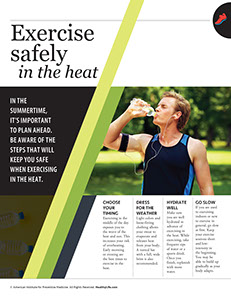
    Summer seems like an ideal time to exercise. After all, you don’t have to worry about slipping on ice or wearing extra layers to keep warm.

    But summer comes with its own set of safety issues. Heat illness can affect anyone, even people who are in great shape and healthy.

    What is heat illness?

    Heat illness happens when a person’s body gets too hot. This often happens when a person exercises in high temperatures.

    Heat illness can be mild to severe. Sometimes it’s just a sign that you need to cool off and get out of the sun. But other times, it can be dangerous or life-threatening.

    Time to chill out

    Signs of a mild heat illness include heat rash and heat cramps. A heat rash may be red and look like pimples. Heat cramps are muscle cramps or spasms.

    If you notice either of these signs when exercising, seek some shade and cool off. These are not usually serious conditions.

    People who have heart conditions or who follow a low-salt diet should talk to a doctor if they notice muscle cramps or spasms with exercise. If your heat rash doesn’t go away within a couple of days, see your doctor.

    When the heat is an emergency

    Heat exhaustion may cause:

    *  Heavy sweating

    *  Cold or clammy skin

    *  Feeling weak

    *  Weak but fast pulse

    *  Feeling sick

    *  Headache

    *  Fainting

    *  Dizziness

    If you notice these signs in yourself or another person, don’t wait. Seek shade or go indoors. Put cool, wet cloths on the body and head or take a cool bath. Get medical help if it doesn’t get better within an hour or if the person is throwing up.

    Heat stroke is the most severe kind of heat illness.

    It may cause:

    *  Temperature over 103ºF

    *  Skin that is clammy, hot or red, and even dry to the touch.

    *  Fast and strong pulse

    *  Headache or confusion

    *  Dizziness and/or fainting

    *  Feeling sick

    If you suspect heat stroke, get emergency medical care. Call 911 right away. Move the person to a cooler place. Apply cool cloths to their body. Do not give them anything to drink.

    Sources: Centers for Disease Control and Prevention, American Academy of Family Physicians

    © American Institute for Preventive Medicine

  • Lift Weights The Safe Way

    BE FIT

    Grandfather and grandson exercising by lifting weights.

    Lifting weights is great exercise. But if you don’t do it properly, you can get hurt. Here’s how you can get started, get stronger and avoid injuries.

    Learn good technique

    Have an instructor show you how to lift. You can use books, videos or virtual instruction if you can’t see a trainer in person.

    Keep your back straight when lifting, and wear shoes with good grip to avoid slipping. Stop the exercise if it hurts and wait a few days before trying it again.

    Set doable goals

    Don’t work the same muscles more than three times per week. Let muscles rest for 24 hours before working them again. Don’t try to do too much, too quickly. You’ll likely feel soreness for a day or two after lifting, and that’s normal.

    Warm up and cool down

    Warm up your muscles with active stretching, light jogging/walking or leg squats before you lift. When you’re done lifting, cool down and  stretch again.

    Stretching should not hurt. Hold the stretch steady – don’t bounce.

    When to see your doctor

    If you have ongoing pain or you think you hurt yourself while lifting, talk to your doctor.

    Source: American Academy of Family Physicians

    © American Institute for Preventive Medicine

  • Cold Weather Exercise

    BE FIT

    Cold weather can put a damper on outdoor exercise. But, continuing to exercise during the winter months has many benefits. Exercise combats seasonal depression, increases energy, and boosts immunity against illness.

    Here’s how to stay comfortable while you exercise in the cold:

    *  Wear layers so you can adjust your temperature as needed.

    *  Protect your hands and feet with warm gloves and socks.

    *  Wear sunglasses to protect your eyes from snow or ice glare.

    *  Stay hydrated. You may feel less thirsty in the cold but still need plenty of fluids.

    *  Stay indoors if the temperature is 0ºF or below or the wind chill is below zero.

    *  Choose the proper footwear for snowy or icy conditions.

    *  Cover your mouth with a breathable wrap to warm the air you breathe.

    *  Start slow. Your body will adapt to cold conditions but progress gradually.

    *  Check with your doctor to make sure cold-weather exercise is right for you.

    © American Institute for Preventive Medicine