Blog

  • Women’s Health

    Women’s Health

    Women at home, exercising with a fitness ball.

    Ask your doctor about the benefits and risks of current recommended screening tests for certain cancers and other health problems.

    Most often, ovarian cancer has no symptoms or only vague ones until the cancer is in an advanced stage. Tell your doctor if pain in your lower abdomen or pelvis lasts or if you feel full, even after a light meal.

    Menopause occurs when menstrual periods have stopped for one whole year. Hot flashes and other symptoms usually occur several years before menopause.

    Many over-the-counter products, such as black cohosh, soy items, vitamin and other supplements, etc. claim to relieve symptoms of menopause. Ask your doctor what products are okay for you to take on your own.

    Health at Home Lifetime book by the American Institute for Preventive Medicine. www.HealthyLife.com. All rights reserved.

    © American Institute for Preventive Medicine

  • Depression 2

    Women’s Health

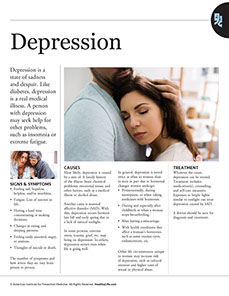
    Close up of women's face as she leans on man chest for support.

    Depression is a state of sadness and despair. Like diabetes, depression is a real medical illness. A person with depression may seek help for other problems, such as insomnia or extreme fatigue.

    Signs & Symptoms

    *  Feeling sad, hopeless, helpless, and/or worthless.

    *  Fatigue. Loss of interest in life.

    *  Having a hard time concentrating or making decisions.

    *  Changes in eating and sleeping patterns.

    *  Feeling easily annoyed, angry, or anxious.

    *  Thoughts of suicide or death.

    The number of symptoms and how severe they are vary from person to person.

    Causes

    Most likely, depression is caused by a mix of: A family history of the illness; brain chemical problems; emotional issues; and other factors, such as a medical illness or alcohol abuse.

    Another cause is seasonal affective disorder (SAD). With this, depression occurs between late fall and early spring due to a lack of natural sunlight.

    In some persons, extreme stress, trauma, grief, etc. may bring on depression. In others, depression occurs even when life is going well.

    In general, depression is noted twice as often in women than in men in part due to hormonal changes women undergo:

    *  Premenstrually, during menopause, or when taking medicines with hormones.

    *  During and especially after childbirth or when a woman stops breastfeeding.

    *  After having a miscarriage.

    *  With health conditions that affect a woman’s hormones, such as some ovarian cysts, endometriosis, etc.

    Other life circumstances unique to women may increase risk of depression, such as cultural stressors and higher rates of sexual or physical abuse.

    Treatment

    Whatever the cause, depression can be treated. Treatment includes medication(s), counseling, and self-care measures. Exposure to bright lights similar to sunlight can treat depression caused by SAD.

    A doctor should be seen for diagnosis and treatment.

    Questions to Ask

    Self-Care / Prevention

    *  Take medications as prescribed. Get your doctor’s advice before you take over-the-counter herbs, like St. John’s Wort, especially if you take other medications.

    *  Don’t use illegal drugs. Limit alcohol. These can cause or worsen depression. Drugs and alcohol can also make medicines for depression less effective. Harmful side effects can happen when alcohol and/or drugs are mixed with medicine.

    *  Eat healthy foods. Eat at regular times. Don’t skip meals or binge on junk food. Limit caffeine and sugary foods.

    *  Try not to isolate yourself. Be with people you feel safe with even though you feel down.

    *  Do something you enjoy. Do things that let you express yourself. Write, paint, etc.

    *  Exercise regularly.

    *  Relax. Listen to soft music, take a warm bath or shower. Do relaxation exercises. Meditation can help you deal with depression.

    *  Keep an emergency number handy (e.g., crisis hotline, trusted friend’s number, etc.) in case you feel desperate.

    Resources

    Women's Self-Care book by the American Institute for Preventive Medicine. www.HealthyLife.com. All rights reserved.

    © American Institute for Preventive Medicine

  • When To Consider Crowns

    Dental & Mouth Concerns

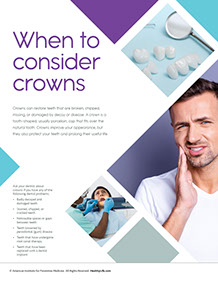
    Crowns can restore teeth that are broken, chipped, missing, or damaged by decay or disease. A crown is a tooth-shaped porcelain cap that fits over the natural tooth. Crowns improve your appearance, but they also protect your teeth and prolong their useful life.

    Ask your dentist about crowns if you have any of the following dental problems.

    *  Badly decayed and damaged teeth.

    *  Stained, chipped, or cracked teeth.

    *  Noticeable spaces or gaps between teeth.

    *  Teeth loosened by periodontal (gum) disease.

    *  Teeth that have undergone root canal therapy.

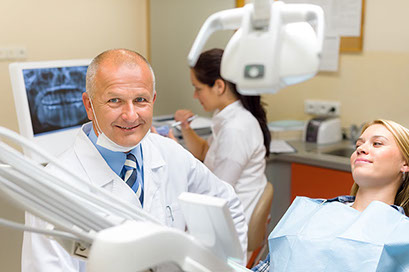
    image of dentist with patient.
    A Year of Health Hints book by the American Institute for Preventive Medicine. www.HealthyLife.com. All rights reserved.

    © American Institute for Preventive Medicine

  • Wheezing

    Respiratory conditions

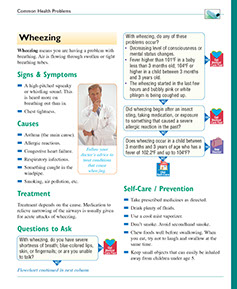
    Wheezing means you are having a problem with breathing. Air is flowing through swollen or tight breathing tubes.

    Signs & Symptoms

    *  A high-pitched squeaky or whistling sound. This is heard more on breathing out than in.

    *  Chest tightness.

    Causes

    *  Asthma (the main cause).

    *  Allergic reactions.

    *  Congestive heart failure.

    *  Respiratory infections.

    *  Something caught in the windpipe.

    *  Smoking, air pollution, etc.

    Treatment

    Treatment depends on the cause. Medication to relieve narrowing of the airways is usually given for acute attacks of wheezing.

    Questions to Ask

    Self-Care / Prevention

    *  Take prescribed medicines as directed.

    *  Drink plenty of fluids.

    *  Use a cool-mist vaporizer.

    *  Don’t smoke. Avoid secondhand smoke.

    *  Chew foods well before swallowing. When you eat, try not to laugh and swallow at the same time.

    *  Keep small objects that can easily be inhaled away from children under age 5.

    Healthier at Home book by the American Institute for Preventive Medicine. www.HealthyLife.com. All rights reserved.

    © American Institute for Preventive Medicine

  • West Nile Virus

    General Health Conditions

    Mosquito bites cause West Nile virus if the mosquito is infected with it.

    Signs & Symptoms

    Most people who get the virus will have no symptoms. About 1 in 5 persons will get mild ones (West Nile fever). Symptoms usually occur 3 to 14 days after being bitten by an infected mosquito. See doctor for the following:

    *  Fever.

    *  Headache.

    *  Body aches.

    *  Skin rash on the trunk of the body (sometimes).

    *  Swollen lymph glands (sometimes).

    About 1 in 150 persons get symptoms of a severe infection (West Nile encephalitis or meningitis). Get Immediate Care for the following:

    *  High fever.

    *  Stiff neck.

    *  Severe headache.

    *  Muscle weakness.

    *  Tremors. Confusion.

    *  Convulsions.

    *  Decreasing level of consciousness.

    *  Paralysis.

    Prevention

    Protect yourself from mosquito bites. Stay indoors at peak mosquito biting times (dawn, dusk, and early evening). Apply an insect repellent with DEET to clothing and exposed skin to last long enough for the times you will be outdoors. Wear long-sleeved shirts and long pants when you are outdoors.

    Resources

    Centers for Disease Control and Prevention

    www.cdc.gov

    Student Self-Care book by the American Institute for Preventive Medicine. www.HealthyLife.com. All rights reserved.

    © American Institute for Preventive Medicine

  • Wash It Off

    General Health Conditions

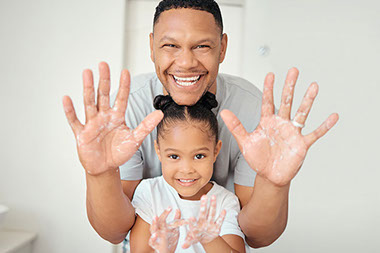
    Father and young daughter washing their hands.

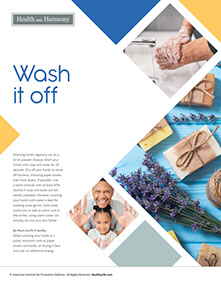
    Washing hands regularly can do a lot to prevent disease. Wash your hands with soap and water for 20 seconds. Dry off your hands to stave off bacteria, choosing paper towels over hand dryers, if possible. Use a hand sanitizer with at least 60% alcohol if soap and water are not readily available. However, washing your hands with water is best for washing away germs. Cold water works just as well as warm, and in the winter, using warm water can actually dry out your skin faster.

    Be More Earth-Friendly

    When washing your hands in a public restroom, and no paper towels are handy, air drying is best and uses no additional energy.

    Health at Home Lifetime book by the American Institute for Preventive Medicine. www.HealthyLife.com. All rights reserved.

    © American Institute for Preventive Medicine

  • Wash Hands For Health

    General Health Conditions

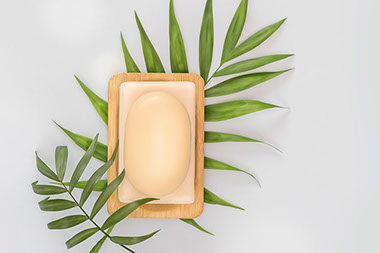
    Bar of soap.

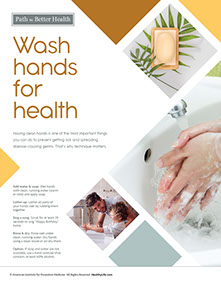
    Having clean hands is one of the most important things you can do to prevent getting sick and spreading disease-causing germs. That’s why technique matters.

    Add water & soap:Wet hands with clean, running water (warm or cold) and apply soap.

    Lather up:Lather all parts of your hands well by rubbing them together.

    Sing a song:Scrub for at least 20 seconds or sing “Happy Birthday” twice.

    Rinse & dry:Rinse well under clean, running water. Dry hands using a clean towel or air-dry them.

    Option:If soap and water are not available, use a hand sanitizer that contains at least 60% alcohol.

    Health at Home Lifetime book by the American Institute for Preventive Medicine. www.HealthyLife.com. All rights reserved.

    © American Institute for Preventive Medicine

  • Warts

    Skin Conditions

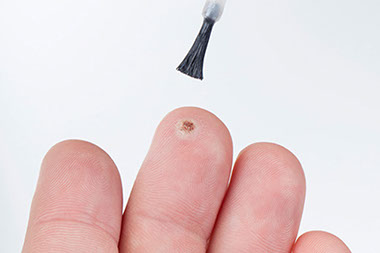
    Image of medication being applied to wart on finger.

    Warts are small skin growths. Most are harmless and painless. They can appear on any part of the body.

    Signs & Symptoms

    *  Common warts. These are firm and often have a rough surface. They are round or have an irregular shape. They are found on places subject to injury, such as the hands, fingers, and knees. Common warts are flesh-colored to brown. They may spread, but are not cancer.

    *  Flat warts. These are smooth and flesh-colored. They are found mainly on the hands and face and may itch.

    *  Plantar warts. These occur on the soles of the feet. They look like corns or calluses and may have little black dots in the center. They can be painful.

    *  Digitate warts. These threadlike warts grow on the scalp.

    *  Filiform warts. These are long, narrow, small growths. They appear mainly on the neck, eyelids, or armpits.

    *  Genital warts. SeeSexually Transmitted Infections (STIs) – Human Papillomavirus (HPV).

    Causes

    Warts are caused by human papillomaviruses. One of these viruses may enter the body through a cut or nick in the skin. Scratching or picking at warts may spread them to other sites. Some persons are more prone to getting warts than others. People who cannot fight off disease are also more at risk for warts. You cannot get warts from frogs or toads.

    Treatment

    Treatment for warts depends on their location, type, and severity and how long they have been on the skin. About 50% of warts go away in 6 to 12 months without treatment.

    Self-care measures can be used for warts not on the face or genitals. Medical treatment includes liquid nitrogen, chemical injections, topical medicines, laser surgery, and minor surgery.

    Questions to Ask

    Self-Care / Prevention

    *  Don’t touch, scratch, or pick at warts.

    *  Never cut or burn a wart off.

    *  Try an over-the-counter wart remover with salicylic acid. This can be a liquid or it can be in a medicated wart pad or patch. {Note: Do not use these wart removers on the face or genitals.} Follow package directions. A pumice stone helps remove the dead skin during this treatment.

    *  Ask your doctor about Retin A for flat warts.

    *  During treatment for plantar warts, put pads or cushions in your shoes. This can help relieve the pain when you walk.

    To Prevent Warts

    *  Don’t touch, scratch, or pick at warts.

    *  Wear plastic sandals or shower shoes in locker rooms and public swimming pool areas.

    *  Change shoes often to air them out.

    Resources

    Skinsight

    www.skinsight.com

    Healthier at Home book by the American Institute for Preventive Medicine. www.HealthyLife.com. All rights reserved.

    © American Institute for Preventive Medicine

  • Want To Have A Baby? Try This

    Pregnancy & Prenatal Care

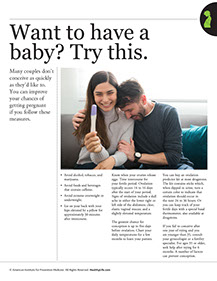
    Image of happy couple looking at positive pregnancy test, while male is making a phone call.

    Many couples don’t conceive as quickly as they’d like to. You can improve your chances of getting pregnant if you follow these measures.

    *  Avoid alcohol, tobacco, and marijuana.

    *  Avoid foods and beverages that contain caffeine.

    *  Avoid extreme overweight or underweight.

    *  Lie on your back with your hips elevated by a pillow for approximately 30 minutes after intercourse.

    *  Know when your ovaries release eggs. Time intercourse for your fertile period. Ovulation normally occurs 14 to 16 days after the start of your period. Signs of ovulation include a dull ache in either the lower right or left side of the abdomen; clear, elastic vaginal mucus; and a slightly elevated temperature.

    You can buy an ovulation predictor kit at most drugstores. The kit contains sticks which, when dipped in urine, turn blue if you’re ovulating.

    Or you can keep track of your fertile days with a special basal thermometer, also available at drugstores. Having intercourse when your temperature drops approximately 0.4ºF increases your chances of conception.

    If you fail to conceive after one year of trying, consult your gynecologist or a fertility specialist. A number of factors can prevent conception.

    A Year of Health Hints book by the American Institute for Preventive Medicine. www.HealthyLife.com. All rights reserved.

    © American Institute for Preventive Medicine

  • Vomiting & Nausea In Children

    Children’s Health

    Signs, Symptoms & Causes

    Vomiting is when you throw up what is in your stomach. Nausea is when you feel like you’re going to throw up.

    Here are some common causes of nausea and vomiting:

    *  Viruses in the intestines. (Your child can get diarrhea, too.)

    *  Getting upset.

    *  Morning sickness in pregnant teens.

    *  Motion sickness (getting “car sick” or “seasick” from travelling).

    *  Some medicines.

    *  Spoiled food.

    *  Eating or drinking too much.

    Some serious problems cause vomiting, too. Here are some of them:

    *  Appendicitis. This is when your child’s appendix is infected.

    *  Stomach ulcers.

    *  Meningitis.

    *  Brain tumors.

    Watch your child very closely if he or she is vomiting. Babies and small children can get dehydrated very fast. Dehydration is when your body doesn’t have enough water.

    Your older child or teen may make themselves throw up. This could be a sign of anorexia nervosa or bulimia.

    Questions to Ask

    Self-Care

    *  Be calm and loving. Throwing up can scare a child.

    *  Keep a bowl or basin near your child. Hold your hand against your child’s forehead when he or she vomits.

    *  Give your child water to rinse his or her mouth out after throwing up. Sponge your child’s face.

    *  Take away dirty clothes or bedding. Change to clean ones.

    *  Don’t smoke near your child.

    *  Don’t feed your child solid food. Don’t give your child milk.

    *  Wait 1 hour after your child throws up. Then give your child clear fluids (not too cold or too hot). Here are some examples:

    – Pedialyte®, Revital Ice®-rehydrating freezer pops, or other over-the-counter mixtures.

    – Lemon-lime soda or ginger ale for  older children. Stir the soda until the fizz is gone.

    – Gelatin (any color but red).

    *  Start with 1 teaspoon to 1 tablespoon of liquid every 10 minutes for babies. Start with 1 to 2 ounces every 15 minutes for children. Give twice as much each hour after the vomiting stops. If your child is still vomiting, stop fluids for 1 hour. Then start to give small amounts of fluid again.

    *  Slowly give your child more and more clear fluids. Don’t make your child drink when he or she doesn’t want anything.

    *  If you are breast-feeding:

    – If the baby throws up 3 or more times, give your baby Pedialyte® or other over-the-counter mixture.

    – Go back to nursing when your baby has gone 2 to 4 hours without vomiting. But feed less. Do only one side, and only for about 10 minutes.

    – Go back to nursing on both sides after 8 hours of no vomiting. But feed your baby less than usual for about 8 hours.

    *  For bottle-fed babies: After 12 hours of no vomiting, give formula. But mix 1/2 formula with 1/2 water.

    *  After your child stops throwing up, keep giving him or her clear fluids, like broth and gelatin (any color but red). Do this for 8 hours. Then give foods easy to digest, like crackers and rice. Then go back to the usual foods your child eats. But wait 12 to 24 hours after the last time your child vomited to give milk.

    *  Don’t give your child over-the-counter medicine unless the doctor tells you to.

    Call the doctor if your child doesn’t get better or if the vomiting comes back.

    Children's Self-Care book by the American Institute for Preventive Medicine. www.HealthyLife.com. All rights reserved.

    © American Institute for Preventive Medicine