Blog

  • Eye Health At Work

    Eye Conditions

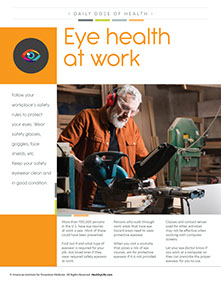
    Man wearing protective eye and hearing gear while using machinery.

    Follow your workplace’s safety rules to protect your eyes. Wear safety glasses, goggles, face shields, etc. Keep your safety eyewear clean and in good condition.

    More than 700,000 persons in the U.S. have eye injuries at work a year. Most of these could have been prevented.

    Find out if and what type of eyewear is required for your job. Ask loved ones if they wear required safety eyewear at work.

    Persons who walk through work areas that have eye hazard areas need to wear protective eyewear.

    When you visit a worksite that poses a risk of eye injuries, ask for protective eyewear if it is not provided.

    Glasses and contact lenses used for other activities may not be effective when working with computer screens.

    Let your eye doctor know if you work at a computer so they can prescribe the proper eyewear for you to use.

    Health at Home Lifetime book by the American Institute for Preventive Medicine. www.HealthyLife.com. All rights reserved.

    © American Institute for Preventive Medicine

  • Eye Care – Glaucoma

    Eye Conditions

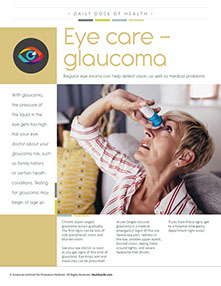
    Older women using eye drops.

    Regular eye exams can help detect vision, as well as medical problems.

    With glaucoma, the pressure of the liquid in the eye gets too high. Ask your eye doctor about your glaucoma risk, such as family history or certain health conditions. Testing for glaucoma may begin at age 40.

    Chronic (open-angle) glaucoma occurs gradually. The first signs can be loss of side (peripheral) vision and blurred vision.

    See your eye doctor as soon as you get signs of this kind of glaucoma. Eye drops and oral medicines can be prescribed.

    Acute (angle-closure) glaucoma is a medical emergency! Signs of this are: Severe eye pain, redness in the eye, swollen upper eyelid, blurred vision, seeing halos around lights, and severe headache that throbs.

    If you have these signs, get to a hospital emergency department right away!

    Health at Home Lifetime book by the American Institute for Preventive Medicine. www.HealthyLife.com. All rights reserved.

    © American Institute for Preventive Medicine

  • Ectopic Pregnancies

    Pregnancy & Prenatal Care

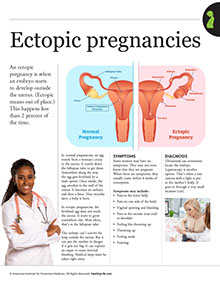
    An ectopic pregnancy is when an embryo starts to develop outside the uterus. (Ectopic means out of place.) This happens less than 2 percent of the time.

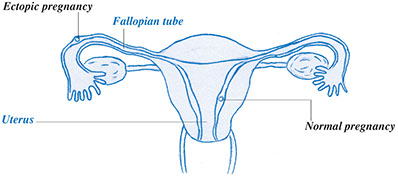
    In normal pregnancies, an egg travels from a woman’s ovary to the uterus. It travels down the fallopian tube to get there. Somewhere along the way, the egg gets fertilized by a male sperm. Once inside, the egg attaches to the wall of the uterus. It becomes an embryo and then a fetus. Nine months later, a baby is born.

    In ectopic pregnancies, the fertilized egg does not reach the uterus. It starts to grow somewhere else. Most often, that’s in the fallopian tube.

    The embryo can’t survive for long outside the uterus. But it can put the mother in danger if it gets too big. It can rupture an organ or cause internal bleeding. Medical steps must be taken right away.

    Symptoms

    Some women may have no symptoms. They may not even know that they are pregnant. When there are symptoms, they usually come within 8 weeks of conception. Symptoms may include:

    *  Pain in the lower belly

    *  Pain on one side of the body

    *  Vaginal spotting and bleeding

    *  Pain in the rectum (rear end) or shoulder

    *  Feeling like throwing up

    *  Throwing up

    *  Feeling weak

    *  Fainting

    Diagnosis

    Ultrasound can sometimes locate the embryo. Laparoscopy is another option. That’s when a tiny camera with a light is put in the mother’s body. It goes in through a very small incision (cut).

    Illustration of normal vs ectopic pregnancy.

    Causes

    There are many causes for ectopic pregnancies:

    *  Damage to the ovary or fallopian tube

    *  Scarring of the ovary or fallopian tube. Scarring can result from endometriosis, pelvic inflammatory disease or an STD.

    Also, the risk for an ectopic pregnancy is higher for women who:

    *  Have had an ectopic pregnancy in the past

    *  Have had fallopian tube surgery

    *  Have had problems getting pregnant

    *  Have used an IUD for birth control

    These women should call their health care provider when they miss a menstrual period.

    Treatment

    Medicines may be used. But if some time has passed, surgery may be needed. The embryo is removed. Any damage to the mother’s body is repaired. In some rare cases, a fallopian tube or ovary must be removed. But women have another set of these. So the mother may become pregnant again.

    Questions to Ask

    Self-Care / Prevention

    Tips to Lower the Risk of an Ectopic Pregnancy

    *  Talk to your health care provider about your risks for damage to your fallopian tubes from:

    – STDs

    – Pelvic Inflammatory Disease

    – Endometriosis

    *  Ask if you need to get tested for these and how often. Find out, too, if your health plan pays for these tests.

    *  Schedule any tests needed with your health care provider.

    Prenatal Self-Care book by the American Institute for Preventive Medicine. www.HealthyLife.com. All rights reserved.

    © American Institute for Preventive Medicine

  • Smart Ways To Exercise During Pregnancy

    Pregnancy & Prenatal Care

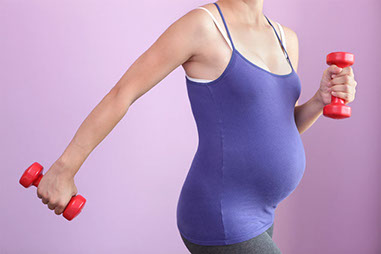
    Image of pregnant women exercising with dumb bells.

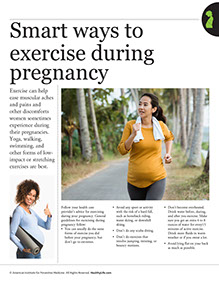
    Exercise can help ease muscular aches and pains and other discomforts women sometimes experience during their pregnancies. Yoga, walking, swimming, and other forms of low-impact or stretching exercises are best.

    Follow your health care provider’s advice for exercising during your pregnancy. General guidelines for exercising during pregnancy follow:

    *  You can usually do the same forms of exercise you did before your pregnancy, but don’t go to extremes.

    *  Check your pulse when you exercise. In general, your heart rate should stay below 140 beats a minute.

    *  Avoid any sport or activity with the risk of a hard fall, such as horseback riding and water skiing.

    *  Don’t do exercises that involve jumping, twisting, or bouncy motions.

    *  Don’t become overheated. Drink water before, during, and after you exercise. Make sure you get an extra 4 to 8 ounces of water for every 15 minutes of active exercise. Drink more fluids in warm weather or if you sweat a lot.

    *  After the 20th week of pregnancy, avoid exercises in which you lie flat on your back.

    A Year of Health Hints book by the American Institute for Preventive Medicine. www.HealthyLife.com. All rights reserved.

    © American Institute for Preventive Medicine

  • Endometriosis

    Women’s Health

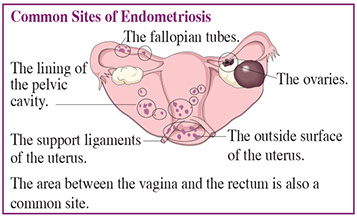
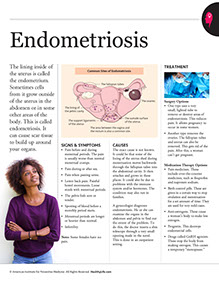
    The lining inside of the uterus is called the endometrium. Sometimes cells from it grow outside of the uterus in the abdomen or in some other areas of the body. This is called endometriosis. It can cause scar tissue to build up around your organs.

    Women in their 20s, 30s, and 40s are most likely to notice problems. Teens and women past menopause can have them, too.

    Signs & Symptoms

    *  Pain before and during menstrual periods. The pain is usually worse than normal menstrual cramps.

    *  Pain during or after sex.

    *  Pain when passing urine.

    *  Lower back pain. Painful bowel movements. Loose stools with menstrual periods.

    *  The pelvis feels sore or tender.

    *  Spotting of blood before a monthly period starts.

    *  Menstrual periods are longer or heavier than normal.

    *  Infertility.

    Some females have no pain.

    Causes

    The exact cause is not known. It could be that some of the lining of the uterus moves backwards through the fallopian tubes into the abdominal cavity. It then attaches and grows in these places. It could also be due to problems with the immune system and/or hormones. The condition may also run in families.

    Common sites of endometriosis.

    A gynecologist diagnoses endometriosis. He or she can examine the organs in the abdomen and pelvis to find out the extent of the problem. To do this, the doctor inserts a slim telescope through a very small opening made in the navel. This is done in an outpatient setting.

    Treatment

    Surgery Options

    *  One type uses a very small, lighted tube to remove or destroy areas of endometriosis. This reduces pain. It allows pregnancy to occur in some women.

    *  Another type removes the ovaries. The fallopian tubes and uterus can also be removed. This gets rid of the pain. A woman can’t get pregnant after this is done.

    Medication Therapy Options

    *  Pain medicines. These include over-the-counter medicines, such as ibuprofen and naproxen sodium.

    *  Birth control pills. These are given in a certain way to stop ovulation and menstruation for a set amount of time. They are used for very mild cases.

    *  Anti-estrogens. These cause a woman’s body to make less estrogen.

    *  Progestin. This destroys endometrial cells.

    *  Drugs called GnRH agonists. These stop the body from making estrogen. This causes a temporary “menopause.”

    Questions to Ask

    Self-Care / Prevention

    Endometriosis needs medical treatment. What can you do?

    *  Do regular exercise.

    *  Eat a diet high in nutrients and low in fat, especially saturated fat. This is mostly found in hydrogenated vegetable oils (trans fats), animal sources of fat, and coconut and palm oils.

    *  Take an over-the-counter medicine for pain. Ask your doctor which one(s) he or she prefers you take.

    Resources

    Endometriosis Association (EA)

    800.992.3636

    414.355.2200

    www.endometriosisassn.org

    Women's Self-Care book by the American Institute for Preventive Medicine. www.HealthyLife.com. All rights reserved.

    © American Institute for Preventive Medicine

  • Emphysema

    Respiratory conditions

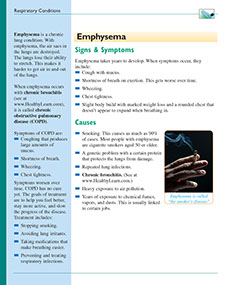
    Emphysema is a chronic lung condition. With emphysema, the air sacs in the lungs are destroyed. The lungs lose their ability to stretch. This makes it harder to get air in and out of the lungs.

    When emphysema occurs with chronic bronchitis it is called chronic obstructive pulmonary disease (COPD).

    Signs & Symptoms

    Emphysema takes years to develop. When symptoms occur, they include:

    *  Cough with mucus.

    *  Shortness of breath on exertion. This gets worse over time.

    *  Wheezing.

    *  Chest tightness.

    *  Slight body build with marked weight loss and a rounded chest that doesn’t appear to expand when breathing in.

    Symptoms of COPD are:

    *  Coughing that produces large amounts of mucus.

    *  Shortness of breath.

    *  Wheezing.

    *  Chest tightness.

    Symptoms worsen over time. COPD has no cure yet. The goals of treatment are to help you feel better, stay more active, and slow the progress of the disease. Treatment includes:

    *  Stopping smoking.

    *  Avoiding lung irritants.

    *  Taking medications that make breathing easier.

    *  Preventing and treating respiratory infections.

    Causes

    *  Smoking. This causes as much as 90% of cases. Most people with emphysema are cigarette smokers aged 50 or older.

    *  A genetic problem with a certain protein that protects the lungs from damage.

    *  Repeated lung infections.

    *  Chronic bronchitis.

    *  Heavy exposure to air pollution.

    *  Years of exposure to chemical fumes, vapors, and dusts. This is usually linked to certain jobs.

    Treatment

    *  A program, medication, and/or nicotine replacement to stop smoking.

    *  Physical therapy to loosen mucus in the lungs for chronic bronchitis.

    *  Medicines, such as bronchodilators, corticosteroids, and antibiotics.

    *  Flu and pneumonia vaccines.

    *  Surgery that removes the most severely diseased parts of the lung. A lung transplant may be needed for some persons with very severe disease.

    Emphysema can’t be reversed. By the time it is found, 50% to 70% of lung tissue may already be destroyed. Prevention is the only way to avoid permanent damage.

    Questions to Ask

    Self-Care / Prevention

    *  Don’t smoke. If you smoke, quit. Avoid secondhand smoke.

    *  Limit exposure to air pollution and lung irritants. Follow safety measures when working with materials that can irritate your lungs.

    *  Use a cool-mist vaporizer indoors.

    *  Drink plenty of fluids.

    *  Avoid dust, fumes, pollutants, etc.

    *  Do breathing exercises as advised by your doctor.

    *  Exercise daily as prescribed by your doctor or exercise therapist.

    Resources

    American Lung Association

    800.LUNG.USA (586.4872)

    www.lungusa.org

    National Cancer Institute’s Smoking Quitline

    877.44U.QUIT (448.7848)

    National Heart, Lung, and Blood Institute

    www.nhlbi.nih.gov

    Smokefree.Gov

    800.QUIT.NOW (748.8669)

    www.smokefree.gov

    Healthier at Home book by the American Institute for Preventive Medicine. www.HealthyLife.com. All rights reserved.

    © American Institute for Preventive Medicine

  • Electric Shock

    First Aid

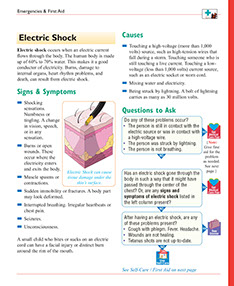
    Electric shock occurs when an electric current flows through the body. The human body is made up of 60% to 70% water. This makes it a good conductor of electricity. Burns, damage to internal organs, heart rhythm problems, and death, can result from electric shock.

    Signs & Symptoms

    *  Shocking sensations. Numbness or tingling. A change in vision, speech, or in any sensation.

    *  Burns or open wounds. These occur where the electricity enters and exits the body.

    *  Muscle spasms or contractions.

    *  Sudden immobility or fractures. A body part may look deformed.

    *  Interrupted breathing. Irregular heartbeats or chest pain.

    *  Seizures.

    *  Unconsciousness.

    A small child who bites or sucks on an electric cord can have a facial injury or distinct burn around the rim of the mouth.

    Causes

    *  Touching a high-voltage (more than 1,000 volts) source, such as high-tension wires that fall during a storm. Touching someone who is still touching a live current. Touching a low-voltage (less than 1,000 volts) current source, such as an electric socket or worn cord.

    *  Mixing water and electricity.

    *  Being struck by lightning. A bolt of lightning carries as many as 30 million volts.

    Treatment

    Contact with electricity from a high-voltage wire or being struck by lightning needs emergency medical care. Contact with electricity from a low-voltage current needs emergency medical care if any signs or symptoms are present. A person who does not have any symptoms should still see a doctor to check for possible internal injuries.

    To Avoid Being Harmed by Lightning

    *  Heed weather warnings.

    *  Take shelter in a building, if you can.

    *  Stay in your car (if it is not a convertible) rather than out in the open.

    *  If you are caught outside, avoid tall trees, open water, metal objects, and high ground. Crawl into a low-lying place or curl up on the ground, head to knees with your head touching the ground.

    Questions to Ask

    Self-Care / First Aid

    Beware! Do not put yourself in danger to give first aid. Do not touch the person until power is shut off.

    *  If the source is a high-voltage wire or lightning, call 9-1-1!

    *  It is safe to touch a person struck by lightning.

    *  If the source is a low-voltage current, remove the fuse or switch off the circuit breaker to the electrical outlet.

    *  If you can’t shut off the source, with dry feet and hands, use a board, wooden stick, rope, etc. to get the person away from the source.

    *  If it is safe for you to touch the person, check for a response. Give CPR, as needed.

    *  Unless it is absolutely necessary, don’t move the person. He or she could have a traumatic injury, especially to the head or neck.

    *  Check for burns. Cover burned areas with dry, sterile dressings.

    *  Give first aid for Shock, if needed.

    Prevention

    *  Stay clear of fallen wires. Inform the police, electric company, etc.

    *  Install ground-fault circuit-interrupters (GFCIs) in wall outlets of bathrooms, kitchens, etc. With GFCIs, when an electrical appliance falls into water, the current is instantly cut off.

    *  Don’t turn electrical switches on or off or touch an electric appliance while your hands are wet, while standing in water, or when sitting in a bathtub.

    *  Replace worn cords and wiring.

    *  Cover all electric sockets with plastic safety caps.

    *  Before you do electrical repairs, remove the fuse from the fuse box or switch off the circuit breaker. Don’t just turn off the appliance or light switch.

    Healthier at Home book by the American Institute for Preventive Medicine. www.HealthyLife.com. All rights reserved.

    © American Institute for Preventive Medicine

  • Erectile Dysfunction

    Men’s Health

    With, erectile dysfunction (ED), a male can’t get or keep an erection firm enough for sex in 25% or more of attempts. Sometimes, ED is called impotence. Impotence can be ED, but can also mean a lack of sexual desire and problems with orgasm.

    Signs & Symptoms

    *  Not being able to get an erection at all.

    *  An erection is too brief, weak, or painful for satisfying sex.

    *  An erection loses strength with penetration.

    Causes

    Blood vessel diseases, diabetes, and other physical problems are the usual cause of ED. Other causes are smoking and a side effect of some medicines, such as beta-blockers and water pills. Only 10% to 20% of ED cases are due to emotional factors, such as stress and fear of not being able to perform. Suspect this cause if erections occur during sleep or when waking up.

    Treatment

    *  Treatment for conditions that cause ED.

    *  Medication.

    *  A vacuum erection device.

    *  Self-injection therapy or a penile implant.

    Questions to Ask

    Self-Care / Prevention

    *  Take medicine for ED as prescribed.

    *  Check with your doctor before you take herbs, etc. sold for ED. These include Actra- Rx, ginko biloba, yohimbe, Siberian ginseng, and Yilishen.

    *  If you have diabetes, follow your treatment plan.

    *  Don’t smoke. Don’t use street drugs.

    *  Don’t have more than 2 alcoholic drinks a day.

    *  Relax. Manage stress. Get plenty of rest.

    *  Share your fears, needs, etc. with your partner.

    *  Don’t focus just on performance. Find pleasure when you hug, kiss, and caress your partner.

    Healthier at Home book by the American Institute for Preventive Medicine. www.HealthyLife.com. All rights reserved.

    © American Institute for Preventive Medicine

  • Eczema

    Skin Conditions

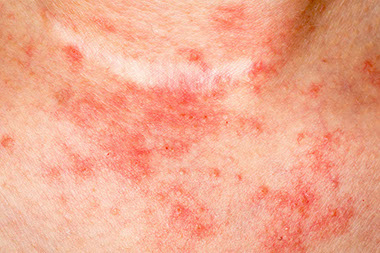
    Image of an eczema rash.

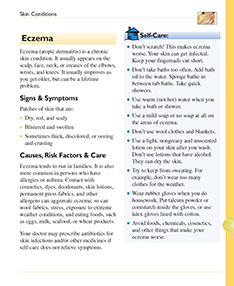
    Eczema (atopic dermatitis) is a chronic skin condition. It usually appears on the scalp, face, neck, or creases of the elbows, wrists, and knees. It usually improves as you get older, but can be a lifetime problem.

    Signs & Symptoms

    Patches of skin that are:

    *  Dry, red, and scaly

    *  Blistered and swollen

    *  Sometimes thick, discolored, or oozing and crusting

    Causes, Risk Factors & Care

    Eczema tends to run in families. It is also more common in persons who have allergies or asthma. Contact with cosmetics, dyes, deodorants, skin lotions, permanent press fabrics, and other allergens can aggravate eczema; so can wool fabrics, stress, exposure to extreme weather conditions, and eating foods, such as eggs, milk, seafood, or wheat products.

    Your doctor may prescribe antibiotics for skin infections and/or other medicines if self-care does not relieve symptoms.

    Self-Care

    *  Don’t scratch! This makes eczema worse. Your skin can get infected. Keep your fingernails cut short.

    *  Don’t take baths too often. Add bath oil to the water. Sponge bathe in between tub baths. Take quick showers.

    *  Use warm (not hot) water when you take a bath or shower.

    *  Use a mild soap or no soap at all on the areas of eczema.

    *  Don’t use wool clothes and blankets.

    *  Use a light, nongreasy and unscented lotion on your skin after you wash. Don’t use lotions that have alcohol. They can dry the skin.

    *  Try to keep from sweating. For example, don’t wear too many clothes for the weather.

    *  Wear rubber gloves when you do housework. Put talcum powder or cornstarch inside the gloves, or use latex gloves lined with cotton.

    *  Avoid foods, chemicals, cosmetics, and other things that make your eczema worse.

    When to Seek Medical Care

    Contact Doctor When:

    *  You have signs of an infection: Fever; and/or large amount of weeping or crusting skin areas.

    *  Your skin is red, you can’t stop scratching, and this keeps you from sleeping.

    *  You get no relief from self-care.

    Health at Home Lifetime book by the American Institute for Preventive Medicine. www.HealthyLife.com. All rights reserved.

    © American Institute for Preventive Medicine

  • Eating Right During Pregnancy

    Pregnancy & Prenatal Care

    What It’s All About

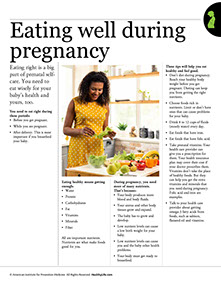
    Eating right is a big part of prenatal self-care. You need to eat wisely for your baby’s health and yours, too. You need to eat right during these periods:

    *  Before you get pregnant

    *  While you are pregnant

    *  After delivery. This is most important if you breast-feed your baby.

    Eating right means getting enough:

    *  Water

    *  Protein

    *  Carbohydrates

    *  Fat

    *  Vitamins

    *  Minerals

    *  Fiber

    These tips will help you eat right and feel good.

    *  Don’t diet during pregnancy. Reach your healthy body weight before you get pregnant. Dieting can keep you from getting the right nutrients.

    *  Choose foods rich in nutrients. Limit or don’t have ones that can cause problems for your baby.

    *  Drink 8 to 12 cups of fluid every day. Follow your provider’s advice for liquids with caffeine. Examples: coffee, tea, and some soft drinks.

    *  Eat foods that have iron.

    *  Eat foods that have folic acid.

    *  Take prenatal vitamins (vitamin pills). Your health care provider can give you a prescription for them. Your health insurance plan may cover the cost of them if your doctor prescribes them. Vitamins don’t take the place of healthy foods. But they can help you get the extra vitamins and minerals that you need during pregnancy. Folic acid and iron are examples.

    *  Talk to your health care provider about getting omega-3 fatty acids from foods, such as salmon and from flaxseed oil and vitamins.

    During pregnancy, you need more of many nutrients. That’s because:

    *  Your body produces more blood and body fluids.

    *  Your uterus and other body tissues grow and expand.

    *  The baby has to grow and develop.

    *  Low nutrient levels can cause a low birth weight for your baby.

    *  Low nutrient levels can cause you and the baby other health problems.

    *  Your body must get ready to breast-feed.

    Food Rich in Nutrients

    Grains – Eat 9 oz. or more every day.

    1 oz. is about 1 slice of bread, about 1 cup of breakfast cereal, or 1/2 cup of cooked rice, cereal, or pasta.

    *  Choose whole-grain cereals, breads, crackers, rice, or pasta as much as you can. When you don’t, choose grains that have folic acid added.

    Vegetables – Eat at least 4 servings every day.

    One serving = 1 cup raw leafy vegetables, 1/2 cup other vegetables (raw or cooked) or 3/4 cup vegetable juice. Vary your veggies.

    *  Eat dark-green veggies like broccoli, spinach, and other dark leafy greens.

    *  Eat orange vegetables like carrots and sweet potatoes.

    *  Eat dry beans and peas like pinto beans, kidney beans, and lentils.

    Fruits – Eat at least 3 servings every day.

    1 serving = 1 medium piece of fruit, 1/2 cup chopped fruit, or 3/4 cup fruit juice. Focus on fruits.

    *  Eat a variety of fruit.

    *  Choose fresh, frozen, canned, or dried fruit. Go easy on fruit juices.

    Milk – Get 3 to 4 servings every day.

    1 serving = 1 cup of milk or yogurt, 1-1/2 oz. natural cheese, or 2 oz. processed cheese. Get calcium-rich foods.

    *  Go low-fat or fat-free when you choose milk, yogurt, and other milk products.

    *  If you don’t drink milk, choose lactose-free products or other calcium sources, such as fortified foods and beverages.

    Meats & Beans – Eat at least 6 oz. every day.

    1 oz. meat = 1/2 cup cooked dried beans, 1 egg, 1/2 cup tofu, 1/3 cup nuts, or 2 tablespoons peanut butter. Go lean with protein.

    *  Choose low-fat or lean meats and poultry.

    *  Bake it, broil it, or grill it.

    *  Vary your protein choices. Choose more fish, beans, peas, nuts, and seeds.

    Items to Limit or Avoid

    *  Do not drink alcoholic beverages. It is not known if any or how much alcohol is safe during pregnancy. It is better to not drink any at all.

    *  Use little or no caffeine. Ask your doctor how much caffeine you can have in a day. Name-brand teas without caffeine are safe. You can find these in the supermarket. But beware of certain herbal or “natural” teas. Sometimes they contain things that can be harmful. Examples of these things: sassafras, mistletoe, bittersweet, and spotted hemlock. These teas are usually found in health food stores. Always read the label to find out what you are buying!

    *  Don’t use saccharin. This is sugar substitute. Follow your health care provider’s advice for other ones, too. Examples: Nutrasweet and Splenda.

    *  Wash fresh fruits and vegetables before you eat them. Don’t eat raw alfalfa sprouts. Don’t eat raw or rare meat. Wash your hands after you handle raw meat.

    *  Some foods have bacteria that can cause an infection called listeriosis. This can cause harm to the baby. How can you avoid this? Don’t have foods that are unpateurized. Examples are soft cheeses like feta and Brie. If you eat hot dogs, luncheon meats, or deli meats, heat them first.

    *  Don’t eat fish that has a lot of mercury. Examples: shark, swordfish, tile fish, and king mackerel. Limit “white” tuna fish, too. Ask your health care provider what kind of fish to eat and how much.

    *  Tell your health care provider if you crave laundry starch, clay, or dirt. Eating these things can harm you and the baby.

    Weight Gain and Your Pregnancy

    *  Talk to your health care provider about weight gain. The amount you should gain depends on:

    – Your height and what you weighed before you got pregnant

    – Your special pregnancy needs

    – Your ethnic and family background

    *  Is your body weight about right for your build? If so, your best weight gain is about 25 to 35 pounds.

    – Petite, small-boned women should gain about 25 pounds.

    – Medium-built women should gain about 30 pounds.

    – Larger, bigger-boned women should gain about 35 pounds.

    – Obese women should gain the number of pounds their health care provider suggests.

    *  How fast should you gain weight? If you start your pregnancy with a healthy body weight:

    – Gain 3 to 4 pounds in the first trimester.

    – Gain 12 to 14 pounds in the second trimester. That’s about a pound a week.

    – Gain 8 to 10 pounds in the third trimester. Third trimester breakdown: During months 7 and 8, gain about a pound a week. During month 9, gain only a pound or two-or nothing at all.

    {Note: It is rare to match this formula for weight gain exactly. It’s okay to vary a little. But try to keep your weight gain steady.}

    *  If you were underweight before you got pregnant, you should gain between 28 and 40 pounds.

    *  If you are 10 to 20 percent overweight, you should gain about 15 to 25 pounds.

    *  If you are more than 20 percent overweight, you should gain about 11 to 20 pounds.

    *  Pregnancy is never a time to lose weight, though. It’s not a time to stay the same weight, either. That’s because your baby can’t live on stored fat alone.

    *  How much weight you should gain is up to your health care provider.

    *  If you are carrying more than one baby:

    – Your health care provider will tell you your ideal weight gain.

    – Your weight will increase to about 35 to 45 pounds for twins. It will be more if you are having more than two babies!

    Resources

    ChooseMyPlate.gov

    www.choosemyplate.gov

    Page from Prenatal Self-Care book by the American Institute for Preventive Medicine. www.HealthyLife.com. All rights reserved.

    © American Institute for Preventive Medicine