Tag: awareness

  • A Bucket Of Ice

    MEDICAL NEWS

    Image of a bucket filled with ice.

    Have you taken the ice bucket challenge? What do you know about the disease you were raising funds for?

    Amyotrophic lateral sclerosis (ALS), sometimes called Lou Gehrig’s disease, is a rapidly progressive, fatal neurological disease that attacks the nerve cells responsible for controlling voluntary muscles.

    According to the National Institute of Neurological Disorders and Stroke, ALS attacks nerve cells that control muscles in the arms, legs, and face. Eventually use of limbs and speech stop. Voluntary movement is lost. And with that comes loss of the ability to breathe.

    There is no test to diagnose it. There is no cure. And no one knows who will get it and who does not. Ongoing research is looking for answers.

    Lou Gehrig was a baseball legend, the first baseman for the New York Yankees who developed the disease that ended his incredible career and his life.

    © American Institute for Preventive Medicine

  • Breast Cancer

    Cancer

    Female doctor holding a pink ribbon for breast cancer awareness.

    The pink ribbon is the symbol of breast cancer awareness.

    If you are due for a mammogram, and have not yet scheduled one this year, do it today.

    Schedule a mammogram. This X-ray of the breasts can help detect breast cancer early, when it is easier to treat successfully.

    Women are advised to get a mammogram every 1 to 2 years starting at age 40. Women at a higher risk for breast cancer should seek expert medical advice about getting mammograms.

    Ask your doctor about your risk for breast cancer. You can also use the Breast Cancer Risk Assessment Tool atcancer.gov/bcrisktool.

    Health at Home Lifetime book by the American Institute for Preventive Medicine. www.HealthyLife.com. All rights reserved.

    © American Institute for Preventive Medicine

  • Alcohol Increases Risk For Breast Cancer

    SELF-CARE CORNER

    Image of middle-aged women smiling wearing a pink blazer.

    Breast cancer is the second leading cause of cancer death for women in the United States, after lung cancer. Dr. Erica Mayer, a breast cancer expert at Dana-Farber Cancer Institute, says there are at least 5 simple ways women can reduce their risk of getting the disease:

    1.Limit alcohol.Research has shown having too much alcohol can increase your risk of breast cancer. If you choose to drink alcohol-including beer, wine, or liquor-limit yourself to no more than one half to one drink a day on average.

    2.Get a mammogram.Many health organizations advise women to get regular mammograms starting at age 40. “Mammography screening does not prevent or cure breast cancer, but it may detect the disease before symptoms occur,” said Dr. Mayer.

    3.Eat a healthy diet and keep your weight under control.The American Cancer Society recommends a diet rich in vegetables, fruits, whole grains, and fiber. “High-fat diets can lead to being overweight or obese, which is a risk factor for breast cancer,” said Dr. Mayer.

    4.Exercise.There’s growing evidence that physical activity reduces a woman’s breast cancer risk.

    5.Determine if you have family history of breast cancer and be vigilant to early detection.Twenty to 30% of people who develop breast cancer have a family history of the disease. About 5 to 10% of women carry a BRCA1 or BRCA 2 mutation, the so called “breast cancer genes.”

    © American Institute for Preventive Medicine

  • Cancer Awareness

    Cancer

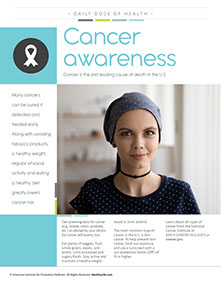
    Smiling female going through cancer.

    Cancer is the 2nd leading cause of death in the U.S.

    Many cancers can be cured if detected and treated early. Along with avoiding tobacco products, a healthy weight, regular physical activity and eating a healthy diet greatly lowers cancer risk.

    Get screening tests for cancer (e.g., breast, colon, prostate, etc.) as advised by your doctor. Do cancer self-exams, too.

    Eat plenty of veggies, fruit, whole grains, beans, and lentils. Limit processed and sugary foods. Stay active and maintain a healthy weight.

    Avoid or limit alcohol.

    The most common type of cancer in the U.S. is skin cancer. To help prevent skin cancer, limit sun exposure and use a sunscreen with a sun protection factor (SPF) of 15 or higher.

    Learn about all types of cancer from the National Cancer Institute at 800.4.CANCER (422.6237) orcancer.gov.

    Health at Home Lifetime book by the American Institute for Preventive Medicine. www.HealthyLife.com. All rights reserved.

    © American Institute for Preventive Medicine

  • Am I Hungry?

    HEALTHY EATING

    Image of empty dish plate.

    Learn to tell if you’re really hungry or just think you’re hungry. Before you grab something to eat, figure out if you are truly hungry or just bored. Maybe you are thirsty rather than hungry.

    Try this, says Anita Kobuszewski, RD, author of Food: Field to Fork, How to Grow Sustainably, Shop Wisely, Cook Nutritiously, and Eat Deliciously. Slow down and sit down. With your mouth closed, let your tongue rest relaxed, sinking low to the floor of your mouth. Close your eyes. Take a deep breath. Hold it for a count of 3. Exhale slowly through pursed lips. Relax. Repeat this 3 times.

    Before you open your eyes, ask your tummy if it’s hungry. If the answer is no, then move on. If the answer is yes, eat something healthy with protein, complex carbs, and a small amount of healthy fat. An example would be a glass of skim milk and a slice of whole grain toast with a dab of chunky peanut butter, or an apple with a dab of almond butter.

    The point is not to run on empty. The body needs a consistent flow of energy to keep all its systems running well.

    © American Institute for Preventive Medicine

  • Recognize And Treat Early Signs Of Burnout

    SUCCESS OVER STRESS

    Image of business man with a notebook over his head.

    Burnout isn’t something that happens overnight. It occurs over time from repeated and unresolved frustration or constant pressure to perform or achieve. With burnout, you feel exhausted, worn out, and detached from others. You feel as if you have nothing more to give and simply do not care about anything. Burnout puts your job, your relationships and your health in jeopardy.

    Signs on the road to burnout

    *  Too much work, not enough relaxation

    *  Feeling as if you have no control over your job

    *  Anger

    *  Fatigue

    *  Sleep problems

    *  Escaping through alcohol, drugs, TV, eating or gambling

    *  Avoiding making decisions

    *  Negative view of yourself and the world

    Also, some traits increase the risk for burnout. These include the need to be in control, wanting everything to be perfect and being a workaholic.

    Ten tips to prevent burnout

    1. Set career and personal goals that can be achieved.

    2. Follow healthy eating and sleeping habits.

    3. Exercise daily – At least 30 minutes most days of the week.

    4. Try not to spread yourself too thin. Delegate tasks at work and at home.

    5. Reduce long work or study hours, if you can. The more you do and the less you rest, the more likely burnout will occur.

    6. Take regular five to 10 minute relaxation breaks. Take mental breaks from stressful situations, too.

    7. Make time for leisure activities that you enjoy and look forward to.

    8. Get creative with a hobby or activity that has nothing to do with work.

    9. Manage stress through meditation, yoga, or therapy.

    10. Plan a vacation one or more times a year. Leave your work at home!

    Discuss feelings and problems you are having with your family, friends, and coworkers. Talking helps ease feelings of frustration that can feed burnout. It things do not get better seek professional help.

    © American Institute for Preventive Medicine

  • Heart Palpitations

    Heart & Circulation Problems

    Signs & Symptoms

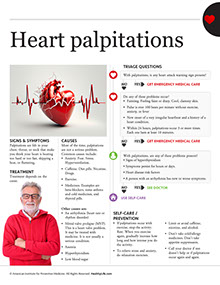
    Palpitations can be felt in the chest, throat, or neck. With them, it feels like the heart is pounding, racing, and/or fluttering. It can feel like the heart has skipped a beat.

    Causes

    Most of the time, palpitations are not a serious problem. Common causes include:

    *  Anxiety. Fear. Stress. Hyperventilation.

    *  Caffeine. Diet pills. Nicotine. Drugs.

    *  Exercise.

    *  Medicines. Examples are beta-blockers, some asthma and cold medicines, and thyroid pills.

    Other causes are:

    *  An arrhythmia (heart rate or rhythm disorder).

    *  Mitral valve prolapse (MVP). This is a heart valve problem. It may be treated with medicine. It is not usually a serious condition.

    *  Anemia.

    *  Hyperthyroidism.

    *  Low blood sugar.

    Treatment

    Treatment depends on the cause.

    Questions to Ask

    Self-Care / Prevention

    *  If palpitations occur with exercise, stop the activity. Rest. When you exercise again, gradually increase how long and how intense you do the activity.

    *  To relieve stress and anxiety, do relaxation exercises.

    *  Limit or avoid caffeine, nicotine, and alcohol.

    *  Don’t take cold/allergy medicines. Don’t take appetite suppressants.

    *  Call your doctor if rest doesn’t help or if palpitations occur again and again.

    Resources

    The American Heart Association

    800.AHA.USA1 (242.8721)

    www.heart.org/HEARTORG

    National Heart, Lung, and Blood Institute (NHLBI)

    www.nhlbi.nih.gov

    Healthier at Home book by the American Institute for Preventive Medicine. www.HealthyLife.com. All rights reserved.

    © American Institute for Preventive Medicine
  • Are You Driving Yourself To Burnout?

    SUCCESS OVER STRESS

    Image of elevated train and cars on road.

    Commuting length, distance, and means are stress factors that can lead to burnout, said Annie Barreck of the University of Montreal’s School of Industrial Relations.

    By car:

    No surprises: the bigger the city, the more stressful the commute, at least for people traveling by car. Passengers are more likely to be stressed out than drivers because carpooling reduces the passenger commuters’ sense of control, which causes them more stress before they’ve even arrived at work.

    By public transit:

    People with long commutes from rural areas via bus or train connections are stressed about uncontrollable delays. The stress carries over into the workplace. But transit users in major urban areas are less likely to have symptoms of burnout.

    By bike or on foot:

    Biking is also a mixed bag that is determined by the area the commuter is working in. Commuting by bike in the suburbs is more stressful than biking in the city where cyclists and walkers have access to safety features such as cycle paths and pedestrian crossings, which increase their sense of control over their commute.

    Study findings show that the risk of burnout increases significantly when a commute lasts more than 20 minutes. Above 35 minutes, all employees are at increased risk of cynicism toward their job. Barreck believes this should lead employers to adopt flexible commuting arrangements.

    © American Institute for Preventive Medicine