Tag: safety

  • Be A Smart Meat Eater

    Nutrition

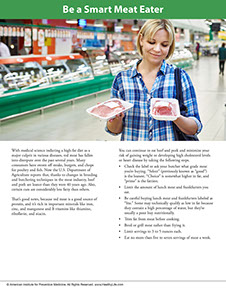
    Image of meat being grilled.

    With medical science indicting a high-fat diet as a major culprit in various diseases, red meat has fallen into disrepute over the past several years. Many consumers have sworn off steaks, burgers, and chops for poultry and fish. Now the U.S. Department of Agriculture reports that, thanks to changes in breeding and butchering techniques in the meat industry, beef and pork are leaner than they were 40 years ago. Also, certain cuts are considerably less fatty than others.

    That’s good news, because red meat is a good source of protein, and it’s rich in important minerals like iron, zinc, and manganese and B vitamins like thiamine, riboflavin, and niacin.

    You can continue to eat beef and pork and minimize your risk of gaining weight or developing high cholesterol levels or heart disease by taking the following steps.

    *  Check the label or ask your butcher what grade meat you’re buying. “Select” (previously known as “good”) is the leanest. “Choice” is somewhat higher in fat, and “prime” is the fattiest.

    *  Limit the amount of lunch meat and frankfurters you eat.

    *  Be careful buying lunch meat and frankfurters labeled as “lite.” Some may technically qualify as low in fat because they contain a high percentage of water, but they’re usually a poor buy nutritionally.

    *  Trim fat from meat before cooking.

    *  Broil or grill meat rather than frying it.

    *  Limit servings to 3 to 5 ounces each.

    *  Eat no more than five to seven servings of meat a week.
    Page from A Year of Health Hints book by the American Institute for Preventive Medicine. www.HealthyLife.com. All rights reserved.

    © American Institute for Preventive Medicine

  • Home Safety

    Home Safety

    General Home Safety

    Food Safety

    Home Security

    Prepare for Disasters

    Prevent Choking, Suffocation, & Drowning

    Prevent Falls

    © American Institute for Preventive Medicine
  • Consider An Exercise Stress Test

    Fitness

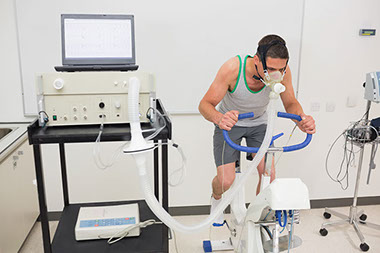
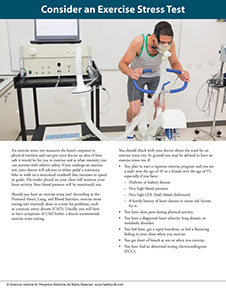
    Image of man performing a stress test.

    An exercise stress test measures the heart’s response to physical exertion and can give your doctor an idea of how safe it would be for you to exercise and at what intensity you can exercise with relative safety. If you undergo an exercise test, your doctor will ask you to either pedal a stationary bike or walk on a motorized treadmill that increases in speed or grade. Electrodes placed on your chest will monitor your heart activity. Your blood pressure will be monitored, too.

    Should you have an exercise stress test? According to the National Heart, Lung, and Blood Institute, exercise stress testing isn’t routinely done to screen for problems, such as coronary artery disease (CAD). Usually, you will have to have symptoms of CAD before a doctor recommends exercise stress testing.

    You should check with your doctor about the need for an exercise stress test. In general you may be advised to have an exercise stress test if:

    *  You plan to start a vigorous exercise program and you are a male over the age of 45 or a female over the age of 55, especially if you have:

    – Diabetes or kidney disease.

    – Very high blood pressure.

    – Very high LDL (bad) blood cholesterol.

    – A family history of heart disease or many risk factors for it.

    *  You have chest pain during physical activity.

    *  You have a diagnosed heart ailment, lung disease, or metabolic disorder.

    *  You feel faint, get a rapid heartbeat, or feel a fluttering feeling in your chest when you exercise.

    *  You get short of breath at rest or when you exercise.

    *  You have had an abnormal resting electrocardiogram (ECG).

    Page image from A Year of Health Hints book by the American Institute for Preventive Medicine. www.HealthyLife.com. All rights reserved.

    © American Institute for Preventive Medicine
  • Home Safety 2

    Home Safety

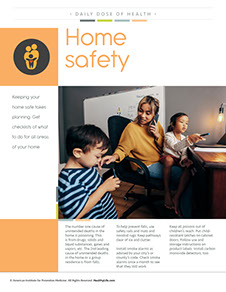
    Mother sitting in an office chair, talking on the phone, with 2 young kids

    Keeping your home safe takes planning. Get checklists of what to do for all areas of your home.

    The number one cause of unintended deaths in the home is poisoning. This is from drugs, solids and liquid substances, gases and vapors, etc. The 2nd leading cause of unintended deaths in the home or a group residence is from falls.

    To help prevent falls, use safety rails and mats and nonskid rugs. Keep pathways clear of ice and clutter.

    Install smoke alarms as advised by your city’s or county’s code. Check smoke alarms once a month to see that they still work.

    Keep all poisons out of children’s reach. Put child-resistant latches on cabinet doors. Follow use and storage instructions on product labels. Install carbon monoxide detectors, too.

    A Year of Health Hints book by the American Institute for Preventive Medicine. www.HealthyLife.com. All rights reserved.

    © American Institute for Preventive Medicine
  • Driving Yourself To Drink

    Substance Use & Abuse

    Take this test to see if you are out of control.

    You may think you are a social drinker, when others see you as a problem drinker. If you have any doubts, or just want to prove your friends and family wrong, take this test developed by Alcoholics Anonymous.

    Answer Yes or No:

    1.  Have you ever decided to stop drinking for a week or more, but lasted only a few days?

    2.  Do you wish people would mind their own business about your drinking and stop telling you what to do?

    3.  Have you ever switched from one kind of drink to another in the hope that this would keep you from getting drunk?

    4.  Have you had a drink in the morning during the past year?

    5.  Do you envy people who can drink without getting into trouble?

    6.  Have you had problems connected with drinking during the past year?

    7.  Has your drinking caused troubles at home?

    8.  Do you ever try to get extra drinks at a party because you are not served enough?

    9.  Do you tell yourself you can stop drinking any time you want, even though you keep getting drunk when you didn’t mean to?

    10. Have you missed days of work because of drinking?

    11. Do you have blackouts?

    12. Have you ever felt your life would be better if you did not drink?

    Score Yourself: If you answered yes to four or more questions, chances are you have a drinking problem and need to seek professional help.

    Action Step

    If your drinking is tied to emotional issues that you are trying to drown, seek counseling. Coming to terms with your triggers and learning to manage those triggers will help put you back in control of your life.

    Page from Ways to Well-Being book by the American Institute for Preventive Medicine. www.HealthyLife.com. All rights reserved.

    © American Institute for Preventive Medicine
  • How To Take Painkillers Safely

    Medication

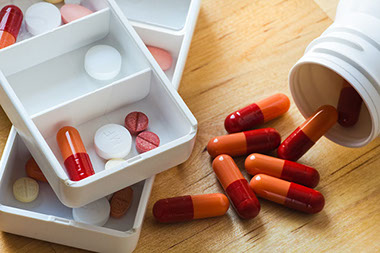
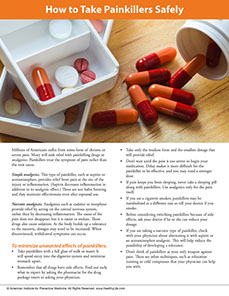
    Image of pills.

    Millions of Americans suffer from some form of chronic or severe pain. Many will seek relief with painkilling drugs or analgesics. Painkillers treat the symptom of pain rather than the root cause.

    Simple analgesics. This type of painkiller, such as aspirin or acetaminophen, provides relief from pain at the site of the injury or inflammation. (Aspirin decreases inflammation in addition to its analgesic effect.) These are not habit forming and they maintain effectiveness even after repeated use.

    Narcotic analgesics. Analgesics such as codeine or morphine provide relief by acting on the central nervous system, rather than by decreasing inflammation. The cause of the pain does not disappear, but it is easier to endure. These drugs also cause sedation. As the body builds up a tolerance to the narcotic, dosages may need to be increased. When discontinued, withdrawal symptoms can occur.

    To minimize unwanted effects of painkillers:

    *  Take painkillers with a full glass of milk or water. It will speed entry into the digestive system and minimize stomach upset.

    *  Remember that all drugs have side effects. Find out early what to expect by asking the pharmacist for the drug package insert or asking your physician.

    *  Take only the weakest form and the smallest dosage that will provide relief.

    *  Don’t wait until the pain is too severe to begin your medication. Delay makes it more difficult for the painkiller to be effective, and you may need a stronger dose.

    *  If pain keeps you from sleeping, never take a sleeping pill along with painkillers. Use analgesics only for the pain itself.

    *  If you are a cigarette smoker, painkillers may be metabolized at a different rate so tell your doctor if you smoke.

    *  Before considering switching painkillers because of side effects, ask your doctor if he or she can reduce your dosage.

    *  If you are taking a narcotic type of painkiller, check with your physician about alternating it with aspirin or an acetaminophen analgesic. This will help reduce the possibility of developing a tolerance.

    *  Don’t think of painkillers as your only weapon against pain. There are other techniques, such as relaxation training or cold compresses that your physician can help you with.

    Page from A Year of Health Hints book by the American Institute for Preventive Medicine. www.HealthyLife.com. All rights reserved.

    © American Institute for Preventive Medicine
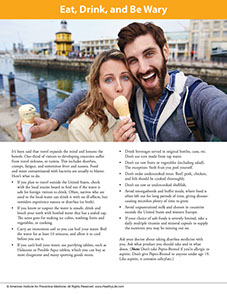
  • Eat, Drink, And Be Wary

    Healthy Travel

    Image of couple eating at a resturant.

    It’s been said that travel expands the mind and loosens the bowels. One-third of visitors to developing countries suffer from travel sickness, or turista. This includes diarrhea, cramps, fatigue, and sometimes fever and nausea. Food and water contaminated with bacteria are usually to blame. Here’s what to do.

    *  If you plan to travel outside the United States, check with the local tourist board to find out if the water is safe for foreign visitors to drink.  Often, natives who are used to the local water can drink it with no ill effects, but outsiders experience nausea or diarrhea (or both).

    *  If you know or suspect the water is unsafe, drink and brush your teeth with bottled water that has a sealed cap. The same goes for making ice cubes, washing fruits and vegetables, or cooking.

    *  Carry an immersion coil so you can boil your water. Boil the water for at least 10 minutes, and allow it to cool before you use it.

    *  If you can’t boil your water, use purifying tablets, such as Halazone or Potable Aqua tablets, which you can buy at most drugstores and many sporting goods stores.

    *  Drink beverages served in original bottles, cans, etc. Don’t use ice made from tap water.

    *  Don’t eat raw fruits or vegetables (including salad). The exception: fresh fruit you peel yourself.

    *  Don’t order undercooked meat. Beef, pork, chicken, and fish should be cooked thoroughly.

    *  Don’t eat raw or undercooked shellfish.

    *  Avoid smorgasbords and buffet meals, where food is often left out for long periods of time, giving disease-causing microbes plenty of time to grow.

    *  Avoid unpasteurized milk and cheeses in countries outside the United States and western Europe.

    *  If your choice of safe foods is severely limited, take a daily multiple vitamin and mineral capsule to supply the nutrients you may be missing out on.

    Ask your doctor about taking diarrhea medicine with you. Ask what  product you should take and in what doses. (Note: Don’t take Pepto-Bismol if you’re allergic to aspirin. Don’t give Pepto-Bismol to anyone under age 19. Like aspirin, it contains salicylate.)

    Page image from A Year of Health Hints book by the American Institute for Preventive Medicine. www.HealthyLife.com. All rights reserved.

    © American Institute for Preventive Medicine
  • Infant Safety

    Child Safety

    Young baby wearing blue hat and wrapped in blue blanket.

    Infants depend on their families to keep them safe. While all babies are unique, there are some safety issues that apply to all infants.

    Never leave a baby or young child alone near any water, such as a bathtub, a toilet, a bucket with water, etc., not even to answer a telephone or the door.

    Do not leave a baby alone on a changing table, bed, sofa or chair.

    Sudden Infant Death Syndrome (SIDS) is the leading cause of death among babies between 1 month and 1 year old. To reduce the risk, place a baby to sleep on its back with a wearable blanket on a flat, sleep surface, covered only with a fitted sheet. Do not use a blanket, pillow, or add toys.

    From infancy on, ask your child’s doctor to check your child’s vision at regular exams. In general, children should start getting vision screening exams starting at age 3.

    A Year of Health Hints book by the American Institute for Preventive Medicine. www.HealthyLife.com. All rights reserved.

    © American Institute for Preventive Medicine

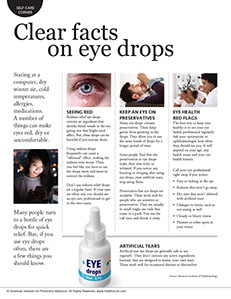
  • Clear Facts On Eye Drops

    SELF-CARE CORNER

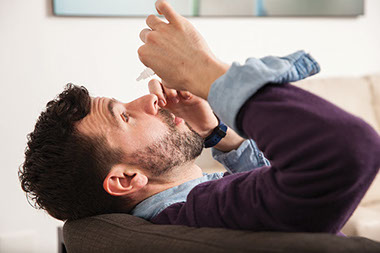
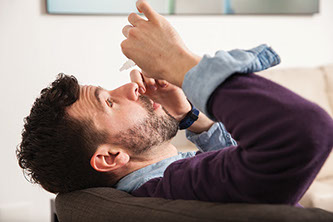
    Image of man placing eye drop in eye.

    Staring at a computer, dry winter air, cold temperatures, allergies, medications. A number of things can make eyes red, dry or uncomfortable.

    Many people turn to a bottle of eye drops for quick relief. But, if you use eye drops often, there are a few things you should know.

    Seeing red

    Redness relief eye drops contain an ingredient that shrinks blood vessels in the eye, giving you that bright-eyed effect. But, these drops can be harmful if you overuse them.

    Using redness drops frequently can cause a “rebound” effect, making the redness even worse. Then you feel like you have to use the drops more and more to control the redness.

    Don’t use redness relief drops on a regular basis. If your eyes are often red, you should see an eye care professional to get to the root cause.

    Artificial tears

    Artificial tear eye drops are generally safe to use regularly. They don’t contain any active ingredients. Instead, they are designed to mimic your own tears. These work well for occasional dryness or discomfort.

    Keep an eye on preservatives

    Many eye drops contain preservatives. These keep germs from growing in the drops. They allow you to use the same bottle of drops for a longer period of time.

    Some people find that the preservatives in eye drops make their eyes itchy or irritated. If you notice any burning or stinging after using eye drops, even artificial tears, stop using them.

    Preservative-free eye drops are available. These work well for people who are sensitive to preservatives. They are usually in small single-use vials that come in a pack. You use the vial once and throw it away.

    Eye health red flags

    The best way to keep eyes healthy is to see your eye health professional regularly. Ask your optometrist or ophthalmologist how often they should see you. It will depend on your age, any health issues and your eye health history.

    Call your eye professional right away if you notice:

    *  Pain or itching in the eye

    *  Redness that won’t go away

    *  Dry eyes that aren’t relieved with artificial tears

    *  Changes in vision, such as not seeing as well

    *  Cloudy or blurry vision

    *  Floaters or other spots in your vision

    Source: American Academy of Ophthalmology

    © American Institute for Preventive Medicine
  • Safe Travel For Pregnant Women

    Healthy Travel

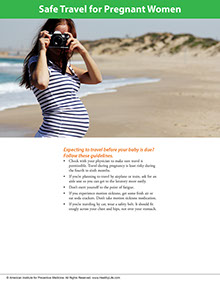
    Image of pregnant women on vacation.

    Expecting to travel before your baby is due? Follow these guidelines.

    *  Check with your physician to make sure travel is permissible. Travel during pregnancy is least risky during the fourth to sixth months.

    *  If you’re planning to travel by airplane or train, ask for an aisle seat so you can get to the lavatory more easily.

    *  Don’t exert yourself to the point of fatigue.

    *  If you experience motion sickness, get some fresh air or eat soda crackers. Don’t take motion sickness medication.

    *  If you’re traveling by car, wear a safety belt. It should fit snugly across your chest and hips, not over your stomach.

    Page image from A Year of Health Hints book by the American Institute for Preventive Medicine. www.HealthyLife.com. All rights reserved.

    © American Institute for Preventive Medicine