Category: Family Life

  • A Parents Guide To Gaming

    FAMILY LIFE

    Father and son playing virtual games.

    Gaming is a popular past-time among this generation of kids. As a parent, here are some things to know to keep gaming safe.

    *  Moderation is key. Set healthy limits on how much video game time you allow your kids.

    *  Know what they’re playing. Some games are better than others. If your kid struggles with mental health, help them find better games.

    *  Prioritize sleep. It’s common for gaming to interfere with healthy sleep habits. Set boundaries that prioritize sleep.

    *  Take breaks. Teach your kids to schedule regular breaks into their gaming time. Stepping away is good for mental health.

    *  Stay connected off-line. Keep your kids grounded in the real world by engaging in screen-free activities together.

    *  Game with your kids. Get involved with your kids’ interests by gaming with them (in moderation!).

    © American Institute for Preventive Medicine

  • Child Safety

    Child Safety

    Do This, Not That

    According to the Centers for Disease Control and Prevention (CDC):

    *  Injuries are the leading cause of death in children and teens.

    *  Each year, nearly 9 million children aged 0 to 19 years are seen in emergency departments for injuries. More than 9,000 children die as a result of being injured.

    *  Injury treatment is the leading cause of medical spending for children.

    The leading causes of injury death differed by age group.

    *  For children less than 1 year of age, 2/3rds of injury deaths were due to suffocation.

    *  Drowning was the leading cause of injury death for those 1 to 4 years of age.

    *  For children 5 to 19 years of age, the most injury-related deaths were due to being an occupant in a motor vehicle traffic crash.

    Most child injures are preventable. Use the tips in this section to keep your children safe at home.

    General Guidelines

    Safe at Home - Do This, Not That Book. Published by the American Institute for Preventive Medicine. www.HealthyLife.com. All rights reserved.

    © American Institute for Preventive Medicine

  • Audit Your Home For Safety

    Home Safety

    Most accidents happen at home. If you think your house is “home, safe home,” take a look around. At first glance it may look orderly, but certain common trouble spots can lead to cuts, falls, burns, or other injuries. The following room-by-room checklist can alert you to accidents waiting to happen.

    Kitchen

    *  Cleaners and dangerous chemicals should be stored out of children’s reach.

    *  Scissors, knives, ice picks, and other sharp tools should be stored separately from other utensils out of the reach of children.

    *  Towels, curtains, and other flammable materials should hang a safe distance from heat sources like the stove.

    *  Kitchen fans and stove ventilation exhausts should be clean and in good working order.

    *  Electrical cords should run a safe distance from the sink or range.

    *  Electrical outlets should not be overloaded.

    *  A sturdy step stool should be available to help reach high cabinets.

    *  Vinyl floors should be cleaned with nonskid wax.

    *  A nonskid floor mat should be in place in front of the sink.

    *  The kitchen should be well-lit.

    Bedroom

    *  Electrical cords should be tucked away from foot traffic and in good working order.

    *  Electrical outlets should not be overloaded.

    *  Electric blankets should not be covered by bedspreads or other blankets when in use.

    *  Carpeting should be secured to the floor.

    *  A night-light should be situated between the bed and the bathroom or hallway.

    *  The bedroom telephone should be easy to reach, even from the floor, if necessary.

    *  Ashtrays, irons, electric hair curlers, and other potential fire hazards should be located away from bedding, curtains, or other flammable material.

    *  Smoke detectors should be located near entrances to rooms.

    Bathroom

    *  Floor mats should have nonskid backing.

    *  Rubber mats or adhesive-backed strips should be in place in the bathtub or shower stall.

    *  A support bar should be securely installed in the bathtub or shower stall.

    *  Hair dryers, electric shavers, or other electric appliances should be kept away from water and unplugged when not in use.

    *  A light switch should be located near the bathroom entrance or entrances.

    Halls and Stairs

    *  Halls and stairs should be well-lit, with a light switch at each end of a stairway.

    *  If a staircase is dimly lit, the top and bottom steps should be marked with reflective tape.

    *  Sturdy hand rails should be securely installed on both sides of each stairway.

    *  Floor covering on stairs and in halls should be skid-proof or carpeted and not creased or frayed.

    *  Stairways should be clear of shoes, books, toys, tools, or other clutter.

    *  When young children are in the house, gates should block access to stairways.

    Basement and Garage

    *  To avoid confusion and misuse, all chemicals and cleaners should be kept in their original containers.

    *  Hazardous chemicals should be kept under lock and key or out of reach of children.

    *  Sharp or otherwise potentially hazardous tools should be in good working order.

    *  Gasoline and other flammable materials should be stored in airtight containers and away from heat sources (outside the home, if possible).

    *  To prevent suffocation, dispose of all plastic bags, or keep them out of reach of children.

    *  Don’t leave objects small enough to be swallowed within reach of children.

    *  Buy a radon test kit from your state department of health or department of environmental protection, or contact the National Radon Hotline at 1.800.767.7236 for information on radon testing. (Radon is an invisible gas that causes health problems if it builds up in homes and can’t escape.) If your home has high radon levels, hire a reliable radon expert to help you reduce levels of this gas in your home.

    Elsewhere around the House

    *  Outdoor porches and walkways should be kept clear of ice in winter weather.

    *  Window screens should be securely fastened, especially if small children are around.

    *  Take steps to remedy unsafe situations as soon as possible.

    A Year of Health Hints book by the American Institute for Preventive Medicine. www.HealthyLife.com. All rights reserved.

    © American Institute for Preventive Medicine

  • How To Save Your Life In A House Fire

    Home Safety

    Image of mother and children in front of a house fire.

    Knowing how to react fast in a house fire can save your life and the lives of those you love. Here are some guidelines to follow.

    *  Keep the phone number of your local fire department clearly posted near all telephones in the house. (Try to memorize the number, in case you have to use a neighbor’s phone.) Use 911! where the service is available.

    *  Prearrange a plan for family members to follow in case of fire. Conduct fire drills using your escape route.

    *  If you live in a two-story house, purchase and install an emergency escape ladder and practice using it.

    *  If a fire breaks out, don’t stop to collect personal possessions. Get people out of the house!

    *  If you can’t get to within 10 to 12 feet of a fire, you can assume it’s too big to handle on your own. Call the fire department immediately. (Call them for small fires, too.)

    *  If you try to put out the fire, make sure you can get to an exit. Don’t back yourself into a corner.

    *  Smother a fire thoroughly and keep it covered so it doesn’t ignite again. The fire department will determine if the fire has been contained or if it has spread.

    *  If you fail to extinguish the fire and smoke is accumulating, get out of the house quickly!

    Poisonous gases and smoke are often more dangerous than flames. (Smoke rises, so remember to “stay low and go.” Crawl if you must. And if you can, place a wet towel over your face to filter out smoke and fumes.)

    A Year of Health Hints book by the American Institute for Preventive Medicine. www.HealthyLife.com. All rights reserved.

    © American Institute for Preventive Medicine

  • What To Do If Clothing Catches Fire

    Home Safety

    Image of mother and daughter.

    Few things are more terrifying than having your clothes catch fire. Teach your children and everyone else in your family this simple, lifesaving technique, known as stop, drop, and roll.

    Stop. Your natural inclination may be to run. But motion only fans the flames.

    Drop. Get to the ground, cover your face with your hands, and keep your face as far from the flames as possible. (If a blanket, rug, or coat is handy, use it to smother the flames. But doing so should never delay stop, drop, and roll.)

    Roll. Roll back and forth, again and again, until the flames go out.

    A Year of Health Hints book by the American Institute for Preventive Medicine. www.HealthyLife.com. All rights reserved.

    © American Institute for Preventive Medicine
  • Positive Parenting Hacks

    FAMILY LIFE

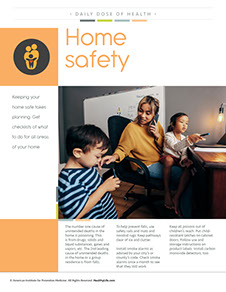
    Parents with son, smile.

    Don’t focus on mistakes or bad behavior. Catch your child doing good things and point them out.

    Chores don’t have to be a punishment. Chores at home can help children learn life skills and independence.

    Spend a little time connecting each day. Take a few minutes to talk to your child without phones or screens.

    © American Institute for Preventive Medicine

  • Be Healthy At Each Cycle Of Life. Recycle Along The Way.

    Home Safety

    Women with smart watch and fist up in the air.

    *  Being healthy at each cycle of life includes healthy eating, exercising, getting quality sleep, and avoiding smoking and secondhand smoke. It also includes getting health tests and vaccines that you need.

    *  Re-use paper bags.

    *  Buy recycled products and items that come in recycled packaging.

    *  Donate usable items to others instead of adding them to the trash.

    *  Rely less on disposable products used for eating, cleaning, and grooming. Use rechargeable batteries.

    *  Recycle paper, newspapers, junk mail, aluminum cans, glass bottles, and plastic. Follow the recycling rules of your city. If you do not have home recycling, take items to a recycling collection center. To find one near you, call 800.CLEAN.UP (253.2687) or visitearth911.com. Involve the whole family in recycling. Recycle at your place of work. Encourage coworkers to do the same.

    A Year of Health Hints book by the American Institute for Preventive Medicine. www.HealthyLife.com. All rights reserved.

    © American Institute for Preventive Medicine
  • Install Smoke Detectors And Be Sure They Work

    Home Safety

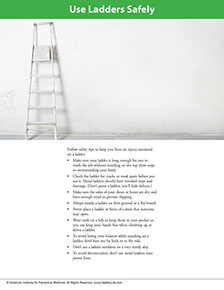
    Image of smoke around a smoke detector.

    Smoke detectors save lives. But if a smoke detector is placed in the wrong spot or not maintained, it may be useless in a fire.

    To install and maintain smoke detectors:

    *  Install at least one smoke detector on each level of your house. Best locations are in hallways and just outside bedroom doors.

    *  As an added safety measure, install two types of smoke detectors. The photoelectric cell variety detects smoldering fires, and the ionization type detects hot, flaming fires. Check for a UL (Underwriters Laboratory) emblem on the label to be sure the detectors you buy meet industry standards. And make sure they each come with a warranty, in case they’re defective.

    *  Affix detectors on the ceiling or high on an interior wall, because smoke and heat rise.

    *  Once a month, check the detectors to make sure the batteries still work. Most detectors have a test button. If you push the button and hear a beep, the batteries are good. If you hear a chirping sound, the batteries need to be replaced. (To be safe, you should replace the batteries annually, whether the malfunction signal goes off or not. To help you remember, choose an annual holiday, like New Year’s Day, as replacement time.)

    *  To make sure the sensing chamber works, you should also test the device with a lit match or candle.

    *  Be sure the alarm rings loudly enough to alert your family.

    *  Most smoke detectors last three to five years. Replace as needed.

    A Year of Health Hints book by the American Institute for Preventive Medicine. www.HealthyLife.com. All rights reserved.

    © American Institute for Preventive Medicine

  • When In Doubt, Throw It Out

    Home Safety

    Take steps to avoid foodborne illnesses.

    If it looks good, and smells good, it’s safe to eat. Right? Not always. Harmful bacteria that cause foodborne illnesses can hide very well in foods. Keeping foods safe to eat can prevent stomach pain, nausea, diarrhea, and other dire symptoms caused by eating spoiled food.

    Store foods safely:

    *  Separate raw, cooked, and ready-to-eat foods when you shop for and store them. Follow instructions on package labels.

    *  Refrigerate foods that can spoil within two hours (one hour if the room or outdoor temperature is above 90°F).

    *  Keep the refrigerator at 40°F or lower; the freezer at or below 0°F.

    *  Wrap meat and poultry securely to prevent leakage onto other foods. Use foil or freezer wrap.

    *  High-acid canned foods, such as tomatoes and pineapple can be stored for 12 to 18 months. Low-acid canned foods, such as most vegetables will keep two to five years if kept in a cool, dry place.

    Prepare foods safely:

    *  Wash your hands with warm water and soap for at least 20 seconds before and after handling food.

    *  Rinse raw fruits and veggies under running tap water before eating, cutting, or cooking.

    *  Scrub firm produce, such as melons and cucumbers with a clean produce brush.

    *  Use clean utensils and clean surfaces.

    *  Thaw frozen foods in the fridge or in cold water. You can also use the microwave if you are going to cook the food right away.

    *  Cook foods to a safe temperature.

    Leftovers, anyone?

    *  Quickly refrigerate leftovers.

    *  Freeze ones that you do not intend to eat within two to four days.

    *  Reheat leftovers on the stove or in the oven or microwave until an internal temperature reaches 165°F.

    *  Keep hot foods higher than 140°F. Keep cold foods at 40°F or lower. Bacteria grow rapidly in the “danger zone” between 40°F and 140°F.

    Action Step

    Find out about food recalls and alerts from your local news, national news, and from

    www.FoodSafety.gov.

    Ways to Well-Being book by the American Institute for Preventive Medicine. www.HealthyLife.com. All rights reserved.

    © American Institute for Preventive Medicine