FAMILY LIFE
© American Institute for Preventive Medicine

FAMILY LIFE
© American Institute for Preventive Medicine

FAMILY LIFE

Playing games is an easy and fun way to experience quality interactions and build family connections. The more time you spend together, the stronger your bond will be. But, finding a game that everyone will enjoy can be a challenge. Here are eight games that are fun and accessible to a wide range of ages.
Charades
This classic game is super easy and sure to have everyone laughing. Even better, no one is too young or too old to play.
Pictionary
If you can hold a pencil, you can play pictionary. Whether your family and friends can decipher your drawing is another matter, but all part of the fun.
Minute to win it style games
The idea is to create a challenge and compete for one minute. For example, who can stack the most cups or keep the most balloons in the air? The options are endless.
Ninja course
Using your home or yard as an obstacle course creates many opportunities for play. Set up a ninja course appropriate for your group and compete in teams or race your personal best.
Dominos
You can play the traditional game or just imagine the amazing fun you could create working together with the whole family.
Dice games
Rolling dice is fairly simple for any age. Simple addition or pattern matching is possible for even young kids. Look for games such as Quix™, Farkle™, and Yahtzee™.
Jenga™
This game will test everyone’s dexterity. The simple rules mean young and old can get in the mix.
Card games
A standard deck of cards contains a wealth of all-ages gameplay. Try easy games like snap, pig, or crazy eights.
Child Safety

Young children often don’t realize busy streets or highways are dangerous. You have to either look out for them yourself or, if your children are old enough, teach them to get around safely. Here are some pointers.
* Never leave children unguarded or out of your sight near parked or moving cars.
* Never summon children from across the street; go over and get them. Always hold a child’s hand when you cross the street together.
* When exiting a parked car, have your child exit on the curb side.
Home Safety
Do This, Not That
According to the FBI:
* 13% of homes are burglarized a year.
* A home is invaded every 12 seconds.
* Most home burglaries occur between 9 a.m. and 5 p.m.
* 85% of all break-ins occur through the door.
* 67% of all burglaries involved forcible entry. Door frame failure is usually the cause.
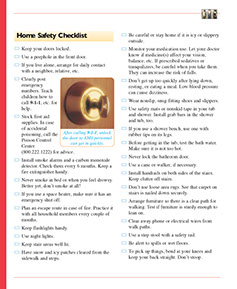
Most home burglaries are the work of amateurs who are looking for a quick way in and out. Follow tips in this section to keep your home as secure as possible. Also, keep others from finding out when you will be on vacation. For example, do not post your whereabouts on social networks. It is best to not leave a spare key under the doormat, in a fake rock, or in a flower pot next to the door. Instead, give a spare key to a trusted neighbor or nearby friend.
General Guidelines
Home Safety
Do This, Not That
Choking and suffocation can occur at any age, but is more common in babies and toddlers. Choking is the 4th leading cause of unintentional death in children under the age of 5. At least 1 child dies from choking on food every 5 days in the U.S. Common foods and other items children choke on include:
* Bubble gum and other types of gum
* Peanuts, other nuts, and popcorn
* Peanut butter (especially from a spoon or with soft white bread)
* Whole grapes and foods with pits, such as cherries
* Hot dogs (whole or cut into round pieces)
* Hard candy and cough drops
* Balloons, button-type batteries, small toy parts, marbles, coins, and safety pins.
In adults, choking usually occurs when food is not chewed properly. The risk increases with talking or laughing while eating, drinking alcohol, taking drugs, or having a condition that impairs chewing or swallowing. In young adults, choking can result from playing the “choking game.” With this, the person uses a rope or belt to cut off blood and oxygen to the brain for a brief “high.”
Learn first aid for choking for babies, children, and adults from your local Red Cross. Find a class in your area atwww.redcross.orgor call 800.733.2767 (800.RED.CROSS).
Adults
Children
Personal HEALTH & Safety
Driving Safety
© American Institute for Preventive Medicine
FAMILY LIFE

Pre-dinner tips
* Get your child involved. Many kids can help with shopping and cooking. Being involved in the process may make them more likely to try new foods. Have them choose a favorite fruit or vegetable from the store. Younger children can help pour ingredients or cut soft foods, like bananas, with a butter knife. Older children can help with measurements.
* Get some exercise. Kids who have been actively playing may be hungrier when dinner comes. The hungrier they are, the more likely they may try new things.
* Turn off devices. Make family mealtimes relaxing and unplugged. Ban cell phones, television or other devices from the table.
Size matters
Don’t force your child to eat foods they don’t like. Rather, put a “sample size” on their plate. It can be just one bite of food. This may be less overwhelming than serving a large portion to them.
Sanity-saving steps
* Make healthier snacks to fill the gaps. Serve fresh fruit or vegetables as a snack to get in extra nutrients. Skip the processed crackers and chips.
* Don’t have a battle. Forcing your child to eat could make them dislike their food even more.
* Don’t use bribes or rewards for eating. Rewards teach your child to expect something every time he/she tries a new food.
* Make one healthy meal for everyone. Don’t feel pressured to make “special meals” for picky eaters.
* Talk about your child’s eating habits with their doctor. Most picky eaters are getting enough of the foods they need. But, ask their pediatrician just in case. Some children need supplements to help get extra nutrients that they’re missing.
Source: American Academy of Pediatrics
FAMILY LIFE

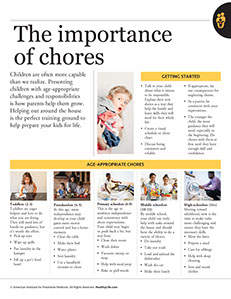
Children are often more capable than we realize. Presenting children with age-appropriate challenges and responsibilities is how parents help them grow. Helping out around the house is the perfect training ground to help prepare your kids for life.
Getting started
* Talk to your child about what it means to be responsible. Explain their new duties as a way they help the family and learn skills they will need for their whole life.
* Create a visual schedule or chore chart.
* Discuss being consistent and reliable.
* If appropriate, lay out consequences for neglecting chores.
* As a parent, be consistent with your expectations.
* The younger the child, the more guidance they will need, especially in the beginning. Do chores with them at first until they have enough skill and confidence.
Age-appropriate chores
Toddlers (2-3)
Toddlers are eager helpers and love to do what you are doing. They will need lots of hands-on guidance, but it’s worth the effort.
* Pick up toys
* Wipe up spills
* Put laundry in the hamper
* Fill up a pet’s food bowl
Preschoolers (4-5)
At this age, more independence may develop as your child gains more motor control and has a better memory.
* Clear the table
* Make their bed
* Water plants
* Sort laundry
* Use a handheld vacuum to clean
Primary schoolers (6-9)
This is the age to reinforce independence and consistency with chore expectations. Your child may begin to push back a bit, but stay firm.
* Clean their room
* Wash dishes
* Vacuum, sweep, or mop
* Help with meal prep
* Rake or pull weeds
Middle schoolers (10-13)
By middle school, your child can truly help with tasks around the house and should have the ability to do a variety of chores.
* Do laundry
* Take out trash
* Load and unload the dishwasher
* Wash the car
* Make their lunch
High-schoolers (14+)
Moving toward adulthood, now is the time to make tasks more challenging and ensure they have the necessary skills.
* Mow the lawn
* Prepare a meal
* Care for siblings
* Help with deep cleaning
* Iron and mend clothes
Connect with relatives
© American Institute for Preventive Medicine


Home Safety

* Save gas by doing close-to-home outdoor recreation activities, such as skating and making snowmen with your children.
* Choose non-toxic toys for children, such as ones made from solid and recycled wood (not pressed wood) and non-toxic paints and finishes. Avoid toys made of PVC plastic; xylene, toluene, or dibutyl phthalate.
* Get the lead out! Contact the U.S. Consumer Product Safety Commission (CPSC) atcpsc.govabout recalled toys and other household products that contain lead. Find out how to dispose of them.
* Send electronic greeting cards and letters or ones made of recycled paper.
* Wrap gifts in recycled paper, the funny papers, a pillow case, etc. Give gift certificates, movie and concert tickets, etc. that do not need to be wrapped.
* Instead of using a cut live tree, buy and decorate a large potted house plant. Or use a potted small tree which can be planted outdoors. If you use a live tree, recycle it. Find out how from your local waste department.
* If you decorate with lights, turn them off when you can, to save energy and to make the lights last longer.
* Use glasses, dishes, and silverware instead of disposable products.