Category: Family Life

  • Poison Control

    Home Safety

    Female wearing cleaning gloves, holding a cleaning bottle with the word "Toxic" on it and looking at her phone in the other hand.

    The National Poison Control Center is staffed 24 hours a day. Memorize the National Poison Control Number: 800.222.1222. Buy household products, vitamins, and medicines in child-resistant packaging. Keep items in original containers. Follow label warnings.

    Carbon monoxide (CO) has no odor or color. Symptoms of CO poisoning are like those of the flu, so you may not suspect CO poisoning. Install carbon monoxide detectors in your home and garage.

    Inhalants are gases or vapors from glues, paints, cooking sprays, and over 1,000 other common products that are used to get high.

    Every hour, five children are rushed to an emergency room due to a suspected medicine poisoning.

    A child can grab and swallow something that could be poisonous in the short time it takes to answer a doorbell or a phone call.

    Teach your children not to touch anything with a skull and crossbones on the label.

    A Year of Health Hints book by the American Institute for Preventive Medicine. www.HealthyLife.com. All rights reserved.

    © American Institute for Preventive Medicine

  • Positive Parenting Hacks

    FAMILY LIFE

    Parents with son, smile.

    Don’t focus on mistakes or bad behavior. Catch your child doing good things and point them out.

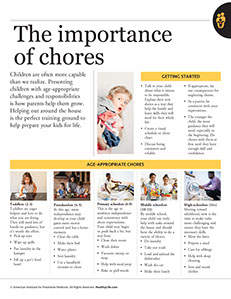
    Chores don’t have to be a punishment. Chores at home can help children learn life skills and independence.

    Spend a little time connecting each day. Take a few minutes to talk to your child without phones or screens.

    © American Institute for Preventive Medicine
  • Infant Safety

    Child Safety

    Young baby wearing blue hat and wrapped in blue blanket.

    Infants depend on their families to keep them safe. While all babies are unique, there are some safety issues that apply to all infants.

    Never leave a baby or young child alone near any water, such as a bathtub, a toilet, a bucket with water, etc., not even to answer a telephone or the door.

    Do not leave a baby alone on a changing table, bed, sofa or chair.

    Sudden Infant Death Syndrome (SIDS) is the leading cause of death among babies between 1 month and 1 year old. To reduce the risk, place a baby to sleep on its back with a wearable blanket on a flat, sleep surface, covered only with a fitted sheet. Do not use a blanket, pillow, or add toys.

    From infancy on, ask your child’s doctor to check your child’s vision at regular exams. In general, children should start getting vision screening exams starting at age 3.

    A Year of Health Hints book by the American Institute for Preventive Medicine. www.HealthyLife.com. All rights reserved.

    © American Institute for Preventive Medicine

  • Make A Fire Escape Plan

    Home Safety

    Image of child with a hard hat on an a drawing of a house.

    Having an escape plan will help you act, not just react if a house fire occurs. Every second counts! According to the National Fire Protection Association (NFPA), families have, on average, less than three minutes from the time the first smoke alarm sounds to escape a fire. Get out first. Then call 911!

    The escape plan should include:

    1.  A map of the floors and rooms in your house and the yard outside of the house. Include where the doors and windows are. Note: You can get a blank grid fromwww.usfa.fema.gov/downloads/pdf/escape_grid.pdf. Or you can use a piece of graph paper or blank paper.

    2.  Two ways that each family member can get out of each room in the house. If you have a two story house, get UL-certified rescue ladders that collapse and keep them near windows on the second floor.

    3.  Names of household members who will get each young child out of the house. This lessens confusion and makes every second count.

    4.  A meeting spot outside of your house that is safe and easy to remember. Examples are on the sidewalk of a certain neighbor’s house or near your curb-side mailbox. Include your outside meeting place on your written plan.

    5.  Post the plan on the refrigerator or place it where all people living in the house can see it.

    Practice Your Escape Plan

    1.  Do this twice a year with everyone who lives in the house, including children and adults who will need help to get out.

    2.  Gather everyone and discuss the escape plan. Tell school-age children that this is like a fire drill at school, but for  your house.

    3.  Have a smoke alarm go off so everyone knows what it sounds like.

    4.  Have each person practice getting out of the house according to the plan. Practice both exit plans.

    5.  Have children practice how to get out on their own in case you cannot help them. Show them how to get low to the floor and crawl along the perimeter of the room to the exit and how to keep their mouths covered.

    6.  Tell your child to feel a closed door with the back of his or her hand before opening it. If the door is hot, tell your child to use the second way out if there is one.

    7.  If you have a rescue ladder, learn how to use it and practice once to make sure it works well. Hold the child in front of you as you back out of the window onto the ladder. Hold the child one rung above you. Keep the child between the ladder and your body as you climb down together.

    8.  Go to your meeting place and call 911!

    9.  Never go back into a house that is on fire. Tell firefighters if anyone or any pets have not yet gotten out.

    10. Remember to practice your fire escape plan every 6 months. Practice once during the day and another time at night.

    Safe at Home - Do This, Not That Book. Published by the American Institute for Preventive Medicine. www.HealthyLife.com. All rights reserved.

    © American Institute for Preventive Medicine
  • Prevent Choking & Suffocation

    Home Safety

    Do This, Not That

    Choking and suffocation can occur at any age, but is more common in babies and toddlers. Choking is the 4th leading cause of unintentional death in children under the age of 5. At least 1 child dies from choking on food every 5 days in the U.S. Common foods and other items children choke on include:

    *  Bubble gum and other types of gum

    *  Peanuts, other nuts, and popcorn

    *  Peanut butter (especially from a  spoon or with soft white bread)

    *  Whole grapes and foods with pits, such as cherries

    *  Hot dogs (whole or cut into round pieces)

    *  Hard candy and cough drops

    *  Balloons, button-type batteries, small toy parts, marbles, coins, and safety pins.

    In adults, choking usually occurs when food is not chewed properly. The risk increases with talking or laughing while eating, drinking alcohol, taking drugs, or having a condition that impairs chewing or swallowing. In young adults, choking can result from playing the “choking game.” With this, the person uses a rope or belt to cut off blood and oxygen to the brain for a brief “high.”

    Learn first aid for choking for babies, children, and adults from your local Red Cross. Find a class in your area atwww.redcross.orgor call 800.733.2767 (800.RED.CROSS).

    Adults

    Children

    Safe at Home - Do This, Not That Book. Published by the American Institute for Preventive Medicine. www.HealthyLife.com. All rights reserved.

    © American Institute for Preventive Medicine
  • Backpacks. Crayons. Glue Sticks. Epipen?

    FAMILY LIFE

    Image of 2 school kids in the classroom.

    For more and more school-age children the Epipen is becoming a necessity for completing the back-to-school supply list. In fact, allergic conditions are one of the most common medical conditions affecting children in the U.S.

    “Accidental exposure to allergens at school is a major concern for kids with severe allergies since any exposure could be fatal,” said Dr. Joyce Rabbat, pediatric allergist at Loyola University Health System.

    Food allergies are the most concerning for school-age children since allergens can be hidden in food or utensils and pots and pans could be contaminated without the child’s knowledge. Dr. Rabbat said that parents of children with food allergies should ensure an Allergy Action Plan is in place for the child at his or her school.

    This really could mean life or death to the child,” she said in suggesting that parents should make sure the school reviews the child’s health records that they provide from the doctor. She also suggests asking what the school does to prevent accidental exposure and that staff are trained to deal with an emergency situation.

    If the child is older and knows how to self-administer medications, Dr. Rabbat suggests talking to the school about allowing the child to carry the medication with them. If that is not allowed at the school, make sure the following medications are available:

    *  Epinephrine autoinjectors

    *  Antihistamines

    *  Albuterol rescue inhalers

    Also make sure a staff member, who is available at all times, is properly trained on to how to administer these medications and that your child is familiar with this person.

    © American Institute for Preventive Medicine
  • Family Matters

    FAMILY LIFE

    Image of family sitting on a couch with their pet dog.

    Your family is where you learn who you are and how to relate to others. It plays a vital role in fulfilling the human need to belong and have close, long-term relationships. Whether you are a child, teen, or adult, family experiences can promote or hinder your well-being.

    Tips to foster family well-being

    *  Live a healthy lifestyle together.

    – Plan for, shop, and eat healthy foods.

    – Exercise as a family if you can. Or, promote physical activity suited for each family member.

    – Get enough sleep.

    *  Plan to eat at least one meal a day together. Have each person talk about his or her day, such as stating the best part and worst part.

    *  Spend time together. Attend important events for each family member.

    *  Express care and concern. Be available to help each other out. Listen, listen, listen.

    *  Practice good manners. Say, “Thank you” and “You’re welcome.” Make it a practice to send thank you calls, notes, letters, or emails to others for gifts and other acts of kindness.

    *  Express affection. Say, “I love you,” “I care about you,” and “You mean a lot to me.”

    *  Discuss the value of the family as a whole. Encourage individual expression and development.

    *  Define clear, yet flexible roles for family members. Assign family chores.

    *  Keep the house as organized as possible.

    *  Discuss the need to adapt to changes and deal with stressful events.

    *  Seek professional help for problems the family cannot deal with on its own.

    © American Institute for Preventive Medicine

  • Moving Away: Tips For Families

    FAMILY LIFE

    Image of couple holding moving boxes.

    Moving is a major change for all members of the family. Whether you’re buying a house across town or heading across the country, a new home can be stressful, fun and confusing at the same time. Kids – and parents – of all ages may need some help during the transition:

    *Plan in advance.Sometimes moves have to happen quickly due to a new job or other situation. But if you can, give your kids plenty of time to tell their friends about the move and to say goodbye. Get addresses, emails and phone numbers so they can keep in touch. Take pictures with friends and at your old home.

    *Talk about it and support each other.Be open with your child, teen or spouse. It’s okay to miss your old home or town. Ask them how they’re feeling. Having good communication can help relieve stress and work through tough feelings.

    *Keep your routine.As much as possible, do the same things you used to do once you’re in your new home. Cook familiar dishes for dinner and keep family activities the same. This can help everyone adjust.

    Essential moving items

    When you’re moving, you may feel like you don’t have anything you need at your new place. Make sure you pack these important items to get by until you’re settled in:

    *  Keys, wallet, purse and cell phone

    *  Chargers for electronics

    *  Medicines

    *  Toiletries, such as soap, shampoo, toothbrushes and deodorant

    *  Toilet paper and tissues

    *  Shower curtain

    *  First aid kit

    *  Sheets and pillows

    *  Plates, cups, utensils  and napkins

    *  Dish soap and hand soap

    *  Easy meals and snacks

    *  Favorite books or toys for kids

    *  A few changes of clothes and laundry detergent

    © American Institute for Preventive Medicine
  • Strike The Right Cord

    FAMILY LIFE

    Image of young smiling family.

    Children can be strangled by window cords on blinds and curtains. In fact, such tragedies are among the top hazards in American homes. Infants and children die each year from accidental strangling in the cords.

    The Consumer Product Safety Commission recommends that only cordless window coverings or those with unreachable cords be used in homes with young children. They are available today in the marketplace and will prevent window blind strangulations.

    In addition, the Window Covering Safety Council encourages parents, grandparents and caregivers to follow these basic cord-safety precautions:

    *  Move all furniture, cribs, beds, and climbable surfaces away from windows.

    *  Keep all window shades, blinds, and drapery cords well out of the reach of children.

    *  Install only cordless window coverings in homes with young children.

    © American Institute for Preventive Medicine
  • What Is Marriage Counseling?

    FAMILY LIFE

    Image of a couple with a marriage counselor.

    Marriage and relationships take lots of work. When a couple has a problem, they may wonder whether marriage therapy or couples counseling could help.

    Counseling usually includes talk therapy. This means you talk to a professional counselor about your issues. But, therapy isn’t just about talking. Your counselor may help one or both partners address mental health problems that can interfere with the relationship. For example, issues such as depression or anxiety may need treatment. This can go hand-in-hand with the couples counseling.

    When a couple goes to counseling, they can get “tools” to use in daily life that help them with their communications. For instance, therapy can give you new ways to look at challenges or problems. This can help you address issues before they become too big to handle. You may also learn ways to talk to each other so you can work out arguments in positive and constructive ways.

    However, if the marriage involves physical or emotional abuse, couples counseling is not going to be the answer. Instead, the person who is abusing their partner should seek treatment for their problems. The victim of abuse should speak privately with their doctor about how they can get away from the abuse.

    Help for resolving arguments

    If you need to talk something out with your spouse, try these tips:

    *  Listen first. Rather than tell your side, calmly listen to what your partner has to say. When he or she is done, then take your turn to speak.

    *  Don’t interrupt, and don’t yell.

    *  Be honest, but don’t insult. Talk about the behavior or incident that upset you. For instance: “When you did X, I felt like you didn’t care about my feelings.” Avoid name-calling.

    Sources: American Academy of Family Physicians, National Domestic Violence Hotline

    © American Institute for Preventive Medicine