Tag: Family Life

  • Only You Can Prevent Christmas Tree Fires

    Home Safety

    Image of Christmas tress in front of fire place.

    Every Christmas season, many families tragically lose their homes because of Christmas tree fires. Here’s how to prevent them.

    To choose a tree:

    *  Pick the freshest tree you can find. Hold the tree by the trunk and tap it against the ground. If needles drop profusely, look for another tree.

    *  Keep the tree outdoors with the trunk in water as long as possible. Once you bring the tree into a heated building, it will dry out more quickly.

    *  Indoors, keep the trunk in water. Check the water level daily, and refill when needed.

    *  Don’t stand the tree near a fireplace, wood stove, heat register, or electrical wires.

    To decorate the tree:

    *  Purchase only tree lights bearing a UL label from Underwriters Laboratory, which shows they meet safety standards.

    *  Check for broken bulbs, worn-out insulation, and damaged sockets. Replace or repair as necessary.

    *  Never attach electrical lights to an artificial, metal tree. Don’t overload extension cords.

    *  Discourage children from touching a decorated tree-it may tip over.

    *  To discourage pets from attacking the tree, avoid shiny decorations, and don’t place tinsel or ornaments on the lower branches.

    A Year of Health Hints book by the American Institute for Preventive Medicine. www.HealthyLife.com. All rights reserved.

    © American Institute for Preventive Medicine

  • Know How To Use A Fire Extinguisher

    Home Safety

    Image of fire extinguisher.

    Every home should have at least one fire extinguisher. Extinguishers should be mounted in plain sight and be simple for all family members (except small children, of course) to use in an emergency. Show the babysitter how it works, too.

    *  Buy a multipurpose extinguisher rated 2A10BC or higher. The letters indicate the type of fire the extinguisher will douse. “A” units are for combustible materials like paper or wood, “B” units are for flammable liquids like gasoline, and “C” units are for electrical fires. The numbers relate to the size of the fire. The higher the number, the greater the capacity to extinguish that fire.

    *  Check for a UL (Underwriters Laboratory) or FM (Fire Mutual) code. They tell you the product is effective, safe, and reliable.

    *  Be sure the directions are simple to understand. Mount the fire extinguisher securely, in plain sight.

    *  Be sure you understand how the firing mechanism works. Check to see whether you need to push a button or pull a lever. Don’t activate the extinguisher, though. Once you do, it must be serviced and recharged, even if you only use it for a few seconds and the gauge indicates it’s full.

    *  Check the pressure indicator once a month to be sure the extinguisher works.

    To use a fire extinguisher, remember the acronym PASS.

    *  Pull the pin.

    *  Aim the nozzle or barrel at the base of the fire, not at the flames.

    *  Squeeze the handle.

    *  Sweep back and forth at the base of the fire.

    A Year of Health Hints book by the American Institute for Preventive Medicine. www.HealthyLife.com. All rights reserved.

    © American Institute for Preventive Medicine

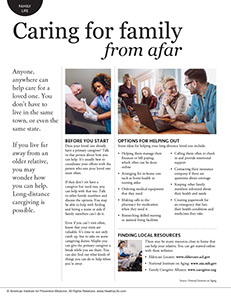
  • Caring For Family From Afar

    FAMILY LIFE

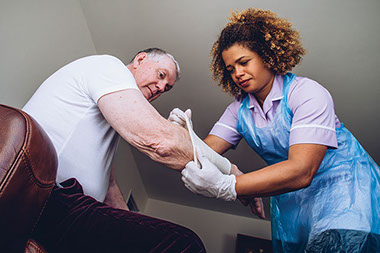
    Nurse helping patient at home.

    Anyone, anywhere can help care for a loved one. You don’t have to live in the same town, or even the same state. If you live far away from an older relative, you may wonder how you can help. Long-distance caregiving is possible.

    Before you start

    Does your loved one already have a primary caregiver? Talk to that person about how you can help. It’s usually best to coordinate your efforts with the person who sees your loved one most often.

    If they don’t yet have a caregiver but need one, you can help with that too. Talk to other family members and discuss the options. You may be able to help with finding and hiring a nurse or aide if family members can’t do it.

    Even if you can’t visit often, know that your visits are valuable. It’s time to not only catch up, but to take on some caregiving duties. Maybe you can give the primary caregiver a break while you are there. You can also find out what kinds of things you can do to help when you’re away.

    Options for helping out

    Some ideas for helping your long-distance loved one include:

    *  Helping them manage their finances or bill paying, which often can be done online

    *  Arranging for in-home care such as home health or nursing aides

    *  Ordering medical equipment that they need

    *  Making calls to the pharmacy for medication when they need it

    *  Researching skilled nursing or assisted living facilities

    *  Calling them often to check in and provide emotional support

    *  Contacting their insurance company if there are questions about coverage

    *  Keeping other family members informed about their health and needs

    *  Creating paperwork for an emergency that lists their health conditions and medicines they take

    Finding local resources

    There may be many resources close to home that can help your relative. You can get started online with these websites:

    *  Eldercare Locator:www.eldercare.acl.gov

    *  National Institute on Aging:www.nia.nih.gov

    *  Family Caregiver Alliance:www.caregiver.org

    Source: National Institute on Aging

    © American Institute for Preventive Medicine

  • Is Your Relationship Healthy?

    FAMILY LIFE

    Happy older couple.

    Sometimes it’s hard to know if you’re in a healthy relationship. This can include a romantic partner, friend or family member.

    Know the good

    Some signs of a healthy relationship include:

    *  You feel good about yourself when you’re around that person.

    *  You feel safe telling them how you feel about things.

    *  They listen to you, and you listen to them.

    *  You feel valued by them.

    *  You trust them, and don’t think they would do something to betray you.

    *  You can disagree or argue, but you don’t insult each other. Neither person uses personal attacks.

    Unsafe signs

    Ask yourself whether you see any of these signs of an unhealthy or abusive relationship:

    *  They say hurtful things to you. They make you feel bad about yourself.

    *  They stop showing love or care when they are mad.

    *  They blame you for feeling bad about something they did or said. They may say you’re “too sensitive,” or, “you made me do it.”

    *  They hurt you physically, such as pushing or hitting.

    *  They keep you from seeing family or friends.

    *  They threaten you or try to control you. They want you to fear them.

    If you’re not sure if you’re in an abusive relationship at home, reach out for help.

    Call the National Domestic Violence Hotline at 1-800-799-7233 or go tothehotline.org.

    © American Institute for Preventive Medicine

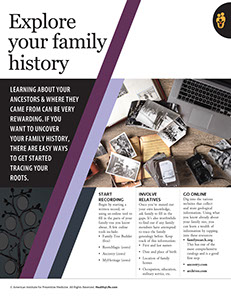
  • Explore Your Family History

    FAMILY LIFE

    Old black and white photos on table next to camera, laptop, old photo album.

    Learning about your ancestors & where they came from can be very rewarding. If you want to uncover your family history, there are easy ways to get started tracing your roots.

    Start recording

    Begin by starting a written record, or using an online tool to fill in the parts of your family tree you know about. A few online tools include:

    *  Family Tree Builder (free)

    *  RootsMagic (costs)

    *  Ancestry (costs)

    *  MyHeritage (costs)

    Involve relatives

    Once you’ve maxed out your own knowledge, ask family to fill in the gaps. It’s also worthwhile to find out if any family members have attempted to trace the family genealogy before. Keep track of this information:

    *  First and last names

    *  Date and place of birth

    *  Location of family homes

    *  Occupation, education, military service, etc.

    Go online

    Dig into the various websites that collect and store geological information. Using what you know already about your family tree, you can learn a wealth of information by tapping into these resources:

    *familysearch.org– This has one of the most comprehensive catalogs and is a good first step.

    *ancestry.com

    *archives.com

    © American Institute for Preventive Medicine

  • Easy Ways To Childproof Your Home

    Child Safety

    Image of mom placing a safety gate on stairs.

    Is your home safe for curious children?

    To see your home from a toddler’s point of view, get down on your hands and knees and crawl around. Look for conditions that can lead to burns, falls, electric shock, entrapment, or poisoning. Then take steps to prevent harm. Some suggestions:

    *  Cover all toddler-height electrical outlets with plastic outlet covers.

    *  Install childproof locks on cabinets where household cleaners, chemicals, and other items that could harm children are stored.

    *  To prevent scalding burns, lower the thermostat on the water heater to 120ºF or lower.

    *  Store medicines and alcohol in high, out-of-reach places. Never leave them on a countertop, a table, or other places children can get them.

    *  Toddlers should eat and drink from plastic dishes and cups only.

    *  Don’t place a child’s crib or bed next to a window. An active or curious toddler could accidentally fall out.

    *  Keep all sharp objects like scissors, knives, or pins out of a toddler’s reach.

    A Year of Health Hints book by the American Institute for Preventive Medicine. www.HealthyLife.com. All rights reserved.

    © American Institute for Preventive Medicine

  • Pedaling Safely With Your Toddler

    Child Safety

    Image of father and daughter on a bike.

    It’s easy to equip a bicycle with a child safety seat so your toddler can ride with you. To ensure the safety of your child:

    *  Be sure the seat is properly installed. If you aren’t sure how to install it correctly, consider having someone at a bicycle repair shop do it.

    *  A plastic cover should shield the back wheel, so the child’s clothing doesn’t get caught in the spokes.

    *  The back of the seat should be high enough to support and protect the child’s back and neck, and it should be marked with reflective tape if you ride after dark.

    *  A passenger restraint (safety belt) should fasten over the child’s shoulder.

    *  The seat should have a footrest, and the child’s legs should not hang free.

    Test the bicycle seat by riding without the youngster to be sure it’s securely fastened. When you take your child riding, be sure he or she is wearing a helmet.

    A Year of Health Hints book by the American Institute for Preventive Medicine. www.HealthyLife.com. All rights reserved.

    © American Institute for Preventive Medicine

  • Use Ladders Safely

    Home Safety

    Image of a ladder.

    Follow safety tips to keep you from an injury sustained on a ladder.

    *  Make sure your ladder is long enough for you to reach the job without standing on the top three steps or overextending your body.

    *  Check the ladder for cracks or weak spots before you use it. Metal ladders should have nonskid steps and footings. (Don’t paint a ladder; you’ll hide defects.)

    *  Make sure the soles of your shoes or boots are dry and have enough tread to prevent slipping.

    *  Always steady a ladder on firm ground or a flat board.

    *  Never place a ladder in front of a door that someone may open.

    *  Wear tools on a belt or keep them in your pocket so you can keep your hands free when climbing up or down a ladder.

    *  To avoid losing your balance while standing on a ladder, don’t lean too far back or to the side.

    *  Don’t use a ladder outdoors on a very windy day.

    *  To avoid electrocution, don’t use metal ladders near power lines.

    A Year of Health Hints book by the American Institute for Preventive Medicine. www.HealthyLife.com. All rights reserved.

    © American Institute for Preventive Medicine

  • Create A Family Mission Statement

    FAMILY LIFE

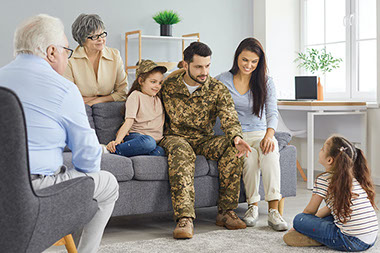
    Family sitting together talking.

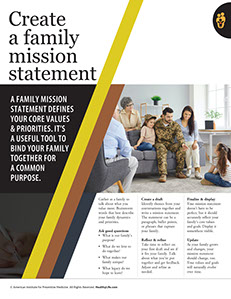
    A family mission statement defines your core values & priorities. It’s a useful tool to bind your family together for a common purpose.

    Gather as a family to talk about what you value most. Brainstorm words that best describe your family dynamics and priorities.

    Ask good questions

    *  What is our family’s purpose?

    *  What do we love to do together?

    *  What makes our family unique?

    *  What legacy do we hope to leave?

    Create a draft

    Identify themes from your conversations together and write a mission statement. The statement can be a paragraph, bullet points, or phrases that capture your family.

    Reflect & refine

    Take time to reflect on your first draft and see if it fits your family. Talk about what you’ve put together and get feedback. Adjust and refine as needed.

    Finalize & display

    Your mission statement doesn’t have to be perfect, but it should accurately reflect your family’s core values and goals. Display it somewhere visible.

    Update

    As your family grows and changes, your mission statement should change, too. Your values and goals will naturally evolve over time.

    © American Institute for Preventive Medicine

  • Kids, Puberty & Sports

    BE FIT

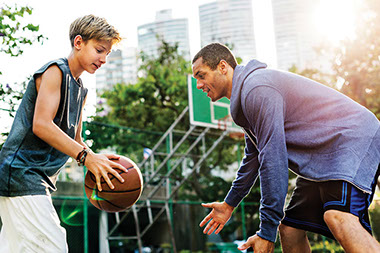
    Adult and teen playing basketball.

    Sports can be a great way for kids to develop social skills, teamwork and resilience. But it’s important to know that athletic ability changes as kids grow.

    Growth affects performance

    During puberty, boys and girls have a growth spurt that can change their athletic ability. After going through puberty:

    *  Boys may notice more muscle strength and overall bigger body size.

    *  Girls often lose some muscle mass. They may temporarily lose some of their speed or agility.

    *  Kids could feel “clumsy” as they adjust to being taller. The brain hasn’t yet adjusted to this new height and may affect balance skills or body control.

    *  It may be harder to throw or hit a ball with longer arms.

    *  Girls may have headaches, mood swings or cramps during menstruation.

    Puberty & knee injuries

    As kids get taller and heavier, they have a higher risk of anterior cruciate ligament (ACL) injury. The ACL is an important ligament that supports the knee.

    ACL injuries can be serious. They may require surgery and can increase the risk of knee arthritis later in life.

    Most ACL injuries happen when a person suddenly stops, changes direction, jumps or lands on the ground. They don’t usually happen from a blow to the knee. Sometimes an ACL injury causes a “popping” sound as it occurs.

    ACL injuries may cause swelling, severe pain, and inability to put weight on the knee. If your child injures their knee, see a doctor right away.

    Positive support is key

    Coaches who know about the effects of puberty can help kids. In addition, parents can help their kids by being positive and supportive. Yelling at kids or being put down may cause them to quit their sport. Remember that changes caused by puberty are only temporary.

    Source: American Academy of Pediatrics

    © American Institute for Preventive Medicine