Category: Family Life

  • Pedaling Safely With Your Toddler

    Child Safety

    Image of father and daughter on a bike.

    It’s easy to equip a bicycle with a child safety seat so your toddler can ride with you. To ensure the safety of your child:

    *  Be sure the seat is properly installed. If you aren’t sure how to install it correctly, consider having someone at a bicycle repair shop do it.

    *  A plastic cover should shield the back wheel, so the child’s clothing doesn’t get caught in the spokes.

    *  The back of the seat should be high enough to support and protect the child’s back and neck, and it should be marked with reflective tape if you ride after dark.

    *  A passenger restraint (safety belt) should fasten over the child’s shoulder.

    *  The seat should have a footrest, and the child’s legs should not hang free.

    Test the bicycle seat by riding without the youngster to be sure it’s securely fastened. When you take your child riding, be sure he or she is wearing a helmet.

    A Year of Health Hints book by the American Institute for Preventive Medicine. www.HealthyLife.com. All rights reserved.

    © American Institute for Preventive Medicine

  • Coping With A Crisis

    Home Safety

    The first step in coping with a crisis is to recognize what is happening. Part of this is to accept the feelings and reactions you have as normal responses to an abnormal event. Some reactions show that your body and mind are on a high state of alert. Others are part of the healing process. The second step is to manage the effect the crisis has on you (e.g., how you feel and the ability to live your life).

    Typical Reactions

    Reactions to a crisis or trauma vary widely. You may experience many, only a few, or none of these reactions. These reactions to a crisis or trauma are common. Most people fully recover from even moderate stress reactions within six to sixteen months.

    Behavior Reactions

    *  Crying, anger outbursts, restlessness

    *  Withdrawal, isolating yourself, or clinging to others

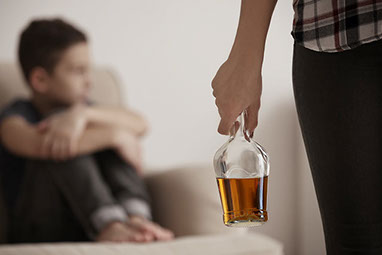
    *  Increased urge for alcohol or drugs

    *  Problems with family, friends, co-workers

    *  Being “on guard” or easily startled

    *  Inappropriate humor

    *  Change in eating, sleeping, and or other behaviors

    *  No longer maintaining daily routines. You may be too afraid to leave your home.

    Physical Reactions

    *  Headaches

    *  Upset stomach

    *  Nervousness

    *  Change in appetite

    *  Muscle aches

    *  Tiredness, fatigue, exhaustion

    *  Insomnia

    Emotional Reactions

    *  Anger

    *  Irritability

    *  Emotional numbness

    *  Worry

    *  Fear

    *  Sadness

    *  Grief

    *  Feeling unmotivated

    *  Feeling unsafe

    *  Weakness

    *  Feeling insecure

    *  Helplessness

    *  Hopelessness

    *  Guilt

    *  Feeling overwhelmed

    Mental Reactions

    *  Disbelief

    *  Shock

    *  Recurring thoughts of the event

    *  Confusion

    *  Poor memory

    *  Impaired concentration

    *  Inability to make decisions

    *  Bad dreams

    *  Violent fantasies

    *  Changes in or questions about religious beliefs

    Handling Anxiety

    *  Write down, ahead of time, the steps to take for different disasters (e.g., house, fires, floods, etc.). Go through drills for each plan with the whole family. Make sure the car always has gas. This is in case you have to leave an area.

    *  Know your place of work’s emergency plans. Find out about them from your supervisor, Employee Assistance Program (EAP), etc.

    *  Take a course in first aid from the Red Cross, your police or fire department.

    *  Give each family member a prepaid phone card with about a ten dollar value. Instruct children how to use the card and a pay phone. Some cell phone services may be overwhelmed in an emergency.

    *  Set up a “check-in” plan. Choose someone for family members to call or e-mail to check on each other. Pick someone far enough away who would not likely be part of the same event. Of course, call each other on cell, regular, or pay phones.

    *  Choose two places to meet. One is at home or near your home. Choose another place farther away in case you can’t get home. Make plans for the safety of your children.

    *  If you have children in school, find out the school’s crisis plan. Know the school’s policy for sending children home. Make sure the school has current phone numbers for you and other caregivers in case you can’t be reached. Find out what the school needs to have to release your child to designated caregivers.

    *  If you have a pet, plan for its safety. For more information, contact the Red Cross orwww.disasterrelief.org/library/prepare/pets.html.

    *  When you enter a building, find emergency exits and stairways. Plan ahead how to get out quickly from buildings, vehicles, crowded public places, etc.

    *  Make an emergency supply kit. Put these things in backpacks or containers that one or more family members can easily carry:

    – Three days’ supply of bottled water (one gallon a day per person if possible. Put these next to, not in your containers.)

    – Food that won’t spoil. A hand can opener.

    – Flashlight and extra batteries

    – A battery powered radio or TV and extra batteries

    – First aid kits for the home and the car

    – Sleeping bags or blankets

    – A change of clothing for each person

    – Items for family members with special needs (e.g., baby supplies, medicines, etc.)

    – Duct tape and dry towels that you can make wet to make a room airtight

    – Bleach

    – Important documents, cash, and credit cards

    For more information on being ready for disasters, contactwww.redcross.orgor call your local Red Cross. Ask about their “Preparing for the Unexpected” class. This one and a half-hour class teaches families and employees safety steps to take for many kinds of disasters.

    Deal with Fear

    Handling Anxiety

    Anxiety is a feeling of dread, fear, or distress over a real or imagined threat to your mental or physical well being. When anxiety becomes extreme, possible threats are overestimated. Also, inner strength, support from family, the community, and the nation are underestimated.

    A certain amount of anxiety is normal. It can alert you to seek safety when you are in physical danger. Anxiety is not normal, though, when there is no apparent reason for it or when it overwhelms you and interferes with your day-to-day life. If this is the case, seek help from your doctor, a mental health professional, or your Employee Assistance Program (EAP) at work. Treatment can include medication and counseling. It may also include behavior therapy or taking part in a self-help group.

    Signs and Symptoms of Anxiety

    *  Rapid pulse and/or breathing rate

    *  Racing or pounding heart

    *  Dry mouth

    *  Sweating

    *  Trembling

    *  Shortness of breath

    *  Faintness

    *  Numbness/tingling of the hands, feet, or other body part

    *  Feeling a “lump in the throat”

    *  Stomach problems

    Self-Help for Anxiety

    *  If you are prescribed medication, take it as advised.

    *  Identify your feelings.

    *  Talk to others about your fears. It’s okay to ask for help. If available at your place of work, attend group meetings with an EAP counselor or other mental health professional where people can share feelings.

    *  Maintain your normal routines.

    *  Escape for a little while. Go to a movie. Read a good book. Take a walk in the woods or a trip to a museum.

    *  Take a long, warm shower or bath.

    *  Don’t fight the desire to cry. Tears can help relieve stress and also release a natural pain-relieving substance from the brain.

    *  Laugh a lot. Laughter relaxes muscles and relieves tension.

    *  Recognize the things you can control and what you can’t control. Identify and use your own strengths and resources.

    *  Use measures that have helped you overcome fear and helplessness in the past.

    *  Don’t take on more than you can handle. Make a to-do list. Prioritize important items.

    *  Reward yourself. Treat yourself to little things that make you feel good.

    *  Think positively.
    Take Charge, Coping with a Crisis book by the American Institute for Preventive Medicine. www.HealthyLife.com. All rights reserved.

    © American Institute for Preventive Medicine

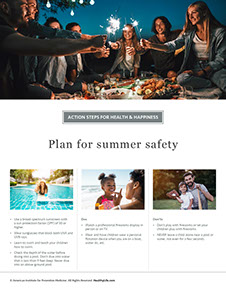
  • Plan For Summer Safety

    Home Safety

    Group of friends, holding sparklers around a picnic table.

    *  Use a broad-spectrum sunscreen with a sun protection factor (SPF) of 30 or higher.

    *  Wear sunglasses that block both UVA and UVB rays.

    *  Learn to swim and teach your children how to swim.

    * Check the depth of the water before diving into a pool. Don’t dive into water that is less than 9 feet deep. Never dive into an above-ground pool.

    Dos

    *  Watch a professional fireworks display in person or on TV.

    *  Wear and have children wear a personal flotation device when you are on a boat, water ski, etc.

    Don’ts

    *  Don’t play with fireworks or let your children play with fireworks.

    *  NEVER leave a child alone near a pool or water, not even for a few seconds.

    A Year of Health Hints book by the American Institute for Preventive Medicine. www.HealthyLife.com. All rights reserved.

    © American Institute for Preventive Medicine

  • Infant Immunization

    Pediatric Care

    Young child getting a vaccine from doctor.

    Starting as infants, one-time vaccination throughout childhood is essential to help provide immunity before children are exposed to potentially life-threatening diseases.

    Keep a record of vaccines your child gets. This includes the type of vaccine, the date, and place it was given. List any reactions your child had to the vaccines, too.

    Each state requires children to have vaccines before they enter child care or school. Schools, preschools and child care centers require proof of vaccines.

    Some vaccines can be combined. This means your child gets fewer shots.

    Find out current immunization guidelines and facts about vaccines from Centers for Disease Control and Prevention (CDC) atcdc.gov/vaccines. Vaccines are available from your child’s doctor or your local health department.

    A Year of Health Hints book by the American Institute for Preventive Medicine. www.HealthyLife.com. All rights reserved.

    © American Institute for Preventive Medicine

  • Dealing With Family Arguments

    FAMILY LIFE

    Mother comforting her young son who's upset.

    It’s normal to have arguments with your children and spouse. Children learn to voice their opinions through their family first. And all close relationships have disagreements sometimes.

    But arguments don’t have to be hurtful.

    Handle disagreements in a positive way:

    *Pick your battles:Don’t fight over every disagreement. Decide if small things are worth an argument. Walk away from an argument when it’s not an important matter.

    *Be open.Try to see others’ point of view. Stop and listen to what they’re saying and really consider it before responding.

    *Set boundaries.Arguments should not include name calling, insults or disrespect. Try to avoid shouting, too. If things get heated, take a break and say you’ll discuss it later when everyone feels calmer.

    *Look at root causes.Are you arguing with the same person all the time? Or are you having the same argument with multiple people? Think about why this is happening, and what you can do to stop having these conflicts. Consider this preventive care for your relationships.

    *Remember that you’re an example.Children see how parents argue. Think about how you would want them to handle a disagreement, and try to model that behavior.

    Source: American Academy of Pediatrics

    © American Institute for Preventive Medicine

  • Talking About Adoption: Do’S & Don’Ts

    FAMILY LIFE

    Image of family waking along sidewalk.

    Many families include one or more children who are adopted. If you know someone with an adopted child, there are respectful ways to talk about it with them. And, if you have an adopted child, share these do’s and don’ts with friends and family members so they can be respectful to you.

    DO: Use the terms “birth child,” “adopted child,” “birth parents” or “biological parents” only when necessary. This may be during a discussion about the adoption itself. Otherwise, simply use “child” and “parent” with no other description. Once a child is adopted, they are their parents’ child and are no different than a child that was born biologically to them.

    DON’T: Use words like “real child,” “natural child,” “real parents” or “natural parents.” These terms can be hurtful to the family and imply that they don’t have a real relationship.

    DO: Treat all siblings in a family the same. Parents love all their children equally, whether they were adopted or not.

    DON’T: Bring up differences between adopted and biological children or refer to them as “adopted son” or “adopted daughter.” The word “adopted” is often not relevant or needed.

    DO: Speak about birth parents as choosing to make the best decision for their child through adoption. Children need to know that their birth parents wanted the best for them.

    DON’T: Say words like “put up” or “given up” for adoption. Also, don’t say “they chose not to keep” the child. This makes it sound like the birth parents didn’t care or didn’t want the child.

    DO: Celebrate cultural or racial differences within a family.

    DON’T: Ignore a child’s ethnicity, race or heritage. Children need support from family and friends to overcome stereotypes and racism.

    DO: Support parents who choose to adopt. Adoption is a beautiful gift for both the child and parents. Understand that the parents may be overwhelmed after adoption and may have financial stress. They may also be anxious about having a new child in the family.

    DON’T: Ask, “what did you pay for your child?” Children are not sold or bought. Adoption fees go toward social workers, court fees, paperwork, travel and other necessary expenses.

    Source: American Academy of Pediatrics

    © American Institute for Preventive Medicine

  • Take The Hazard Out Of Halloween

    Child Safety

    Image of children in halloween customs.

    Dressing up to go trick-or-treating is a traditional childhood ritual. But wandering the streets in the dark dressed in bizarre costumes and knocking on strangers’ doors to ask for food can pose hazards. To be sure your children have a Halloween that’s fun and safe, take these precautions.

    *  Choose white or bright costumes, preferably of flame-retardant fabric and marked with reflective tape.

    *  Be sure a costume is short enough so that your child won’t trip.

    *  Don’t let your trick-or-treaters wear masks, which can interfere with their vision. Instead, apply makeup to their faces.

    *  Trick-or-treaters should carry flashlights, not candles. Small children should be accompanied by an adult.

    *  Avoid trick-or-treating at homes on dark streets or in unfamiliar neighborhoods.

    *  Check all treats before your children eat them. Don’t let children eat candy or other treats that aren’t commercially wrapped or look as though they’ve been tampered with.

    *  Keep carved, candlelit pumpkins out of reach of young children. And be sure to set your jack-o’- lantern on a nonflammable surface.

    A Year of Health Hints book by the American Institute for Preventive Medicine. www.HealthyLife.com. All rights reserved.

    © American Institute for Preventive Medicine

  • Make A Fire Escape Plan

    Home Safety

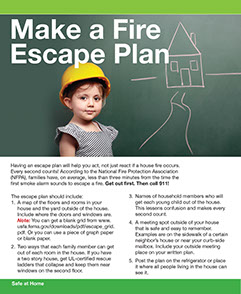
    Image of child with a hard hat on an a drawing of a house.

    Having an escape plan will help you act, not just react if a house fire occurs. Every second counts! According to the National Fire Protection Association (NFPA), families have, on average, less than three minutes from the time the first smoke alarm sounds to escape a fire. Get out first. Then call 911!

    The escape plan should include:

    1.  A map of the floors and rooms in your house and the yard outside of the house. Include where the doors and windows are. Note: You can get a blank grid fromwww.usfa.fema.gov/downloads/pdf/escape_grid.pdf. Or you can use a piece of graph paper or blank paper.

    2.  Two ways that each family member can get out of each room in the house. If you have a two story house, get UL-certified rescue ladders that collapse and keep them near windows on the second floor.

    3.  Names of household members who will get each young child out of the house. This lessens confusion and makes every second count.

    4.  A meeting spot outside of your house that is safe and easy to remember. Examples are on the sidewalk of a certain neighbor’s house or near your curb-side mailbox. Include your outside meeting place on your written plan.

    5.  Post the plan on the refrigerator or place it where all people living in the house can see it.

    Practice Your Escape Plan

    1.  Do this twice a year with everyone who lives in the house, including children and adults who will need help to get out.

    2.  Gather everyone and discuss the escape plan. Tell school-age children that this is like a fire drill at school, but for  your house.

    3.  Have a smoke alarm go off so everyone knows what it sounds like.

    4.  Have each person practice getting out of the house according to the plan. Practice both exit plans.

    5.  Have children practice how to get out on their own in case you cannot help them. Show them how to get low to the floor and crawl along the perimeter of the room to the exit and how to keep their mouths covered.

    6.  Tell your child to feel a closed door with the back of his or her hand before opening it. If the door is hot, tell your child to use the second way out if there is one.

    7.  If you have a rescue ladder, learn how to use it and practice once to make sure it works well. Hold the child in front of you as you back out of the window onto the ladder. Hold the child one rung above you. Keep the child between the ladder and your body as you climb down together.

    8.  Go to your meeting place and call 911!

    9.  Never go back into a house that is on fire. Tell firefighters if anyone or any pets have not yet gotten out.

    10. Remember to practice your fire escape plan every 6 months. Practice once during the day and another time at night.

    Safe at Home - Do This, Not That Book. Published by the American Institute for Preventive Medicine. www.HealthyLife.com. All rights reserved.

    © American Institute for Preventive Medicine

  • Poison Control

    Home Safety

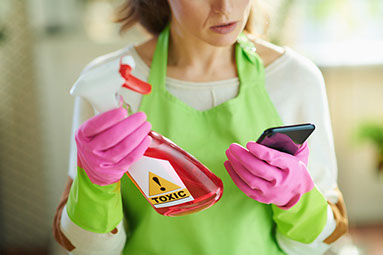
    Female wearing cleaning gloves, holding a cleaning bottle with the word "Toxic" on it and looking at her phone in the other hand.

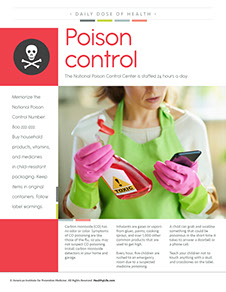
    The National Poison Control Center is staffed 24 hours a day. Memorize the National Poison Control Number: 800.222.1222. Buy household products, vitamins, and medicines in child-resistant packaging. Keep items in original containers. Follow label warnings.

    Carbon monoxide (CO) has no odor or color. Symptoms of CO poisoning are like those of the flu, so you may not suspect CO poisoning. Install carbon monoxide detectors in your home and garage.

    Inhalants are gases or vapors from glues, paints, cooking sprays, and over 1,000 other common products that are used to get high.

    Every hour, five children are rushed to an emergency room due to a suspected medicine poisoning.

    A child can grab and swallow something that could be poisonous in the short time it takes to answer a doorbell or a phone call.

    Teach your children not to touch anything with a skull and crossbones on the label.

    A Year of Health Hints book by the American Institute for Preventive Medicine. www.HealthyLife.com. All rights reserved.

    © American Institute for Preventive Medicine